Tesla Picks ByteDance's Doubao for In-Car AI, Signaling China Strategy Shift
The electric-vehicle maker's decision to embed a Chinese LLM in its infotainment system reflects both regulatory pragmatism and a bet on local voice-assistant technology.
A New Voice Inside the Cabin
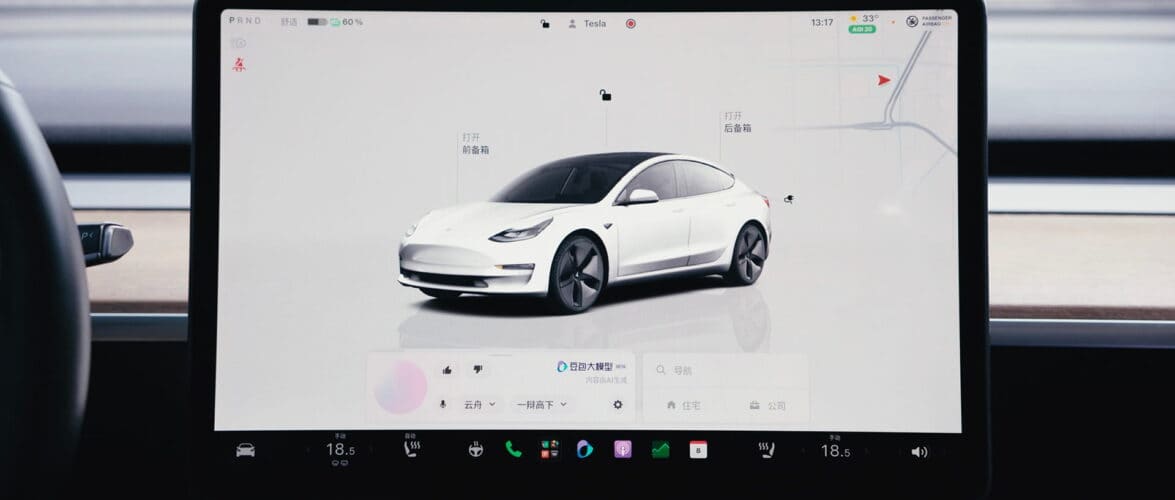
Late last month, Tesla began pushing an over-the-air update to Model 3, Y, S, and X vehicles across China that introduced ByteDance's Doubao large language model as a standalone app in the infotainment stack. Drivers and passengers can now summon the assistant with one of four voice profiles, ask it to pull information from the web in real time, debate trivia, narrate stories, or join them in singing. The feature also supports conversational language practice, a use case that has gained traction in China's LLM ecosystem as students and professionals look for low-friction ways to improve English or other tongues.
At DailyTechWire, we've tracked the collision between automotive hardware and generative AI across Asia for the past eighteen months, and this partnership stands out less for its technical novelty than for what it says about Tesla's strategic calculus in a market where it no longer enjoys the brand halo it once did. Embedding a third-party Chinese model signals that the automaker is willing to cede a piece of the software stack in order to remain competitive on features that local rivals have been shipping for months.
Why Doubao, and Why Now
ByteDance has spent the past two years pouring compute and talent into Doubao, positioning it as a general-purpose foundation model that can serve everything from short-video recommendation to enterprise workflow automation. The model's inferencing cost per token is reported to be among the lowest of any Chinese LLM at commercial scale, a function of ByteDance's vertical integration across data centers, custom silicon partnerships, and years of optimizing recommendation engines for TikTok and Douyin.
For Tesla, cost matters. The company has historically resisted licensing expensive third-party software when it believes it can build in-house, but voice assistants in Mandarin present a different challenge. Natural-language understanding in tonal languages demands training corpora that reflect regional dialects, slang, and cultural context. ByteDance's consumer apps generate that corpus every day. Doubao has ingested billions of interactions from Douyin comments, Toutiao articles, and Lark workplace chats, giving it a vernacular fluency that would take Tesla years and significant capital to replicate.
Regulatory pressure also played a role. China's Cyberspace Administration has tightened oversight of generative AI services, requiring that any LLM accessible to the public pass content-safety audits and demonstrate alignment with national guidelines. ByteDance navigated that process early, securing one of the first batches of approvals for public deployment. By integrating an already-approved model, Tesla avoids the compliance burden and timeline risk of submitting its own system for review.
The Competitive Landscape in Chinese Cabins
Tesla's move arrives at a moment when domestic EV makers have turned the in-car experience into a primary battleground. NIO, XPeng, and Li Auto have each shipped voice assistants powered by combinations of Baidu's ERNIE, Alibaba's Qwen, and in-house tuning. These systems are marketed not as novelties but as core product differentiators, capable of controlling climate, navigation, and media through conversational commands that feel closer to chatting with a co-pilot than barking wake-words at a dashboard.
XPeng's latest P7i, for instance, allows drivers to ask the assistant to "find a charging station with a coffee shop nearby and add it as a waypoint," then adjust the route if traffic builds, all without touching a screen. Li Auto's MEGA van integrates voice control across three rows of seats, letting rear passengers request temperature changes or select entertainment independently. In that context, Tesla's legacy voice system, which relies on a limited command set and struggles with accent variation, had begun to feel dated.
The partnership with ByteDance is an acknowledgment that software differentiation in China now requires local partnerships. Tesla's Autopilot and Full Self-Driving features remain the company's flagship AI products globally, but those capabilities are heavily restricted in China due to data-localization rules and map-licensing requirements. Voice and infotainment represent one of the few domains where Tesla can deploy AI-driven features without waiting for regulatory green lights on autonomous driving.
What Doubao Brings to the Table
Doubao's integration is, for now, relatively contained. It does not replace Tesla's existing voice-command layer or gain direct control over vehicle functions like climate or seat adjustment. Instead, it operates as a conversational layer, a pocket of generative AI that users can dip into when they want information, entertainment, or practice rather than hard control. That separation likely reflects both technical caution and a desire to retain Tesla's core user interface, which the company has spent years refining.
Still, the feature set is more ambitious than it appears. Real-time internet access means Doubao can pull live traffic data, weather forecasts, restaurant reviews, and news headlines, then synthesize them into natural responses. The language-practice mode taps into a growing consumer behavior in China, where LLM-based tutors have become a common supplement to formal education. By embedding that use case in a car, Tesla is betting that commute time can double as study time, a proposition that resonates in a market where long urban commutes are the norm.
The four voice profiles also hint at ByteDance's emphasis on personality and tone, a design choice inherited from Douyin's creator ecosystem. Users can select voices that range from energetic and playful to calm and professorial, adjusting the assistant's character to match their mood or the context of the drive. It's a small touch, but one that reflects a broader shift in how Chinese consumers expect AI to behave: less like a tool, more like a companion.
Strategic Implications for Tesla's China Business
Tesla's China sales have faced headwinds over the past year. Domestic competitors have closed the gap on battery range, charging infrastructure, and build quality, while undercutting Tesla on price. The company's market share in China's EV segment has slipped from its 2021 peak, and the brand's once-untouchable cachet has dimmed as local automakers have poured resources into design, service, and software.
The Doubao partnership is a signal that Tesla is willing to adapt its playbook. Historically, the company has prided itself on vertical integration, building everything from battery cells to seat frames in-house. Software has been no exception; Tesla's infotainment OS, Autopilot stack, and even the neural-network training pipeline are all proprietary. But in China, that go-it-alone approach has limits. The market moves faster, regulatory requirements are stricter, and consumer expectations around localization are higher than in any other geography Tesla serves.
By working with ByteDance, Tesla gains access to a model that is already culturally tuned, regulatory compliant, and cost-efficient at scale. It also opens a channel to ByteDance's broader ecosystem. If the partnership deepens, future iterations could integrate Douyin content, Toutiao news feeds, or even Lark productivity tools directly into the vehicle interface, turning the Tesla cabin into a node in ByteDance's consumer graph.
Risks and Constraints
The arrangement is not without friction. ByteDance operates under intense scrutiny both domestically and internationally, and any data-sharing between Tesla and ByteDance will draw questions about privacy, storage, and cross-border flows. Tesla has committed to storing all Chinese customer data on servers within China, but the specifics of how Doubao's real-time internet queries are logged, anonymized, and retained remain unclear.
There is also the question of feature parity. Tesla's global user base expects a consistent experience across markets, but the Doubao integration is China-only. That creates a bifurcation in the product roadmap: one software stack for China, another for the rest of the world. Managing that split adds complexity to testing, updates, and customer support, and it risks alienating users in other markets who wonder why their vehicles lack comparable AI features.
Finally, the partnership exposes Tesla to ByteDance's own strategic whims. If ByteDance decides to prioritize its own automotive ambitions or partners more deeply with a rival EV maker, Tesla could find itself dependent on a supplier that has conflicting interests. The two companies have signed a commercial agreement, but the terms and exclusivity provisions have not been disclosed.
The Broader Pattern
Tesla's decision to embed Doubao is part of a larger pattern we've been watching across Asia's tech landscape: global companies partnering with local AI providers to navigate regulatory, linguistic, and competitive realities. Apple has explored similar arrangements with Baidu for iCloud services in China. Google has licensed models to regional partners in Southeast Asia. Even Microsoft, which has its own LLM infrastructure, has collaborated with local clouds and data-sovereignty frameworks to serve enterprise customers in Japan, South Korea, and India.
What distinguishes the Tesla-ByteDance partnership is the visibility. An in-car assistant is a consumer-facing feature, one that users interact with daily and that shapes their perception of the brand. By handing that experience to ByteDance, Tesla is making a statement about where it believes the value lies: not in controlling every layer of the stack, but in delivering the features that matter most to Chinese drivers, even if that means sharing the wheel.
Whether that bet pays off will depend on execution, user adoption, and how quickly competitors respond. But for now, the presence of Doubao in Tesla's cabin is a reminder that in China's EV market, software is no longer a differentiator you can build in isolation. It's a capability you assemble, often with partners who know the terrain better than you do.