Bengaluru Startup Airbound Raises $37M to Build Drones That Weigh Less Than Their Cargo
The three-year-old company is designing tail-sitter aircraft for medical deliveries today and a 10,000-flight-a-day network across Andhra Pradesh tomorrow, betting that vertical flight can match trucking economics.
A Design Constraint Most Aircraft Ignore
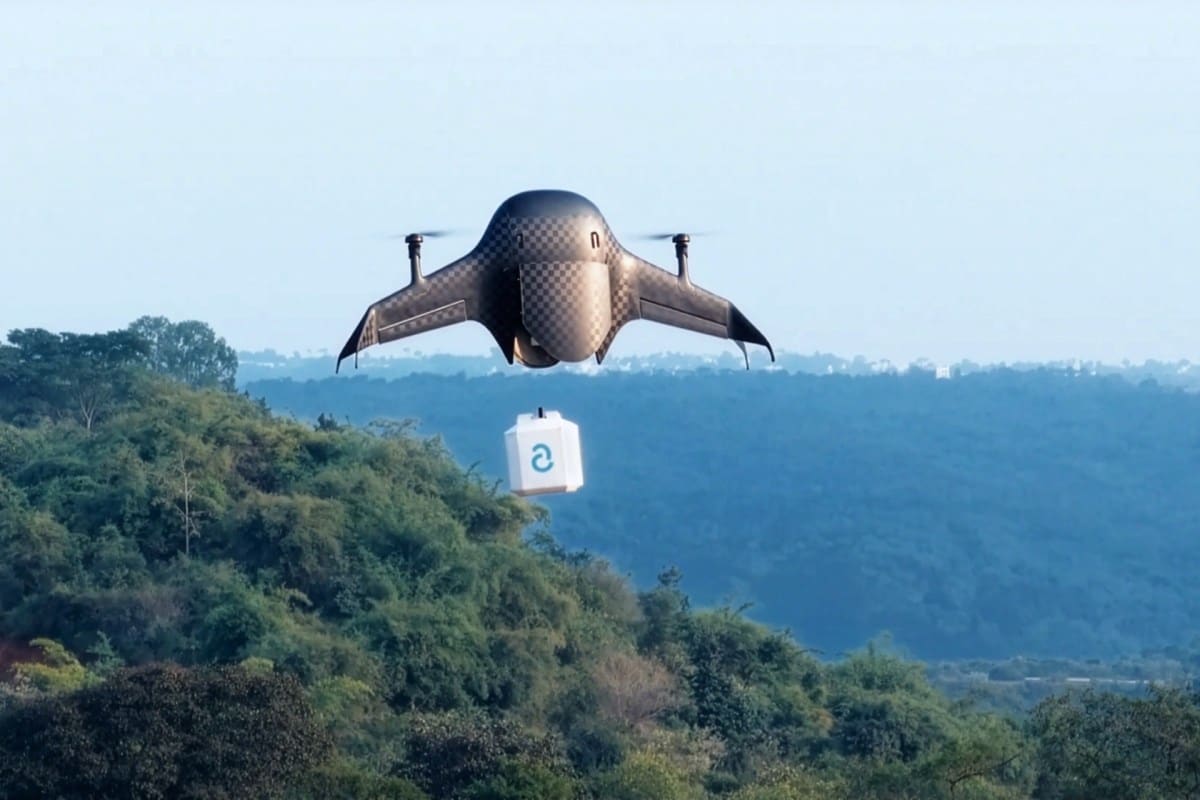
Most aircraft spend the majority of their fuel budget lifting themselves, not the goods they carry. Airbound, a Bengaluru-based startup founded in 2023, has made the inverse ratio its core engineering principle: build vertical-flight drones that weigh less than the payload they transport.
The company announced $37 million in Series A funding led by Greenoaks, with participation from DoorDash, Lachy Groom, Lightspeed, and Humba Ventures. Combined with an $8.65 million seed round closed less than twelve months ago, Airbound has now raised close to $50 million in capital.
Founder and CEO Naman Pushp argues that conventional drone economics fail because the aircraft-to-cargo weight ratio makes short-haul logistics prohibitively expensive. Airbound's current platform, the TRT, weighs roughly 3.3 pounds and carries 2.2 pounds of payload. The next iteration under development will weigh 6.6 pounds and handle up to 11 pounds of cargo, inverting the traditional calculus.
The aircraft uses a rocket-like tail-sitter configuration: it takes off and lands vertically in an upright stance, then transitions to horizontal flight for cruise efficiency. Pushp intends to preserve vertical takeoff and landing capability even as the platform scales to larger payloads, eliminating the need for runways or fixed infrastructure.
13,000 Flights and One Hospital Route
Airbound has logged more than 13,000 autonomous flights across Bengaluru and Guntur in southern India. Over 1,000 of those have been commercial operations with Narayana Health, an Indian hospital network, transporting diagnostic samples between healthcare facilities.
The route covers approximately 2.5 miles and completes in seven minutes. The same samples, when moved by motorcycle courier, can take three to five hours once you account for the time spent aggregating enough specimens to justify dispatching a rider, according to Pushp.
That partnership is expanding to include Narayana's new Banashankari hospital in Bengaluru, which was designed without an on-site diagnostic lab or blood bank. Instead, the facility will rely on Airbound's drones to shuttle samples and blood products to and from centralized facilities, embedding aerial logistics into the hospital's core operating model from day one.
At DailyTechWire, we've tracked the rise of medical drone networks across Southeast Asia and India, where last-mile infrastructure gaps and traffic congestion create structural advantages for vertical flight. What distinguishes Airbound's approach is the willingness to redesign the aircraft around a single economic target: cost parity with trucking.
A 10,000-Flight-a-Day Ambition
Airbound has signed an agreement with the government of Andhra Pradesh to build a drone delivery network connecting three cities in the state, with an eventual target of 10,000 flights per day serving retail, e-commerce, and healthcare customers.
Reaching that daily flight volume will require between 250 and 1,000 aircraft, depending on route distance and turnaround time. Pushp estimates the figure will land closer to 250 once the network is optimized. The agreement does not include a government contract or subsidy; instead, the state is collaborating with Airbound on the regulatory framework needed to enable beyond visual line of sight (BVLOS) operations at scale.
Revenue will come from commercial customers using the network for deliveries. Pushp positions Airbound not as a logistics operator competing with delivery platforms, but as an aircraft manufacturer supplying the hardware that other networks will eventually fly. He draws the analogy to Boeing: the company that builds the planes airlines depend on, rather than the airline itself.
That strategy sets Airbound apart in a crowded field. Indian startups including Skye Air Mobility and TSAW Drones are already building aerial logistics businesses, while drone manufacturers such as Garuda Aerospace have explored delivery use cases. Pushp's bet is that the winner in this category will be the company that solves the unit economics of the aircraft, not the company that operates the largest fleet.
Manufacturing In-House, Waiting on Regulation
Airbound designs and manufactures its aircraft in a 43,000-square-foot facility in Bengaluru, keeping the airframe and core systems in-house. Pushp declined to disclose production capacity or the total number of aircraft built to date, but said manufacturing will not be the constraint as the company scales.
The real bottleneck, he noted, is regulation. Securing BVLOS certification, which allows drones to fly beyond the direct line of sight of an operator, is critical to operating delivery networks at any meaningful scale. Those regulatory constraints have also limited Airbound's ability to convert flights into commercial revenue.
The startup remains broadly pre-revenue despite employing more than 150 people. Pushp is explicit about the trade-off: Airbound is optimizing for long-term scale, not near-term revenue. The goal, he said, is to build a company that becomes a giant in a few decades, not one that rushes to monetize before the infrastructure and regulatory environment can support sustainable unit economics.
The Tension Between Ambition and Reality
Airbound's thesis rests on two assumptions: that drones can achieve cost parity with ground transport, and that regulators will eventually enable the BVLOS operations required to make that parity meaningful. Both remain unproven at scale.
Drone delivery has seen successful deployments in controlled environments, but it has yet to match the versatility, reliability, or cost structure of trucking for most use cases. Airbound's tail-sitter design and weight-to-payload ratio address part of the cost equation, but the regulatory and operational challenges of flying thousands of autonomous aircraft daily across urban and semi-urban airspace are formidable.
The funding round signals that investors see a path through those obstacles. Greenoaks, which led the round, has backed infrastructure-layer companies across Asia and sees Airbound as a potential platform play rather than a point solution. DoorDash's participation is particularly notable: the delivery giant has explored drone partnerships in the past but has yet to integrate aerial logistics at scale in any market.
For now, Airbound's strategy is to prove the model in healthcare logistics, where speed and reliability create margin for higher costs, then use that operational experience to drive down unit economics for e-commerce and retail. The Andhra Pradesh network will be the first large-scale test of whether that strategy can work outside a single hospital route.
If Airbound succeeds, it will have built the aircraft equivalent of what Stripe did for payments infrastructure: a layer that other companies depend on but never see. If it fails, it will join a long list of startups that underestimated the difficulty of making vertical flight economically viable outside niche use cases.
The next twelve months will clarify which trajectory the company is on.