SpaceX Bets $60 Billion on Cursor in Fight for AI Developer Tools
The acquisition signals Elon Musk's ambition to control the entire AI stack, from satellites to integrated development environments, as competition intensifies with Anthropic and OpenAI.
A $60 Billion Bet on the Developer Experience
SpaceX has agreed to acquire Cursor, an AI-native integrated development environment, for $60 billion in an all-stock transaction. The companies announced the deal today, with closing expected in the third quarter of this year.
The price tag is remarkable for a developer tool, even one backed by large language model capabilities. It reflects both the strategic value SpaceX places on controlling the AI application layer and the broader market frenzy around tools that promise to accelerate software engineering. At DailyTechWire, we've tracked similar valuations across the region, from Bengaluru-based coding assistants to Seoul's vertical-specific AI platforms, but this acquisition dwarfs them all in absolute terms.
The timing is equally striking. SpaceX completed its initial public offering just two days before announcing the Cursor deal, providing the stock currency needed for the transaction. That IPO followed by only a few months the merger of SpaceX and xAI, Elon Musk's AI research venture. The xAI integration brought significant organizational restructuring, consolidating AI capabilities under the SpaceX umbrella and setting the stage for acquisitions like this one.
The Cursor Story: Early Mover in a Crowded Field
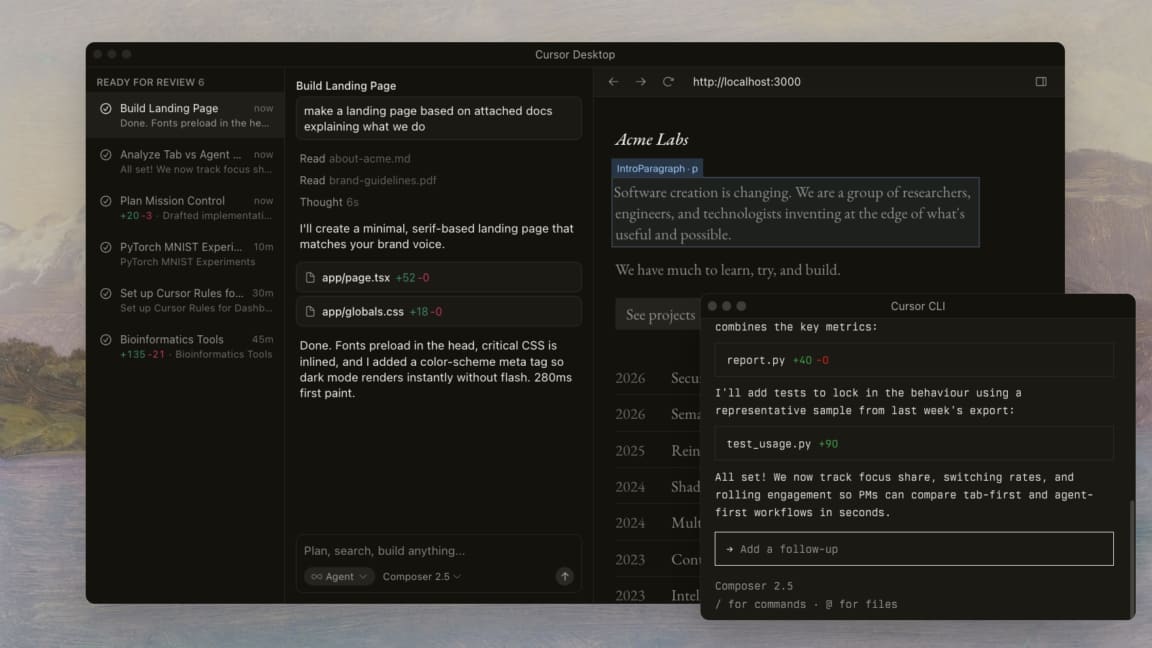
Cursor emerged as one of the first development environments to deeply integrate large language model functionality. Built as a fork of Microsoft's open-source Visual Studio Code editor, Cursor layered on AI features that ranged from code completion to natural-language-driven refactoring and bug detection. For developers willing to adopt a new tool, it offered a glimpse of what programming might look like when models could reason about entire codebases rather than just autocomplete the next line.
That early-mover advantage, however, has eroded. Microsoft itself has embedded similar capabilities into Visual Studio Code through GitHub Copilot, which runs on OpenAI's models. Anthropic has partnered with a growing list of IDE vendors to bring Claude into the coding workflow. Google's Gemini Code Assist, JetBrains' AI Assistant, and a constellation of startups from Replit to Tabnine have all converged on the same thesis: that the next generation of software will be written in conversation with a model, not typed character by character.
In that environment, Cursor's standalone position became both a liability and an asset. It lacked the distribution muscle of Microsoft or the model prowess of OpenAI, but it also represented a neutral platform that could be steered by a new owner with different strategic priorities.
Why SpaceX Wants an IDE
The rationale for SpaceX acquiring a coding tool is less obvious than it might be for a pure-play AI company. SpaceX's core businesses revolve around launch services, satellite internet through Starlink, and increasingly, the infrastructure that supports xAI's training clusters. An integrated development environment does not slot neatly into rocket manufacturing or constellation management.
The answer lies in vertical integration of the AI stack. By merging with xAI, SpaceX gained access to frontier models and the compute to train them. By going public, it secured the capital markets' endorsement and a stock that can serve as acquisition currency. By acquiring Cursor, it now controls a distribution channel directly into the daily workflow of millions of developers.
This mirrors strategies we have seen across Asia's tech giants. Alibaba Cloud bundles Qwen models with its developer tools. Tencent integrates Hunyuan into WeChat's mini-program IDE. The logic is the same: owning the toolchain creates lock-in, generates usage data to improve models, and offers a wedge into enterprise accounts that might otherwise default to OpenAI or Anthropic.
For SpaceX, the Cursor acquisition also positions the company to compete in the enterprise software market, where recurring revenue and gross margins look very different from hardware-intensive aerospace operations. If xAI's models can be tuned for code generation and Cursor can serve as the interface, SpaceX suddenly has a credible offering against GitHub Copilot, Anthropic's Claude for Work, and OpenAI's ChatGPT Enterprise.
The Competitive Landscape: Incumbents and Insurgents
The AI coding tool market has become one of the most contested segments in enterprise software. GitHub Copilot, launched in 2021, now counts millions of paid subscribers and has become a meaningful revenue line for Microsoft. Anthropic has positioned Claude as the model of choice for complex reasoning tasks, including code review and architecture design. OpenAI's ChatGPT, while not an IDE, is widely used by developers for prototyping and debugging.
Startups have carved out niches. Replit combines an in-browser IDE with model-driven app generation, targeting educators and hobbyists. Tabnine emphasizes on-premise deployment for enterprises concerned about code leakage. Sourcegraph layers AI over code search, appealing to teams managing sprawling legacy systems.
Cursor's differentiation was speed and user experience. Early adopters praised its responsiveness and the fluidity with which AI suggestions appeared inline. But user experience alone is rarely a defensible moat when incumbents can copy features and distribute them to existing user bases at zero marginal cost.
SpaceX's entry changes the calculation. If Cursor becomes the default IDE for developers building on xAI models or integrating with Starlink's edge compute offerings, it gains distribution that no standalone startup could match. The question is whether developers, who tend to be platform-agnostic and skeptical of lock-in, will accept an IDE owned by a conglomerate with interests spanning rockets, satellites, and social media.
Risks and Open Questions
The $60 billion valuation will face scrutiny. It implies that Cursor, a tool with a user base measured in the hundreds of thousands at most, is worth more than established software companies with mature revenue streams. The all-stock structure shifts risk to Cursor's shareholders, who must now bet on SpaceX's ability to execute across aerospace, telecom, AI research, and developer tools simultaneously.
There are execution risks as well. Integrating a fast-moving developer tool into a conglomerate known for hardware and mission-critical systems is not straightforward. SpaceX's engineering culture prioritizes reliability and vertical integration in physical products; software products, especially those aimed at external developers, require different rhythms of iteration and openness.
Regulatory hurdles may also emerge. SpaceX already faces export control scrutiny due to its satellite and launch technologies. Adding an AI coding platform that could be used to develop dual-use software introduces new compliance questions, particularly if the tool is marketed internationally.
Finally, there is the competitive response. Microsoft, Google, and Anthropic are unlikely to cede the developer tools market without a fight. If they perceive SpaceX as a serious threat, they can accelerate feature development, undercut on price, or pursue their own acquisitions. The coding assistant wars, already intense, are about to get more crowded.
What This Means for the AI Tooling Market
The Cursor deal is a signal that the market for AI-native productivity tools has matured to the point where strategic acquirers are willing to pay multiples that reflect future platform value, not just current revenue. It also confirms that vertical integration, from model training to end-user application, is the dominant strategy among well-capitalized players.
For developers in Asia, the implications are mixed. On one hand, more competition should drive better tools and lower prices. On the other, consolidation around a few large platforms could reduce choice and increase switching costs. Startups building coding tools will need to articulate why independence matters or find acquirers of their own before the window closes.
At DailyTechWire, we will be watching how SpaceX integrates Cursor and whether the combined entity can deliver on the promise of a vertically integrated AI stack. The third quarter close is ambitious given the complexity of the transaction. If it succeeds, expect more aerospace and hardware companies to look at software acquisitions as a way to capture value higher up the stack. If it stumbles, it will serve as a cautionary tale about the limits of conglomerate expansion into developer-facing products.
The next few months will reveal whether SpaceX's bet on Cursor is visionary or a distraction from its core mission. Either way, the developer tools market just became a great deal more interesting.