Three Automakers Launch Premium SUVs Within Fortnight as China's EV Battle Moves Upmarket
Li Auto, Nio, and Aito have each released flagship electric SUVs priced above half a million yuan, signaling a strategic pivot toward wealthier buyers in a maturing market where volume growth is slowing and margin pressure is mounting.
A Crowded Window at the Top
Inside a span of twelve days this May, three of China's most closely watched electric vehicle brands each unveiled a flagship SUV priced at or above half a million yuan. The clustering was not coincidental. Li Auto, Nio, and Aito are all betting that the next phase of China's electric transition will be won not by selling the most cars, but by selling the most expensive ones to buyers who can afford to pay a premium for features that were unthinkable in mass-market models even two years ago.
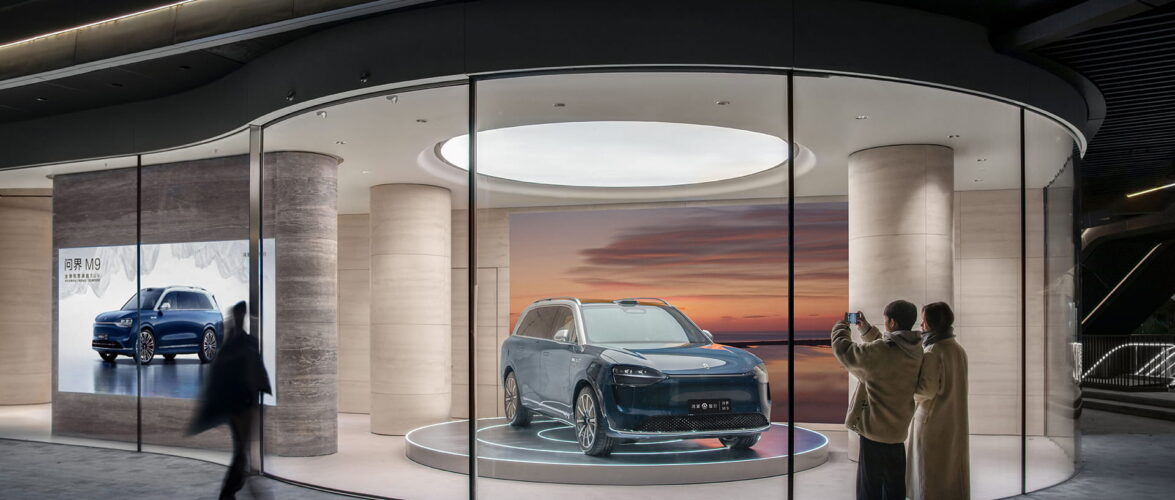
Li Auto opened the sequence on May 15 with the new-generation L9, whose top Livis trim incorporates an 8,000-volt active suspension, brake-by-wire, steer-by-wire, and a fully drive-by-wire chassis, according to the company. That variant starts at RMB 509,800, equivalent to around USD 75,000. Twelve days later, on May 27, both Nio and Aito held launch events on the same calendar day. Nio introduced the ES9 with a starting price of RMB 498,000, while Aito's refreshed M9 begins at RMB 499,800.
The near-simultaneous timing reflects a shared reading of the domestic market. At DailyTechWire, we've tracked how Chinese EV makers have spent the past eighteen months navigating a price war that compressed margins across the industry. Now, with penetration of new-energy vehicles approaching 50 percent in many tier-one cities, the manufacturers with the strongest balance sheets and the most advanced supply chains are steering toward segments where customers are less price-sensitive and where hardware differentiation still commands a premium.
Why Half a Million Yuan Matters
The RMB 500,000 threshold is significant in China's automotive landscape. It sits well above the mass-market ceiling but below the entry point for traditional European luxury marques such as Porsche or the upper trims of BMW and Mercedes-Benz. For domestic brands, crossing that line has historically required not only advanced powertrains and software but also a credible claim to build quality, interior materials, and brand equity that can justify the price to buyers who grew up associating premium cars with German or American badges.
Li Auto's decision to equip the L9 Livis with an 8,000-volt suspension system is illustrative. High-voltage active suspension allows individual wheel control with millisecond response times, smoothing out road imperfections and enabling dynamic ride-height adjustment. Combined with brake-by-wire and steer-by-wire, the architecture eliminates mechanical linkages in favor of electronic actuators, reducing weight and creating headroom for advanced driver-assistance features that rely on precise, software-defined control of steering and braking inputs.
Nio's ES9 and Aito's M9 occupy the same price band but emphasize different value propositions. Nio has built its brand around battery-swap infrastructure and a membership model that bundles vehicle ownership with services such as priority charging access and concierge support. The ES9 extends that ecosystem into the three-row SUV category, targeting families and executives who want the practicality of a large vehicle without sacrificing the connectivity and over-the-air update cadence that Nio users expect.
Aito, a joint venture closely associated with Huawei's automotive technology stack, leans heavily on integrated cabin electronics and advanced driver-assistance systems developed in-house by Huawei. The M9 refresh brings updated sensor suites and revised software that Huawei has been refining across multiple vehicle programs over the past two years. For buyers in China's tech-forward urban centers, the Huawei connection carries weight; the brand's smartphone and telecommunications heritage translates into perceived competence in areas such as sensor fusion, voice recognition, and seamless integration with other Huawei devices.
Margin Compression and the Flight to Premium
The strategic rationale for this upmarket push is straightforward: margin preservation. China's EV market has grown explosively, but the spoils have not been evenly distributed. A prolonged period of subsidy reduction, raw-material price volatility, and aggressive discounting by both domestic startups and legacy automakers has left many players operating on single-digit net margins or worse. Tesla's price cuts in early 2023 triggered a cascade of reductions that rippled through the industry, forcing even well-capitalized firms to choose between volume and profitability.
By concentrating product development and marketing resources on vehicles priced above RMB 500,000, manufacturers can achieve two objectives simultaneously. First, they reduce their exposure to the cutthroat competition in the RMB 150,000 to RMB 300,000 bracket, where dozens of models from both startups and state-owned enterprises are fighting for share. Second, they can command higher absolute margins per unit, even if overall production volumes are lower. A single sale of an ES9 or L9 Livis generates revenue equivalent to two or three mid-tier sedans, and the gross margin percentage on that sale is typically several points higher because the buyer is less likely to negotiate aggressively and because the vehicle incorporates proprietary technology that competitors cannot easily replicate.
This dynamic is particularly important for companies that have raised significant venture capital and are under pressure to demonstrate a path to sustainable profitability. Nio, for example, has been burning cash for years while building out its swap-station network and R&D infrastructure. Moving upmarket allows the company to improve unit economics without abandoning its brand positioning or alienating its existing customer base, many of whom have already bought into the premium narrative.
Technology as Table Stakes
What distinguishes this generation of flagship SUVs from earlier attempts is the depth of integration between hardware and software. Drive-by-wire systems, once the domain of aerospace and high-end motorsport, are now appearing in volume production vehicles because the cost of electronic control units, sensors, and actuators has fallen to the point where they can be economically deployed in cars selling in the low six figures. At the same time, the regulatory environment in China has become more accommodating of advanced driver-assistance features, provided manufacturers can demonstrate robust fail-safe mechanisms and clear communication to drivers about system limitations.
The 8,000-volt active suspension in the Li L9 Livis, for instance, requires not only high-voltage actuators but also a control architecture capable of processing inputs from accelerometers, ride-height sensors, and GPS data in real time. The system must predict road conditions ahead of the vehicle and adjust damping and ride height proactively, rather than reactively. That level of predictive control depends on machine-learning models trained on vast datasets of driving scenarios, which in turn requires access to fleet data and the compute infrastructure to process it.
Nio and Aito face similar technical challenges. Nio's battery-swap model imposes strict constraints on vehicle architecture, because the battery pack must be removable and replaceable within a few minutes. That requirement influences everything from the placement of cooling systems to the design of the underbody structure. The ES9 must accommodate those constraints while still delivering the interior space and ride quality that buyers in this segment expect.
Aito's reliance on Huawei's technology stack brings advantages in sensor fusion and software updates but also introduces dependencies. If Huawei's automotive division encounters supply-chain disruptions or shifts strategic priorities, Aito's product roadmap could be affected. Conversely, Huawei's deep integration across multiple vehicle programs gives it economies of scale in software development that few other suppliers can match, allowing Aito to offer features that would be prohibitively expensive for a smaller brand to develop independently.
The Competitive Landscape Beyond Domestic Rivals
While the immediate competition is among Chinese brands, the broader context includes established luxury automakers that have been slower to electrify their lineups in China. BMW, Mercedes-Benz, and Audi all offer electric SUVs in the RMB 500,000-plus range, but their products often carry a price premium for the badge rather than a clear technological edge. European automakers have historically relied on brand heritage and dealer networks to justify higher prices, but those advantages are eroding as domestic brands improve build quality and as younger Chinese buyers demonstrate greater willingness to consider local alternatives.
Tesla occupies a unique position. The Model X, Tesla's large SUV, competes on price and performance but lacks some of the interior refinement and feature richness that Chinese buyers in this segment have come to expect. Tesla's minimalist design philosophy and reliance on a central touchscreen for most controls appeal to some customers but alienate others who prefer physical buttons and more traditional luxury cues. The three SUVs launched in May are all designed with the Chinese market's specific preferences in mind: larger rear-seat space, more elaborate infotainment options, and greater emphasis on ride comfort over outright performance.
Risk and Execution
Launching a flagship product is inherently risky. Development costs are high, and any quality issues or safety incidents can do lasting damage to a brand that is still establishing its reputation in the premium segment. Li Auto, Nio, and Aito have each experienced growing pains. Li Auto faced criticism over earlier models' range claims and software bugs. Nio has dealt with battery-fire incidents and the logistical complexity of scaling its swap network. Aito's close association with Huawei has been both an asset and a vulnerability, particularly as geopolitical tensions have periodically disrupted Huawei's supply chains.
The decision to launch three competing products within a two-week window also raises questions about market capacity. China's wealthy tier-one cities can absorb a certain number of RMB 500,000 SUVs each quarter, but the addressable market is not infinite. If all three brands are targeting the same pool of affluent buyers, the result could be another round of discounting and promotional incentives that undermines the original margin objective. Early sales data will be closely watched by investors and competitors alike.
Forward View
The clustering of these launches suggests that Chinese EV makers see the premium SUV segment as a near-term battleground where technological differentiation still matters and where brand loyalty is not yet entrenched. The companies that succeed will be those that can deliver on the promise of advanced features without sacrificing reliability, that can scale production without compromising quality, and that can navigate the regulatory and geopolitical uncertainties that continue to shape the industry.
For now, the message is clear: the race in China's electric vehicle market is no longer just about who can build the cheapest car or deliver the longest range on a single charge. It is about who can convince buyers that a half-million-yuan domestic SUV is worth choosing over a German sedan or a Tesla, and whether that conviction can be sustained as competition intensifies and the market matures. The answers will emerge not in the launch events but in the showrooms and service centers over the months ahead, as these three flagship models move from engineering achievements to commercial realities.