Sony's 67-Megapixel A7R VI Proves You Can Have Speed and Resolution
The full-frame mirrorless flagship shoots 30 fps bursts and delivers dual-gain processing, but its video codec choices and $4,500 price tag reveal where Sony drew the line.
The False Choice Sony Just Retired
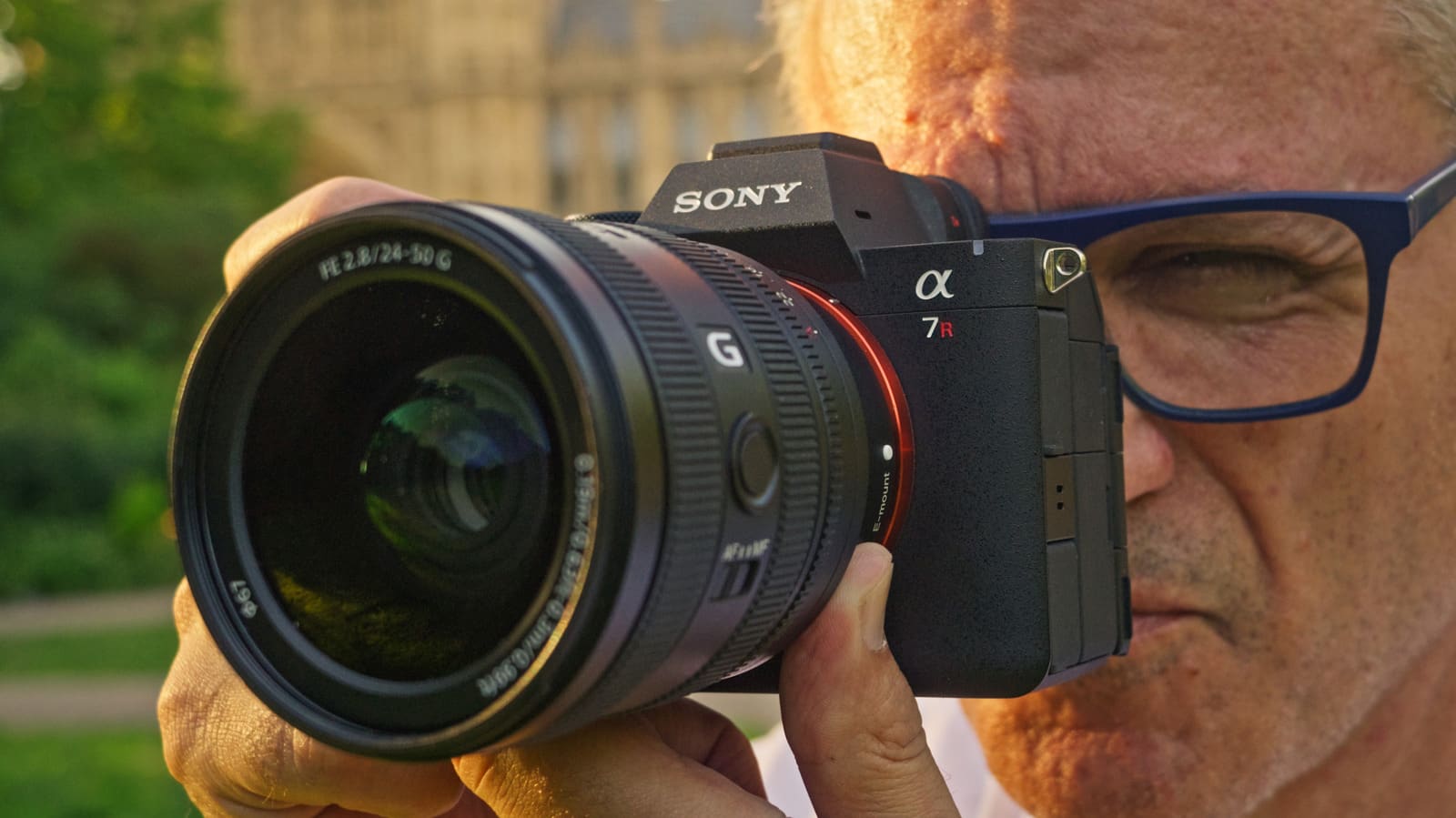
For a decade, Sony's full-frame mirrorless lineup forced photographers into a corner: pick the A7 or A7S for speed, or accept the A7R's resolution at the cost of burst performance. The A7R VI, announced this week, dismantles that binary. Its stacked 67-megapixel sensor fires 30 frames per second in electronic shutter mode with continuous autofocus and zero blackout, triple the rate of its predecessor. At DailyTechWire, we've tracked sensor roadmaps across Tokyo, Seoul, and Shenzhen long enough to know that marrying this much resolution with this much speed requires more than iterative engineering. It demands architectural rethinking at the silicon level, and Sony appears to have committed the R&D budget to prove it.
The camera ships at $4,500, a $600 climb over the A7R V's launch figure. That premium buys a Bionz XR2 processor, an 18-millisecond sensor readout time that is 5.6 times faster than the previous generation, and dual-gain processing that Sony claims delivers up to 16 stops of dynamic range. The spec sheet positions the A7R VI against Canon's EOS R5 II and Nikon's Z8, both of which retail in the same bracket but offer meaningfully different trade-offs in video codec support and rolling-shutter mitigation.
Burst Performance That Respects Buffer Realities
Thirty frames per second sounds transformative until you consider file size. A single compressed RAW frame from a 67-megapixel sensor occupies roughly 65 to 80 megabytes depending on scene complexity. A two-second burst generates north of 3.5 gigabytes. Sony pairs the camera with CFexpress Type A slots, a format the company introduced years ago and continues to champion despite industry reluctance. Type A cards top out at 800 MB/s write speeds, a ceiling that becomes a practical constraint when shooting back-to-back sequences. The camera also accepts SD UHS-II media in its dual-slot configuration, but those cards saturate even faster.
In mechanical shutter mode, the A7R VI holds at 10 fps, matching the 33-megapixel A7 V but delivering double the pixel count. That parity matters for photographers who prefer the predictability of a physical curtain or work in artificial lighting environments where electronic-shutter banding remains a risk. Rolling shutter is measurably improved thanks to the faster readout, yet it still surfaces during aggressive pans or when tracking subjects moving perpendicular to the frame. The A7R VI is not a dedicated sports body. Its 18-millisecond scan time sits well above the 4-millisecond figure Sony achieved in the A1 II, and that gap shows up in edge cases, particularly motorsport and fast-moving wildlife.
Autofocus has been tuned to detect smaller subject sizes within the frame across human, animal, bird, vehicle, and insect categories. The practical uplift is modest in typical shooting distances but becomes noticeable when a bird occupies less than five percent of the frame and you plan to crop aggressively in post. Eye, face, head, and body detection for humans remains consistent with Sony's recent releases, and hit rates in street and event scenarios were high during testing in London. The system occasionally lagged when the buffer filled during consecutive 30 fps bursts, a reminder that processing horsepower and memory bandwidth remain distinct bottlenecks.
Dual-Gain Architecture and What It Unlocks
Sony integrated specialized circuits directly onto the sensor to enable real-time fusion of high- and low-ISO signal paths, a technique the company calls dual-gain processing. This is not a software trick applied in post-conversion; it happens at the analog-to-digital boundary, before the Bionz XR2 processor receives the data. The result is a measurable expansion in dynamic range, particularly in the shadow-to-midtone transition where single-gain sensors typically introduce read noise.
According to Sony, the A7R VI achieves 15 stops of dynamic range in standard operation and up to 16 stops with dual-gain mode active. Independent lab measurements align with those figures, placing the camera ahead of any current full-frame mirrorless competitor in recoverable highlight and shadow detail. High-contrast scenes involving backlit subjects, open water with reflected sun, or stage lighting against dark backgrounds all demonstrated exceptional latitude. Pushing shadows by three stops in RAW processing introduced grain that remained fine and film-like rather than the blocky chroma noise typical of older sensors.
The camera's native ISO range spans 100 to 32,000, expandable to 50 and 102,400. Dual native ISO behavior is most evident at ISO 12,800, where shadow regions retain surprising cleanliness even under aggressive exposure adjustments. Night shooting around London landmarks showed that the A7R VI maintains usable image quality well into four-digit ISO values, a capability that extends its utility beyond daylight portraiture and controlled studio work.
Sony also revised its automatic white balance algorithm. Previous A7R models exhibited a persistent cool cast in shadow regions, skewing toward blue-cyan even under neutral ambient light. The A7R VI reduces that tendency, though it does not eliminate it entirely. Occasional color shifts toward teal-green hues still appear in mixed lighting, a quirk that Nikon and Panasonic bodies handle with greater consistency.
Stabilization Gains and the One-Second Threshold
In-body stabilization now delivers 8.5 stops of correction when paired with compatible lenses, up from 7.5 stops in the A7R V. That single-stop improvement is meaningful at the extreme end of handheld exposure durations. One-second exposures with a static subject and careful breathing technique yielded sharp primary elements with intentional motion blur in secondary areas, a technique useful for isolating moving vehicles or pedestrians against sharp architectural backgrounds.
The stabilization system uses a five-axis gyro array and compensates for pitch, yaw, roll, and horizontal-vertical shift. Sony's implementation favors correction authority over sensor travel, meaning the physical sensor assembly moves less than some competitors but applies more aggressive algorithmic prediction. This approach works well for photography but introduces slight artifacts in video when electronic stabilization is layered on top, particularly in 4K modes where additional digital cropping compounds the effect.
Video Codec Choices and Where Sony Held Back
The A7R VI records 8K video at up to 30 fps and 4K at up to 120 fps, both in 10-bit 4:2:2 using Sony's XAVC codec. Maximum bitrate in All-Intra mode reaches 520 megabits per second, adequate for broadcast and high-end production but trailing the flexibility offered by 12-bit RAW workflows. Canon's EOS R5 II and Panasonic's Lumix S5R II both support internal RAW video recording; the A7R VI does not. Sony has not publicly explained the omission, but the decision likely reflects a combination of thermal design limits, processing overhead, and market segmentation strategy to protect its Cinema Line.
The sharpest video output comes from 8K mode, which subsamples an 8.2K region of the sensor with a 1.22x crop factor. All 4K modes derive from the full sensor width but subsample a 5K area, effectively binning half the photosites. The result is 4K footage noticeably softer than what Canon and Panasonic achieve through oversampling or line-skipping alternatives. Compression artifacts become visible in high-frequency detail such as foliage, fine text, or chain-link fencing, scenarios where RAW recording would bypass the codec bottleneck entirely.
Dual-gain processing is available in 4K video with S-Log3 enabled, delivering over 14 stops of recoverable dynamic range according to Sony. That figure held up in mixed-exposure scenes involving stage lighting, vehicle interiors at dusk, and urban environments with neon signage. Low-light video performance mirrors the stills capability, with ISO 12,800 remaining clean enough for deliverable footage. Rolling shutter in 8K mode is well controlled for a sensor of this resolution, though fast horizontal pans still introduce skew.
The camera lacks open-gate recording, restricting output to 16:9 aspect ratio regardless of mode. Filmmakers who prefer to capture the full sensor area for reframing in post or anamorphic workflows will find the A7R VI less accommodating than competitors.
Ergonomics, Viewfinder Brightness, and the Battery Swap
Sony revised the body material to a slightly softer composite that reduces hand fatigue during extended sessions, a small but welcome change for event and wedding photographers. The grip is deeper than the A7R V, though users with large hands may still find their fingers compressed between the grip and lens barrel, particularly with compact primes. Four control dials, a joystick, and a dozen programmable buttons provide extensive customization, but the absence of a top-left button for toggling between single-frame and burst modes is a missed opportunity, especially given that the A1 II includes one.
The electronic viewfinder uses a 9.44-million-dot OLED panel, now twice as bright as the previous generation. The improvement is most noticeable in direct sunlight or when viewing high-key scenes. The rear display flips and extends on an articulating arm, accommodating both waist-level composition and vlogger-style front-facing use. Brightness in extreme sunlight remains a limitation, though less so than on competing models.
Sony introduced the NP-SA100 battery, the first change to its mirrorless power cell in a decade. The new unit offers higher capacity and a health indicator accessible through the menu system, but it is incompatible with older Sony bodies. Photographers with existing A7-series kits will need to maintain separate battery stocks.
Competitive Context and What the Price Buys
At $4,500, the A7R VI sits alongside Canon's EOS R5 II and Nikon's Z8 in both capability and cost. It surpasses both in resolution and matches or exceeds them in burst speed and dynamic range. However, Canon and Nikon deliver superior video codec options, faster card formats, and in Canon's case, a more mature lens ecosystem for RF-mount telephotos. Panasonic's Lumix S1R II offers a lower entry price but relies on a non-stacked sensor, sacrificing burst performance and readout speed.
The $600 price increase over the A7R V reflects a combination of component cost escalation, tariff adjustments affecting Japanese exports, and the engineering investment required to produce a stacked sensor at this resolution. Whether that premium is justified depends on how much weight a buyer places on burst speed, dual-gain processing, and the ability to crop a 67-megapixel file down to 22 megapixels and still retain print-worthy detail.
For portrait, landscape, and editorial photographers who occasionally need to capture fast-moving subjects or work in challenging light, the A7R VI removes previous compromises. It is not a dedicated action camera, and its video feature set will frustrate hybrid shooters who prioritize codec flexibility. But within the boundaries Sony chose, the execution is confident. The company has spent years refining autofocus, stabilization, and color science; the A7R VI consolidates those improvements into a body that no longer asks you to pick between resolution and speed.
What Comes Next
Sony's decision to unify high resolution and high speed in a single platform signals a broader industry shift. Sensor fabrication has reached a point where stacked architectures no longer demand a trade-off in photosite density, and processing pipelines can handle the data rates that multi-megapixel burst shooting generates. Canon and Nikon will respond, and Panasonic's full-frame roadmap likely includes a stacked sensor refresh within the next product cycle.
The A7R VI will appeal most to photographers who have outgrown 45-megapixel sensors but cannot justify the cost or size of medium-format systems. It also serves studios that need both resolution for commercial work and speed for occasional event coverage, consolidating what previously required two camera bodies. Whether it displaces the A1 II as Sony's flagship depends on how much you value an extra 30 megapixels over a 4-millisecond readout and a top-left mode button.
For now, the A7R VI is the most capable high-resolution full-frame camera you can buy. It just costs accordingly.