Anthropic Rolls Out Persistent Channel Assistant to Challenge Slackbot
Claude Tag introduces shared-memory AI that learns team workflows, proactively surfaces updates, and operates across organizational boundaries with admin-controlled permissions.
A Shared Memory Layer for Team Channels
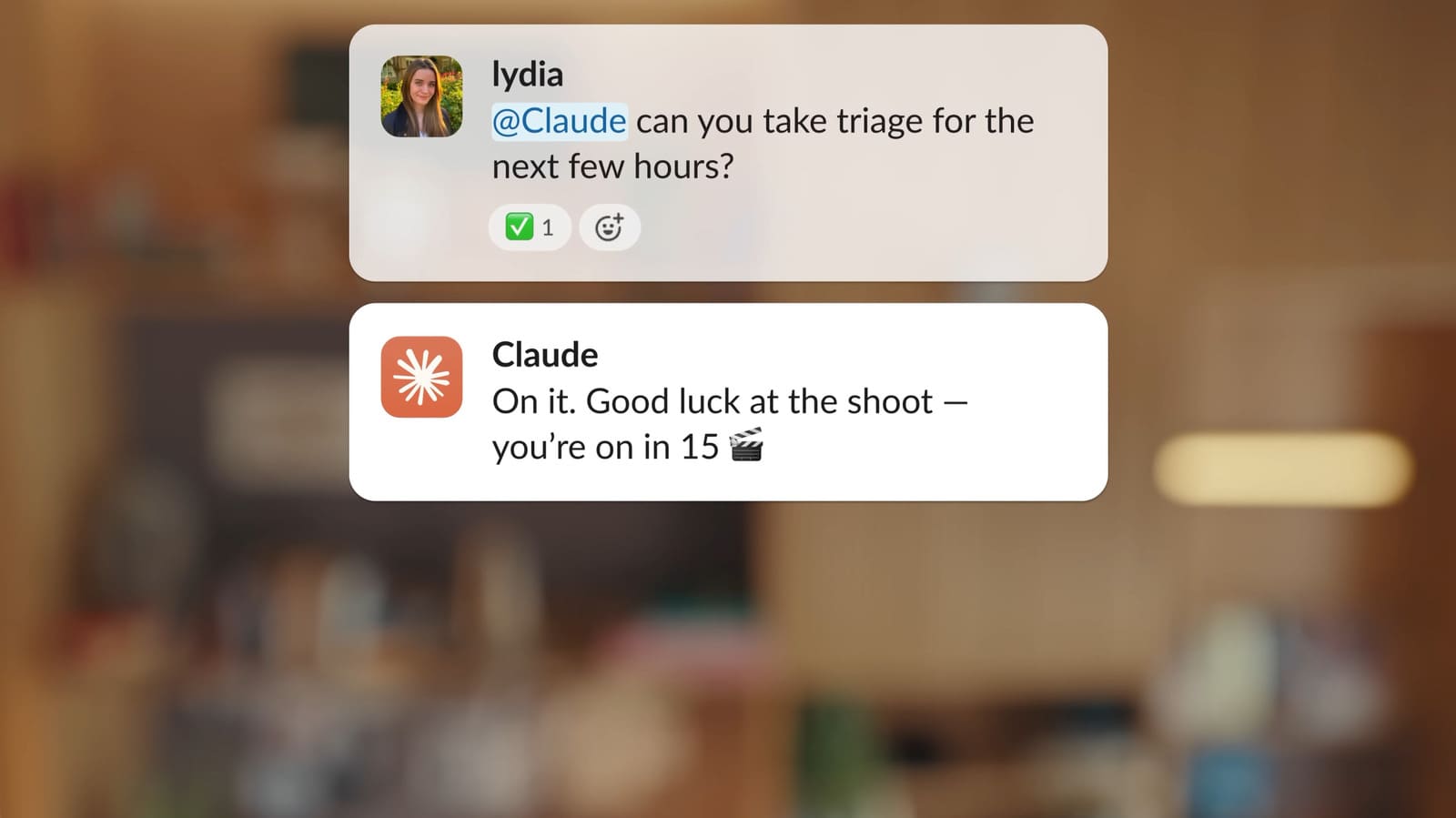
Anthropic has released Claude Tag in research preview, positioning it as a replacement for the passive, rules-based bots that have populated enterprise chat tools for the past decade. Unlike traditional workflow automation that responds to keywords or triggers, Claude Tag operates as a continuous presence inside Slack channels - summoned with @Claude - that accumulates context about how a team works, what they need, and where information lives across the organization.
The architecture is straightforward: one identity per channel, visible to everyone, with conversation threads that any member can resume. If an engineer asks Claude Tag about a product roadmap update in the morning and logs off, a product manager can pick up that same thread in the afternoon without re-explaining the project. The assistant builds a shared understanding of recurring tasks, jargon, dependencies, and workflow patterns specific to that channel, reducing the onboarding friction that typically accompanies handoffs or shift changes.
At DailyTechWire, we've tracked the evolution of workplace AI from isolated copilots - tools that live in individual chat windows or IDE sidebars - to these ambient, multi-user systems that operate at the team layer. The shift matters because much of the inefficiency in distributed work stems not from individual productivity gaps but from misaligned context: person A doesn't know what person B already explained to person C, and the same questions get asked in three different threads. A persistent assistant that everyone can see and interrogate offers a partial answer to that problem, though it also introduces new questions about whose preferences the system prioritizes when team members disagree.
Proactive Intelligence and Cross-Organizational Reach
The more contentious feature set involves what Anthropic calls "ambient" behavior. When enabled by a workspace administrator, Claude Tag can monitor conversations and surface relevant information from other parts of the organization without being explicitly asked. If a sales channel is discussing a customer deployment and engineering has flagged a related bug fix in a separate channel, Claude Tag can push that update into the sales thread autonomously.
This capability depends on two layers of access control. First, administrators must grant Claude Tag permission to read from specific channels, databases, or internal tools on a per-channel basis. Second, the ambient mode itself must be toggled on; by default, Claude Tag operates in a reactive mode, answering only when summoned. The dual-gate design reflects a familiar tension in enterprise AI: the more context an assistant has, the more useful it becomes, but the broader its access, the greater the risk of leaking sensitive data across teams that shouldn't have visibility into one another's work.
Anthropic has not yet disclosed the technical mechanisms for enforcing these boundaries - whether Claude Tag's memory is segmented by channel, how it handles edge cases where a user belongs to multiple channels with conflicting access policies, or what audit logs are available to track which information crossed which boundaries. These details will determine whether enterprises with strict compliance requirements can deploy the tool beyond low-stakes use cases.
Follow-Up Automation and Task Persistence
A third capability allows Claude Tag to track task status and prompt users when action items stall. If a team member commits to updating a document by end-of-week and the thread goes quiet, Claude Tag can nudge the channel with a reminder. This mirrors functionality already present in project management platforms like Asana or Linear, but embedding it directly in the communication layer reduces the friction of switching between tools.
The risk, as with any automated follow-up system, is that it becomes noise. If Claude Tag's judgment about what constitutes a stalled task is too aggressive, teams will mute or ignore it; if it's too conservative, the feature adds little value. Anthropic has not specified whether users can tune the sensitivity of these prompts or whether the system adapts based on how often its nudges are acted upon versus dismissed.
The design also raises workflow questions. In channels where responsibilities are fluid or where multiple people share ownership of a task, it's unclear how Claude Tag decides whom to prompt or how it handles tasks that were intentionally deprioritized rather than forgotten. The difference between a task that's blocked and a task that's been shelved is often tacit knowledge that lives in people's heads, not in the message history.
Enterprise Rollout and Competitive Context
Claude Tag is launching in research preview for customers on Claude Enterprise and Claude Team plans, according to Anthropic. The phased rollout suggests the company is using early adopters to surface edge cases and refine permission models before expanding access. Pricing has not been disclosed, but the feature appears bundled into existing enterprise tiers rather than sold as a standalone add-on.
The competitive landscape is crowded. Microsoft's Copilot already operates across Teams and Office 365 with similar cross-application awareness. Google's Duet AI integrates with Workspace tools, including Chat. OpenAI has partnerships with enterprise platforms but has not yet shipped a persistent, channel-wide assistant. Anthropic's advantage lies in its reputation for safety research and its focus on controllable, interpretable AI systems - a positioning that resonates with regulated industries wary of deploying black-box models in sensitive workflows.
The deeper challenge is adoption behavior. Slack channels are already noisy, and many teams have developed informal norms to manage that noise: designated threads for off-topic discussion, emoji reactions in place of reply-all messages, explicit rules about when to use @channel mentions. Introducing an AI participant that can interject autonomously, even with good intentions, requires renegotiating those norms. Early adopters will need to establish conventions around when to invoke Claude Tag publicly versus in a direct message, how to correct it when it surfaces irrelevant information, and how to handle disagreements about whether its interventions are helpful or distracting.
Memory, Governance, and the Ambient Workplace
The long-term trajectory here is not just about replacing Slackbot - a lightweight utility that handles reminders and status updates - but about embedding intelligence into the infrastructure of work itself. If Claude Tag succeeds, the next generation of workplace tools will assume that every channel, every project space, every shared document has an AI participant with memory, agency, and cross-system visibility.
That vision depends on solving governance problems that remain unsettled. Who owns the knowledge that Claude Tag accumulates about a team's workflows? If an employee leaves, does their conversation history with Claude Tag get anonymized, deleted, or retained as institutional memory? If Claude Tag makes a mistake - surfaces confidential information to the wrong channel, or gives outdated advice that leads to a costly error - who is accountable?
Anthropic has positioned itself as the AI company most concerned with these questions, publishing extensively on constitutional AI, red-teaming, and alignment research. Whether that translates into product features that enterprises can actually operationalize - audit trails, version control for assistant behavior, rollback mechanisms when things go wrong - will determine whether Claude Tag becomes a standard layer in the workplace stack or remains a high-ceiling, high-risk experiment that most organizations are too cautious to adopt.
For now, the research preview offers a glimpse of a workplace where AI is not an external tool you summon when needed but a continuous, observing presence that knows what your team is working on, what's blocking you, and what happened in the meeting you missed. Whether that feels like an upgrade or an intrusion will vary widely across teams, industries, and organizational cultures. The companies that figure out how to tune that balance - useful without being overbearing, informed without being invasive - will define the next chapter of how distributed teams collaborate.