Sony Abandons Zoom Lens in Flagship Xperia Redesign
The Xperia 1 VIII trades continuous optical zoom for a camera overhaul, keeping headphone jacks and premium pricing while exiting the US market entirely.
A Rare Pivot for Sony's Niche Flagship
Sony's latest Xperia 1 VIII represents the clearest break from recent form we've seen in the company's flagship phone strategy. The device abandons the continuous optical zoom telephoto lens that has been the technical hallmark of the Xperia 1 line since the fourth generation, opting instead for a comprehensive camera system redesign. At the same time, Sony has overhauled the industrial design language, moving away from the aesthetic consistency that marked previous iterations.
The decision to remove continuous optical zoom is particularly notable. For four consecutive generations, Sony positioned variable zoom as a differentiator in a market increasingly dominated by fixed focal-length periscope modules from Samsung, Xiaomi, and Oppo. The technology allowed users to smoothly transition between focal lengths rather than jumping between discrete lenses, a feature borrowed from Sony's Alpha mirrorless camera division. That it has now been retired suggests either technical constraints, cost pressures, or a reassessment of what enthusiast buyers actually value in a smartphone camera.
At DailyTechWire, we've tracked the slow retreat of niche Android flagships from Western markets, and Sony's decision to skip a US launch for the Xperia 1 VIII accelerates that trend. The phone will be available in the UK and Europe starting at £1,399 and €1,499 respectively, equivalent to roughly $1,850 at current exchange rates. That pricing places it in direct competition with the iPhone 16 Pro Max and Samsung Galaxy S26 Ultra, both of which enjoy far stronger carrier relationships and retail presence in those regions.
What Stays, What Goes
Despite the camera and design changes, Sony has retained several features that define the Xperia value proposition for its remaining enthusiast audience. The 3.5mm headphone jack survives, a rarity among premium Android devices in 2026. So does the microSD card slot, which has been progressively eliminated by most competitors in favor of higher-margin internal storage tiers. Both features appeal to a narrow but loyal segment: audiophiles who prefer wired IEMs, photographers who swap media cards between devices, and users in markets where cloud storage remains expensive or unreliable.
The front of the device still carries thick bezels to accommodate stereo speakers, a design choice that runs counter to the edge-to-edge displays favored by most flagship Android manufacturers. Sony has historically justified this by pointing to media consumption and gaming, where front-firing audio improves the experience. Whether that trade-off resonates with buyers in 2026, when computational audio and spatial processing have improved dramatically, is less clear.
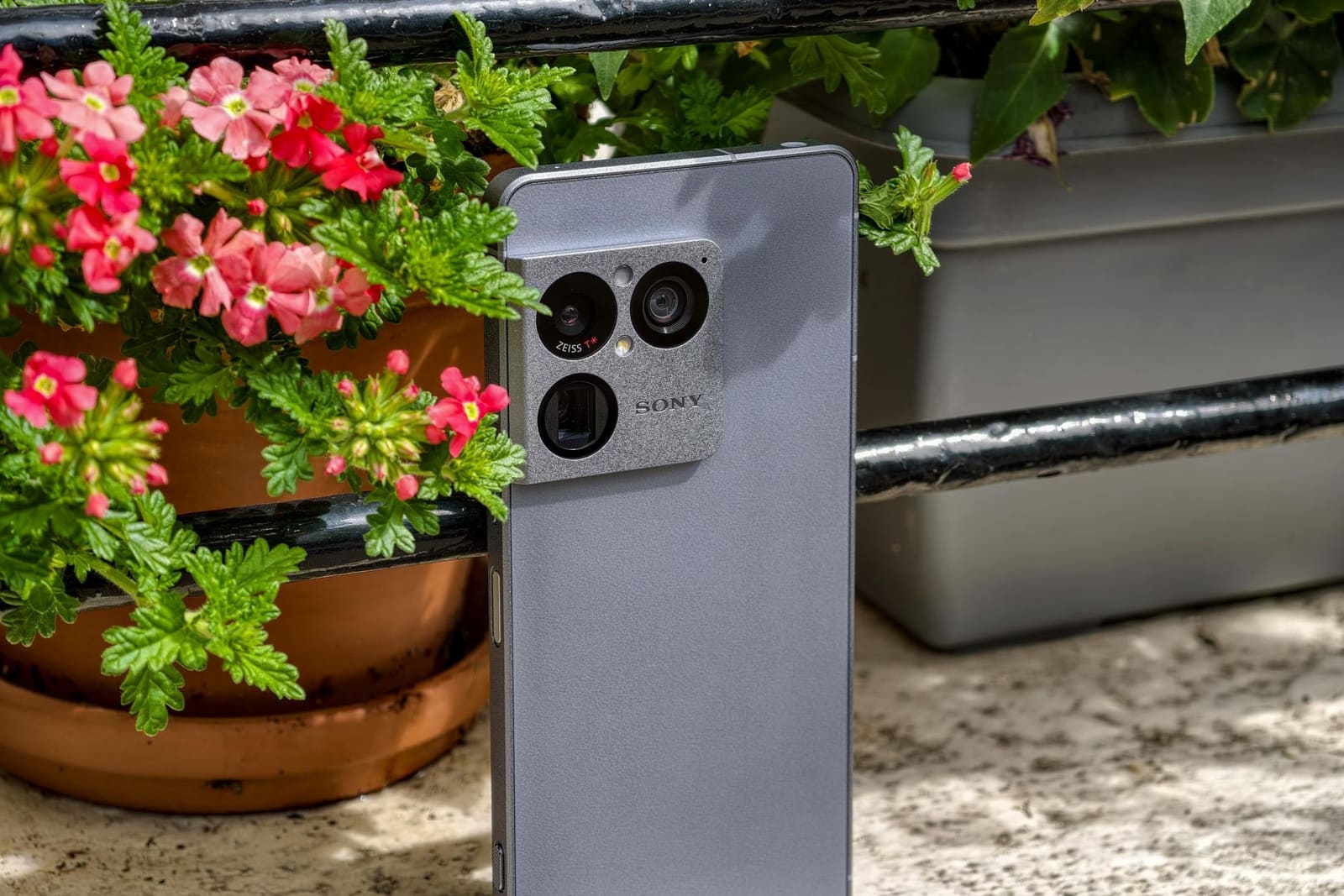
The industrial design overhaul itself marks a departure from the flat, angular aesthetic Sony has maintained since the Xperia Z series over a decade ago. Early product images suggest slightly curved edges and a revised camera module layout, though Sony has not yet detailed materials or durability certifications. The shift may be an attempt to broaden appeal beyond the core enthusiast base, though it risks alienating the very users who appreciated Sony's design consistency.
Camera Strategy in a Crowded Field
Removing continuous optical zoom forces Sony to compete on different terms. The company has not yet disclosed the focal lengths or sensor specifications of the new camera array, but the move likely signals a shift toward larger sensors, improved computational photography, or both. Competitors have spent the past two years integrating variable aperture systems, stacked sensors with faster readout, and AI-driven image processing that can rival or exceed the flexibility of optical zoom in many shooting scenarios.
Sony's challenge is that its Alpha camera heritage, while prestigious, has not translated into smartphone market share. The company's decision to prioritize manual controls and RAW capture in previous Xperia models appealed to a small number of enthusiasts but left it without a compelling computational photography story for mainstream buyers. If the Xperia 1 VIII leans harder into AI processing and point-and-shoot usability, it may alienate existing fans. If it doubles down on manual control, it risks remaining a niche product in a market that has moved on.
The broader context is also challenging. Chinese manufacturers like Vivo, Oppo, and Honor have aggressively pushed camera innovation in the premium segment, often at lower price points than Sony. Vivo's X200 Pro, for example, ships with a 200-megapixel periscope telephoto and advanced night mode processing at roughly two-thirds the cost of the Xperia 1 VIII in European markets. Samsung's Galaxy S26 Ultra is expected to introduce an upgraded 1-inch main sensor later this year. Apple continues to refine its computational photography pipeline, with the iPhone 16 Pro models offering class-leading video capture and editing workflows.
Market Position and the US Absence
Sony's decision to forgo a US launch is both pragmatic and symbolic. The company has struggled to gain carrier partnerships in the United States, where the vast majority of premium smartphones are sold through subsidized contracts with AT&T, Verizon, and T-Mobile. Without those relationships, Sony has been forced to rely on unlocked sales through its own online store and a handful of retailers, a distribution model that has failed to generate meaningful volume.
The US absence also reflects broader trends in Android fragmentation. Outside of Samsung, which commands roughly 25 percent of the US smartphone market, and Google's Pixel line, which has carved out a small but growing niche, Android flagships have found little traction with American buyers. Motorola, once a major player, has largely retreated to the budget and mid-range segments. LG exited the smartphone business entirely in 2021. OnePlus, after years of trying to build a premium brand, has seen its US market share stagnate.
Europe and the UK present slightly better conditions for Sony, though the competitive landscape remains difficult. The company retains stronger brand recognition in these markets, and the lack of a single dominant carrier ecosystem allows for more direct-to-consumer sales. However, Xiaomi, Oppo, and other Chinese brands have expanded aggressively in Europe over the past three years, often undercutting Sony on price while matching or exceeding hardware specifications.
The Enthusiast Dilemma
Sony's Xperia line has long occupied an unusual space: a premium product aimed at enthusiasts who prioritize specific features over mass-market appeal. The challenge is that the enthusiast segment has fragmented. Audiophiles increasingly use dedicated DACs and wireless earbuds with high-resolution codecs. Mobile photographers often prefer computational photography over manual controls, or they carry dedicated cameras. Gamers have shifted toward devices with active cooling and high-refresh displays optimized for specific titles, features that Sony has been slow to adopt.
The Xperia 1 VIII's redesign suggests Sony is attempting to broaden its appeal, but the high price point and limited distribution work against that goal. At £1,399, the device is priced for early adopters and brand loyalists, not mainstream buyers exploring alternatives to Samsung and Apple. The absence of aggressive trade-in programs, carrier subsidies, or bundled services further limits its reach.
What remains unclear is whether Sony views the Xperia line as a sustainable business or a brand-building exercise tied to its broader consumer electronics portfolio. The company's imaging sensor division supplies camera modules to Apple, Samsung, Xiaomi, and nearly every other major smartphone manufacturer. Xperia devices serve as a showcase for Sony's hardware capabilities and a testbed for features that may eventually appear in partner devices. If that is the primary function, profitability and market share become secondary metrics.
Forward View
The Xperia 1 VIII will face immediate comparisons with the iPhone 16 Pro Max and Samsung Galaxy S26 Ultra when it reaches European shelves in the coming months. Both competitors offer mature ecosystems, extensive retail and carrier partnerships, and years of refinement in computational photography. Sony's historical advantages, such as continuous optical zoom and a distinct design language, have been diluted by the changes in this generation.
The device's success will likely depend on execution in areas Sony has not yet detailed: battery life, software update commitments, thermal management, and the quality of its new camera system under real-world conditions. If Sony can deliver a genuinely differentiated experience that justifies the premium price, the Xperia 1 VIII may find an audience among users frustrated with the homogeneity of mainstream flagships. If it falls short, it risks becoming another high-priced curiosity in a market that has little patience for products that do not clearly excel in at least one dimension.
The departure from continuous optical zoom, in particular, will be a litmus test. If the new camera system proves more versatile and user-friendly, Sony will have validated its pivot. If it merely brings the Xperia in line with competitors without offering a clear advantage, the company will have sacrificed one of the few features that set its phones apart. Either way, the Xperia 1 VIII represents a gamble, and the outcome will shape Sony's smartphone strategy for years to come.