The Economics Behind Thunderbolt Cable Pricing
Active retimer chips, certification overhead, and a niche market combine to push premium cable costs far above commodity USB-C - but the performance gulf is real.
The Premium Cable Paradox
A one-meter Thunderbolt 5 cable retails for forty dollars or more, while a visually identical USB-C cord sits on the same shelf for eight. Both plug into the same oval port on your laptop. To the casual shopper, the price multiplier feels arbitrary, even exploitative. Yet the gap reflects a genuine divide in engineering complexity, supply-chain economics, and the realities of selling a high-performance product to a narrow audience.
At DailyTechWire, we have tracked the evolution of interconnect standards across consumer electronics and enterprise infrastructure for years. The Thunderbolt pricing story is less about vendor markup than about the compound cost of delivering multi-gigabit bandwidth, power delivery at laptop-charger wattages, and display protocols over a cable thin enough to coil in your palm. Understanding where that premium comes from requires looking inside the cable, at the certification apparatus that governs it, and at the market forces that keep volumes low.
Active Signal Conditioning at Eighty Gigabits
Thunderbolt 5 delivers bidirectional throughput of eighty gigabits per second, with a boost mode that pushes downstream bandwidth to 120 Gbps while upstream drops to forty. Moving that much data over copper wire without catastrophic signal degradation demands active electronics embedded in the cable itself. Longer Thunderbolt cables - typically anything beyond half a meter - incorporate retimer integrated circuits that sample, clean, and re-amplify the signal mid-flight. These chips compensate for attenuation, crosstalk, and jitter that accumulate as electrons traverse twisted pairs at multi-gigahertz frequencies.
Thunderbolt 4, the prior generation, runs at forty gigabits bidirectional. Even at that lower rate, passive cables struggle beyond short lengths; active retimers become standard once you exceed one meter. The retimer silicon adds bill-of-materials cost, requires its own power budget drawn from the cable's power-delivery lines, and introduces yield risk during manufacturing. A flaw in the retimer or its integration can render the entire cable non-functional, driving scrap rates higher than for passive designs.
By contrast, the typical USB-C cable bundled with a smartphone supports USB 2.0 signaling - 480 megabits per second, less than one percent of Thunderbolt 5's headline speed. At that rate, passive copper and minimal shielding suffice. Even USB 3.2 Gen 2, which tops out at ten gigabits, rarely justifies active components in consumer-length cables. The cost structure diverges sharply once you cross into the Thunderbolt performance envelope.
Power Delivery and Protocol Multiplexing
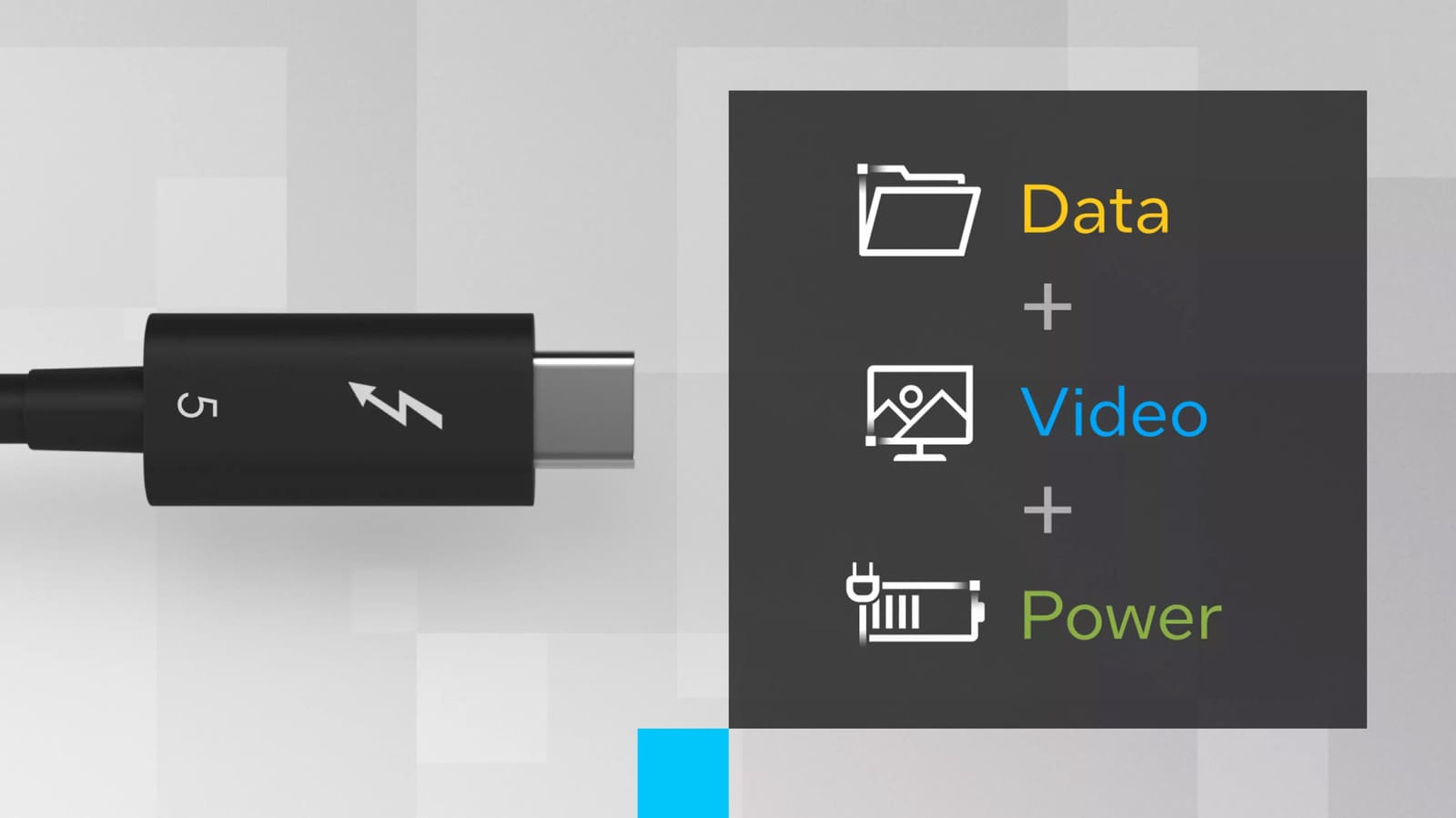
Thunderbolt 5 cables are specified to carry up to 140 watts via the USB Power Delivery standard, with select models rated for 240 watts when paired with compatible chargers and devices. Thunderbolt 4 commonly supports 100 watts. Delivering that much power safely requires conductors sized for current capacity, robust insulation, and careful thermal management to prevent the cable from becoming a fire hazard during prolonged high-power operation.
Beyond raw data and power, Thunderbolt multiplexes multiple protocols over the same physical link. DisplayPort 2.1 video, PCI Express Gen 4 lanes for external GPUs, and USB data all share the high-speed differential pairs. The cable must maintain signal integrity across all these modes simultaneously, meeting distinct electrical specifications for each protocol. That level of versatility is absent from commodity USB-C cables, which typically handle either data or power well but rarely both at high performance, and almost never video at resolutions above 4K at sixty hertz.
Daisy-chaining - connecting multiple Thunderbolt peripherals in series through a single host port - adds another layer of complexity. Each cable in the chain must preserve timing, handle protocol arbitration, and pass through power without introducing latency spikes or data corruption. The engineering required to make that work reliably is non-trivial.
Intel's Certification Regime
Intel developed Thunderbolt in partnership with Apple, with the first consumer cable shipping in 2011. The standard remains under Intel's governance, and any cable bearing the Thunderbolt name or lightning-bolt logo must pass Intel's certification program. That process verifies advertised speeds, safe power delivery, backward compatibility with older Thunderbolt and USB standards, and interoperability across a matrix of host devices and peripherals.
Certification is not free. Cable manufacturers pay fees to submit samples, and they absorb the cost of any design iterations required to pass. If a batch fails electrical compliance testing, the vendor must re-engineer, re-tool, and re-submit. These costs are amortized across production runs. For a high-volume product, the per-unit impact is negligible. For a cable sold in the tens of thousands rather than millions, certification overhead becomes a meaningful line item in the retail price.
The certification also acts as a quality gate. Uncertified cables that claim Thunderbolt-adjacent performance do exist, often marketed with vague language like "compatible with Thunderbolt ports" or "supports 40 Gbps data transfer." Some perform adequately; others fail under sustained load, exhibit intermittent dropouts, or damage connected hardware through out-of-spec power delivery. The Intel badge offers a guarantee, and that assurance carries a cost.
USB4 and the Blurred Lines
USB4, the open standard partly derived from Thunderbolt 3 technology, muddies the pricing landscape. USB4 cables can reach forty gigabits per second, matching Thunderbolt 4, and USB4 Version 2 hits eighty gigabits, on par with Thunderbolt 5. Reputable USB4 cables from established accessory brands often retail at lower prices than their Thunderbolt-certified counterparts, even when the underlying silicon and construction are similar.
The difference lies in branding, certification cost, and market positioning. USB4 cables do not require Intel's blessing, so vendors avoid that fee. However, USB4 compliance testing through the USB Implementers Forum is less rigorous than Intel's Thunderbolt program, and the USB-IF does not mandate logo certification for every cable. As a result, USB4 cables exhibit wider performance variation in the wild. For users who need guaranteed interoperability and the full Thunderbolt feature set - particularly daisy-chaining and PCI Express tunneling - paying the Thunderbolt premium remains the safer bet.
Market Scale and Manufacturing Economics
The overwhelming majority of USB-C cables sold globally are simple charging and low-speed data cables. Smartphone manufacturers, accessory vendors, and third-party brands produce these by the hundreds of millions annually. High-volume automated manufacturing, commodity components, and intense price competition drive per-unit costs down to a few dollars at retail.
Thunderbolt cables occupy a niche. They appeal to creative professionals who need to shuttle terabytes of video footage, gamers connecting external GPUs, and enterprise users driving multiple high-resolution displays from a single laptop. That addressable market is orders of magnitude smaller. Production runs are shorter, tooling costs are spread across fewer units, and supply-chain partners have less incentive to optimize for cost. The basic economics of scale work against Thunderbolt cables.
Intel's tight control over the standard also limits the number of suppliers. Fewer manufacturers compete for Thunderbolt business than for generic USB-C, reducing competitive pressure on price. This dynamic is common in specialized interconnect markets - whether Thunderbolt, high-speed Ethernet, or fiber-optic cables - where performance requirements and certification barriers create natural oligopolies.
Use-Case Calculus
For most consumers, the performance envelope of Thunderbolt is overkill. Charging a smartphone, connecting a wireless mouse dongle, or backing up a few gigabytes of photos to an external SSD does not require eighty gigabits of bandwidth. A ten-dollar USB-C cable handles those tasks without complaint. The market reflects that reality: the vast majority of buyers have no reason to spend forty dollars on a cable.
The users who do need Thunderbolt know who they are. Video editors moving 8K RED footage from an external RAID to a workstation benefit directly from Thunderbolt 5's boost mode. Architects rendering complex models on a laptop gain frame rates when an external GPU is connected via Thunderbolt's PCI Express lanes. Traders and analysts running three or four 4K monitors from a single ultrabook rely on Thunderbolt's DisplayPort bandwidth. For these professionals, the cable is not an accessory - it is infrastructure, and the premium is justified by the productivity gain.
The challenge for the industry is that Thunderbolt's value proposition remains opaque to the broader market. The cables look identical to cheap USB-C cords, the ports are indistinguishable without a logo, and the performance difference is invisible until you attempt a workload that stresses bandwidth, power, or protocol versatility. Education and clear labeling help, but the confusion persists.
The Path Forward
Thunderbolt pricing is unlikely to converge with commodity USB-C in the near term. The active electronics, certification overhead, and limited scale are structural, not transient. As USB4 adoption grows and more devices ship with USB4 controllers, some of the cost gap may narrow - USB4 cables will become more common, driving manufacturing scale, while Thunderbolt's differentiation will rest increasingly on certification and ecosystem lock-in rather than raw capability.
Intel's decision to open-source the Thunderbolt 3 specification in 2019 laid the groundwork for USB4, but the company has retained control over branding and certification. That hybrid model allows Intel to benefit from wider adoption of the underlying technology while preserving a premium tier for users who value the assurance of the lightning bolt. Whether that strategy sustains Thunderbolt's relevance as USB4 matures remains an open question. For now, the price gap is a feature, not a bug - a signal of genuine technical differentiation in a market where physical ports have become maddeningly uniform.