Robotic Arms and Modular Pods: How Satellite Servicing Is Evolving Past the Tugboat Era
Northrop Grumman's shift from docked life-extension vehicles to detachable propulsion pods marks a new economic model for keeping aging communications satellites operational in geostationary orbit.
The Handoff at 27,000 Miles
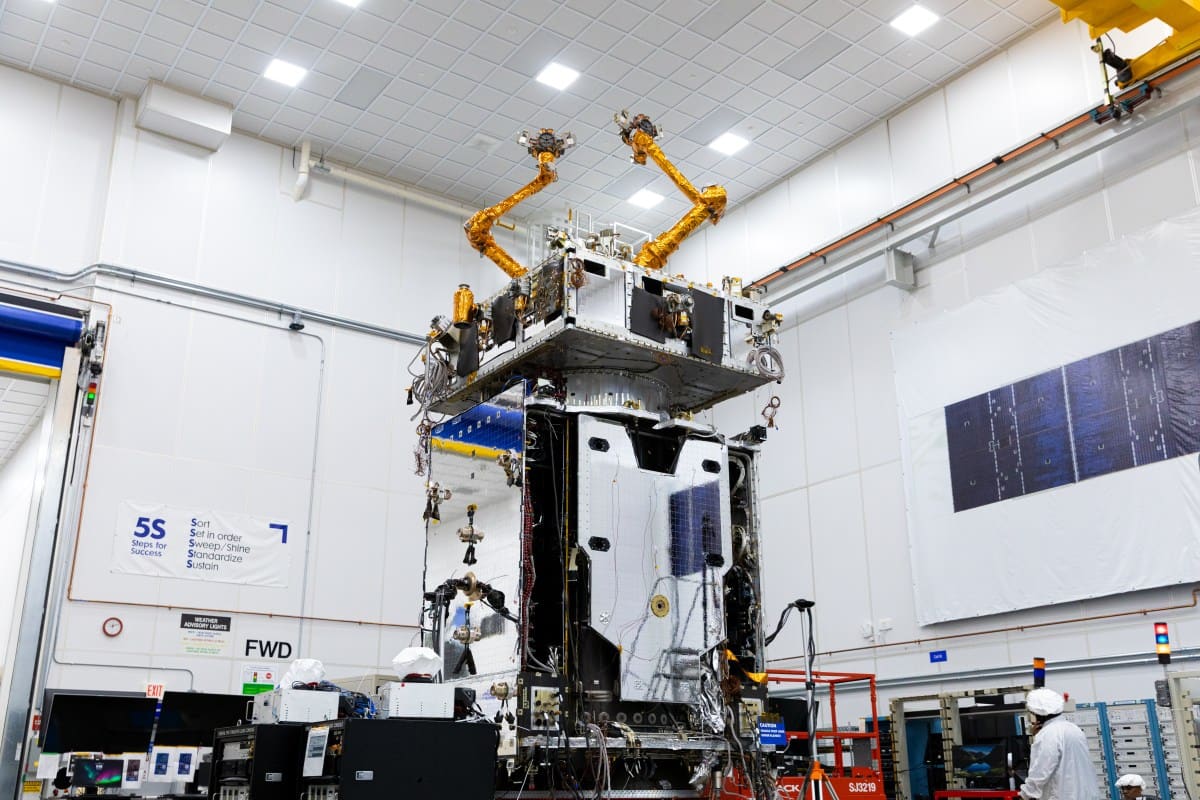
This week, a spacecraft that has spent more than a year attached to an Australian communications satellite disconnected and departed, making way for a fundamentally different kind of replacement. The outgoing vehicle, one of Northrop Grumman's Mission Extension Vehicles, had been maintaining the orbital position of an Optus satellite since 2023. Its successor will arrive sometime in 2027, carried and installed by a robotic spacecraft equipped with dual manipulator arms.
The transition represents more than a simple crew change. It signals a shift in how the satellite servicing industry plans to make money: moving from dedicated tugboats that remain attached to their clients toward reusable service platforms that install modular hardware and move on to the next job.
Four spacecraft launched in July aboard a Falcon 9 are now climbing toward geostationary orbit. One is the Mission Robotic Vehicle, developed in partnership with DARPA and outfitted with advanced robotic arms. The other three are Mission Extension Pods, compact propulsion units designed to be permanently grafted onto aging satellites. Once the MRV attaches a pod to the Optus satellite, that spacecraft, originally built for a fifteen-year mission starting in 2009, could continue generating revenue into the early 2030s.
Why Satellites Die Before Their Electronics Do
Most communications satellites and Earth-observation platforms in high orbits fail not because their transponders or sensors stop working, but because they exhaust the propellant needed to counteract orbital drift. Without regular thruster burns, a geostationary satellite will wander out of its assigned slot, rendering it useless for its intended coverage area.
At DailyTechWire, we've tracked the economics of this problem across the region. A satellite that cost hundreds of millions of dollars to build and launch may have years of functional payload life remaining when it runs dry. That gap between hardware lifespan and fuel supply has created the business case for orbital servicing, a concept that remained theoretical until launch costs began falling in the late 2010s.
Northrop Grumman currently operates two first-generation Mission Extension Vehicles in orbit, launched in 2019 and 2020. According to the company, those two spacecraft have delivered a combined ten years of life extension across three client satellites, two operated by Intelsat and one by Optus. The vehicles use a docking probe that inserts into and grips the client satellite's thruster nozzle, remaining attached for the duration of the service contract.
The Pod Model and Its Economics
The Mission Extension Pod approach inverts that arrangement. Satellite operators purchase and own the pods outright, and the robotic vehicle performs the installation before departing to service additional customers. Cassie Wong, Northrop Grumman's director of logistics and servicing, described the shift as enabling "a more resilient architecture and infrastructure base where we can do things like spacecraft repairs, life extension, or even upgrades and maintenance."
The new model should lower the per-customer cost, since the expensive MRV, with its autonomous navigation systems and robotic arms, is freed from long-term attachment to a single satellite. The pods themselves are simpler, essentially a fuel tank, thruster assembly, and basic control electronics. For operators, the trade-off is upfront capital expenditure in exchange for permanent propulsion capability rather than leased service time.
The technology demands are significant. Rendezvous and docking at geostationary altitude require centimeter-level precision between two objects traveling at thousands of miles per hour relative to Earth's surface. The first-generation MEVs demonstrated the feasibility of autonomous docking using a mechanical probe. The MRV takes that further, using robotic arms to manipulate and attach hardware, a capability that opens the door to more complex servicing tasks like component swaps or inspection.
Northrop Grumman designed the MRV to be refuelable in orbit, a feature that doubles as a proof of concept. If in-orbit servicing becomes routine, future satellites will need standardized refueling interfaces and grapple fixtures. Right now, most spacecraft lack those features because the added mass and cost are difficult to justify when servicing infrastructure barely exists.
The Tension Between Disposable Constellations and High-Value Assets
The satellite industry is currently pulling in two directions. Low Earth orbit is dominated by constellations of small, inexpensive, and effectively disposable spacecraft. Operators like Starlink and Amazon's Project Kuiper plan to launch thousands of units and replace them on short cycles, making in-orbit servicing economically irrelevant for those systems.
Geostationary orbit, by contrast, remains the domain of large, expensive, single-purpose platforms. A commercial communications satellite in GEO can cost upward of 300 million dollars when launch and insurance are included. For those assets, adding six or eight years of operational life through a propulsion pod costing a fraction of a replacement satellite makes clear financial sense.
The U.S. Department of Defense operates numerous high-value satellites in geostationary and other high orbits, and DARPA's involvement in developing the MRV's robotic arms suggests military customers are a likely growth area. Defense satellites often carry classified payloads with long development cycles, making life extension particularly attractive compared to designing, building, and launching a replacement.
That dual-use potential has not gone unnoticed. The U.S. Space Force has previously characterized a Chinese satellite with robotic arms as a potential anti-satellite weapon, arguing that a spacecraft capable of grappling and maneuvering another vehicle could be used to disable or degrade it. Northrop Grumman has emphasized that its vehicles are intended exclusively for servicing missions, though the underlying technology is inherently dual-use.
Expanding the Scope of Orbital Services
Wong indicated that future missions could extend beyond propulsion. The MRV's robotic arms are theoretically capable of installing new antennas, swapping out malfunctioning components, or adjusting solar array orientation. Whether those services find a market depends partly on whether satellite manufacturers begin designing spacecraft with modular, serviceable architectures.
The company also sees potential applications in low Earth orbit, where valuable science missions or specialized platforms might justify servicing. A startup called Katalyst Space attempted a similar mission in recent weeks, aiming to stabilize a tumbling NASA space telescope after an onboard malfunction. The mission encountered difficulties, but the company reported progress toward a fix.
If the Optus mission succeeds in 2027, it will validate both the robotic attachment process and the economic model. The first-generation MEVs proved that orbital servicing could work technically. The MRV and MEP system will test whether it can scale commercially, with a reusable service platform and customer-owned hardware reducing the cost per mission.
What Comes After the Proof of Concept
The satellite servicing industry is still in its demonstration phase. A handful of missions have shown that rendezvous, docking, and life extension are feasible. The next phase will determine whether operators are willing to design future satellites with servicing in mind, adding the mass and cost of standardized interfaces in anticipation of a mature servicing market.
For Northrop Grumman, the immediate challenge is operational: successfully attach three MEPs to client satellites using the MRV's robotic arms, prove the pods function as designed, and return the MRV to service another customer. If those milestones are met, the company will have demonstrated a repeatable, scalable model.
The broader question is whether the industry will embrace a paradigm where satellites are maintained, upgraded, and refueled over multi-decade lifespans, or whether the economics of mass-produced, short-lived constellations will dominate even in higher orbits. The answer will depend on launch costs, satellite design trends, and whether the capital markets reward long-term asset optimization or rapid replacement cycles.
For now, an aging Australian communications satellite will serve as the test case, waiting in geostationary orbit for a robotic visitor carrying a propulsion module that could keep it working into the next decade.