Anthropic Embeds Claude Cowork Into Chrome Extension
The company's consumer-focused AI agent now syncs history, skills, and connectors across desktop and browser workflows.
A Tighter Integration for Browser Work
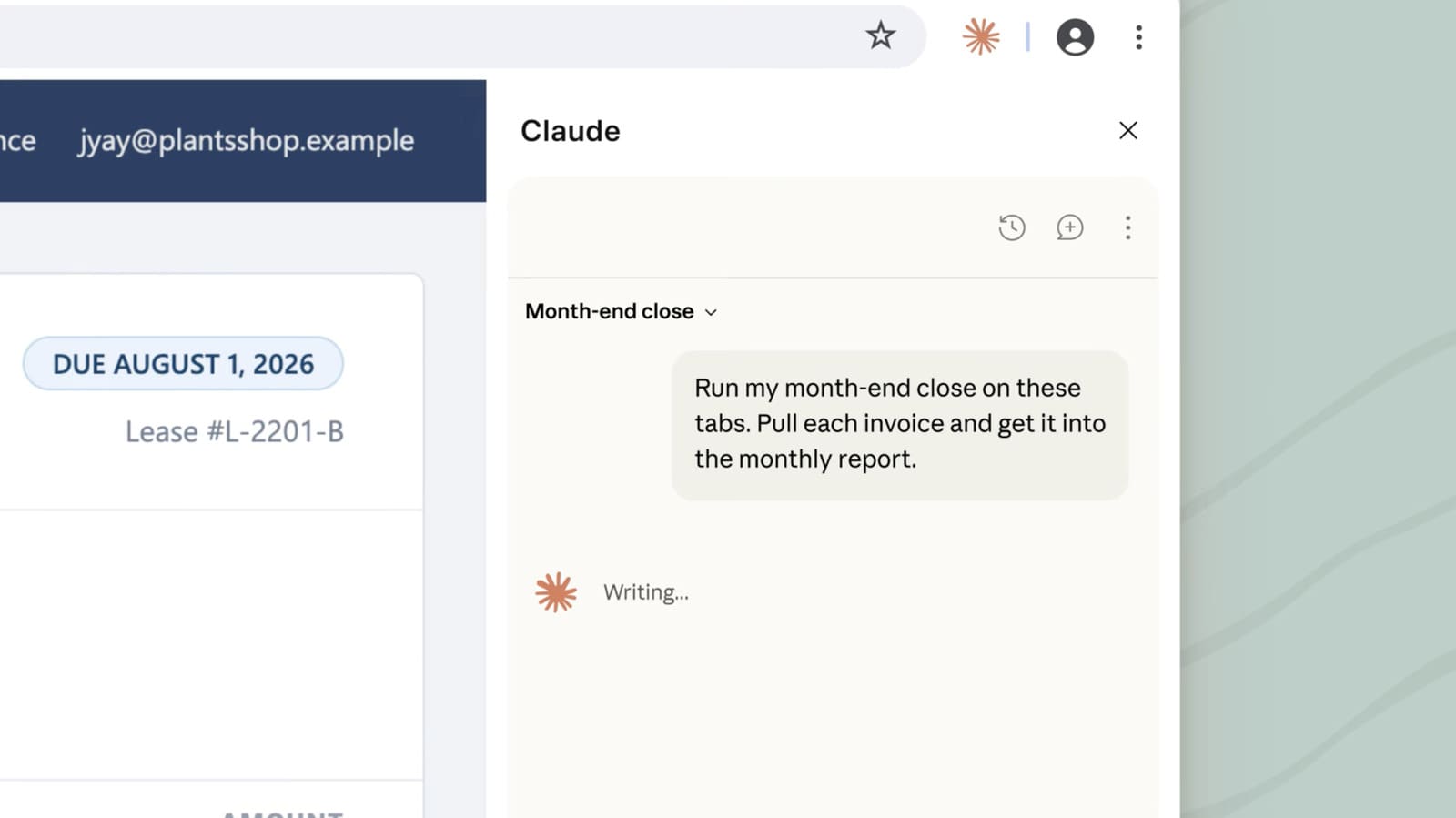
Anthropic now bundles Claude Cowork inside its Chrome extension, a move that erases the friction between separate browser and desktop workflows. Users who pay for Max or Team subscriptions can begin a task in the main Claude app, switch to Chrome's side panel, and pick up exactly where they left off. The extension preserves conversation history, applies custom skills, and activates connectors without requiring fresh logins or context switches.
Pro-tier subscribers will see the feature arrive over the next few weeks. The timing suggests Anthropic is staging the rollout to monitor infrastructure load as more users route agent tasks through the browser.
Why Chrome Matters for AI Agents
Chrome commands roughly 65 percent of the global browser market, making it the default environment where knowledge workers toggle between Slack threads, spreadsheets, internal dashboards, and documentation wikis. By embedding Cowork into the side panel, Anthropic sidesteps the need to negotiate individual integrations with every SaaS tool a user touches. The agent can observe the active tab, read context from open pages, and execute instructions that span multiple browser-based services, even those that have not signed formal API partnerships with Anthropic.
This approach mirrors the strategy Microsoft pursued with Copilot in Edge, though Anthropic's implementation leans on a modular connector architecture rather than deep OS hooks. The trade-off is portability: users on Windows, macOS, or Linux can install the same extension and expect consistent behavior, whereas Edge-native Copilot remains tightly coupled to Windows 11 workflows.
Cowork Versus Code: Two Lanes for Two Audiences
Claude Code, the professional-grade variant optimized for software engineering tasks, has lived inside the Chrome plugin since late 2025. It handles repository cloning, dependency installation, multi-file refactoring, and terminal command execution. Cowork, by contrast, strips out the low-level system access and focuses on general productivity: drafting emails, summarizing research tabs, filling web forms, and coordinating calendar invites.
The distinction reflects Anthropic's segmentation strategy. Code users typically work in VS Code or JetBrains IDEs and treat the browser as a secondary surface for documentation lookups or pull request reviews. Cowork users live primarily in Chrome, where their job is less about compiling code and more about orchestrating information across fragmented web apps.
Anthropic introduced smartphone control for Cowork in recent months, signaling a push to meet users wherever they initiate a task. The Chrome extension completes that loop: start a briefing on mobile during a commute, refine it in the desktop app at the office, then finalize it in a shared Google Doc via the browser side panel.
The Connector Gambit
Anthropic has signed integration deals with Notion, Slack, Google Workspace, Zoom, and a handful of vertical SaaS providers. But the long tail of enterprise software remains fragmented. Marketing teams use Asana, Airtable, or Monday; sales teams rely on Salesforce, HubSpot, or Pipedrive; finance teams operate in NetSuite, QuickBooks, or Xero. Building and maintaining native connectors for hundreds of niche tools would require an engineering army.
The Chrome extension offers a pragmatic workaround. If a tool exposes a web interface, Cowork can interact with it by reading DOM elements, clicking buttons, and filling input fields. This browser-automation layer is less elegant than a REST API integration but far more scalable. It also creates a new class of risk: web apps redesign their UIs frequently, and a layout change can break an agent's ability to locate the submit button or parse a table correctly.
Anthropic has not disclosed how it handles these brittleness issues. Competitors like Adept and Lindy have invested in self-healing workflows that use vision models to re-anchor UI elements after a redesign, and it is likely Anthropic employs a similar technique under the hood.
Timing and Competitive Context
The Chrome extension launched to all Anthropic users in late 2025, but Cowork's inclusion is new. The gap suggests the company spent the intervening months stress-testing the agent's behavior inside a browser sandbox, where it must coexist with ad blockers, password managers, and corporate security policies that restrict script execution.
OpenAI's ChatGPT does not yet offer a comparable Chrome side-panel experience; users must navigate to chat.openai.com or install third-party wrappers. Google has previewed Gemini integration across Chrome, but those features remain gated behind Workspace Enterprise tiers and focus primarily on summarization rather than task execution.
Anthropic's positioning hinges on execution reliability. Cowork must demonstrate that it can complete multi-step browser tasks without manual correction. If users find themselves constantly repairing agent mistakes, the convenience of a side panel evaporates, and they revert to manual workflows. Early adopter feedback over the next quarter will determine whether this integration becomes a retention driver or a support burden.
What This Signals About Anthropic's Product Map
Embedding Cowork into Chrome reflects a broader bet that the next phase of AI adoption will be won not by standalone chat interfaces but by ambient agents that live inside the tools users already open dozens of times per day. The browser is the most universal of those surfaces, cutting across operating systems, corporate IT policies, and device form factors.
Anthropic is also testing how far it can stretch a single model, Claude 3.5 Sonnet, across divergent use cases. Code and Cowork share the same underlying reasoning engine but differ in prompt scaffolding, safety guardrails, and access permissions. This architecture lets the company amortize training costs while offering differentiated products, a strategy that matters as compute budgets tighten and investors scrutinize unit economics.
The rollout cadence, Max and Team first, Pro later, suggests Anthropic is prioritizing enterprise customers who pay higher per-seat fees and are more likely to deploy Cowork across entire teams. Consumer Pro subscribers, who pay monthly for personal use, represent a lower-margin segment and receive features after the platform has stabilized under heavier workloads.
Open Questions
Several design choices remain opaque. Does Cowork run inference locally in the browser using WebGPU, or does every interaction round-trip to Anthropic's servers? The former would reduce latency and improve privacy; the latter would give Anthropic more control over model behavior and safety filtering. Neither Anthropic's documentation nor its privacy policy clarifies the execution environment.
Another unknown: how Cowork handles credentials. If a user asks the agent to update a Jira ticket or post a Slack message, the extension must authenticate on their behalf. Anthropic could store OAuth tokens server-side, embed them in the extension's local storage, or prompt the user to re-authenticate each session. Each approach carries trade-offs between convenience and security, and enterprises evaluating the tool will demand clarity before rolling it out to employees with access to sensitive systems.
Finally, pricing remains a lever Anthropic has yet to pull. Max and Team subscriptions currently cost $20 and $30 per user per month, respectively. If Cowork adoption accelerates and drives significant inference volume, the company may introduce usage tiers or throttle the number of browser tasks included in base plans. That would align with the broader industry trend toward metered AI services but could alienate users who expect flat-rate pricing.