iOS 27's Quiet Upgrades Target Everyday Friction Points
Apple's latest mobile OS brings receipt scanning to Wallet, flexible location controls to Find My, and a wave of improvements to Maps and Music that hint at a platform strategy beyond AI headlines.
Beyond the AI Spectacle
The headlines from this year's Worldwide Developers Conference centered on artificial intelligence and a revamped Siri. Yet buried beneath that noise sits a collection of product decisions in iOS 27 that reveal where Apple sees friction in daily mobile life - and where it intends to compete more directly with established third-party services. From splitting dinner bills by scanning a receipt to pausing location sharing for a few hours, the operating system update arriving this fall addresses mundane pain points that collectively matter more to most users than any chatbot upgrade.
At DailyTechWire, we've tracked Apple's incremental encroachment into categories once dominated by specialists: payments, maps, fitness tracking, even podcast discovery. iOS 27 accelerates that pattern. The question is whether these features are polished enough to displace habits users have already formed around Venmo, Google Maps, and Spotify.
Wallet Becomes a Receipt Parser
Apple Wallet is adding a feature that lets users photograph a paper receipt and automatically parse line items, then split the bill among friends through Apple Cash, according to Apple. The system uses on-device intelligence to identify individual dishes or purchases, apportion tax and tip, and send payment requests via Messages or directly within Wallet.
The capability targets a narrow but persistent frustration: the post-meal negotiation over who owes what. Apps such as Splitwise and Venmo have built user bases around this exact problem, but both require manual entry or at best optical character recognition that still demands verification. Apple's implementation folds the workflow into an app users already carry payment credentials in, lowering the activation energy.
Wallet is also gaining support for digitizing physical membership and loyalty cards by scanning barcodes with the iPhone camera. The feature extends to Apple Watch, where cards can be pinned to the Smart Stack for quicker access at checkout. For Apple, every card migrated into Wallet is another reason to open the app - and another data point about purchase behavior, even if that data stays on-device.
Travelers staying at participating hotels will see trip details, activity schedules, service information, and real-time updates inside Wallet when they store a digital room key, according to Apple. The move positions Wallet as a travel hub, not merely a payment vessel, and puts pressure on hotel chains to integrate or risk looking dated.
Payment Flow Gets a Redesign
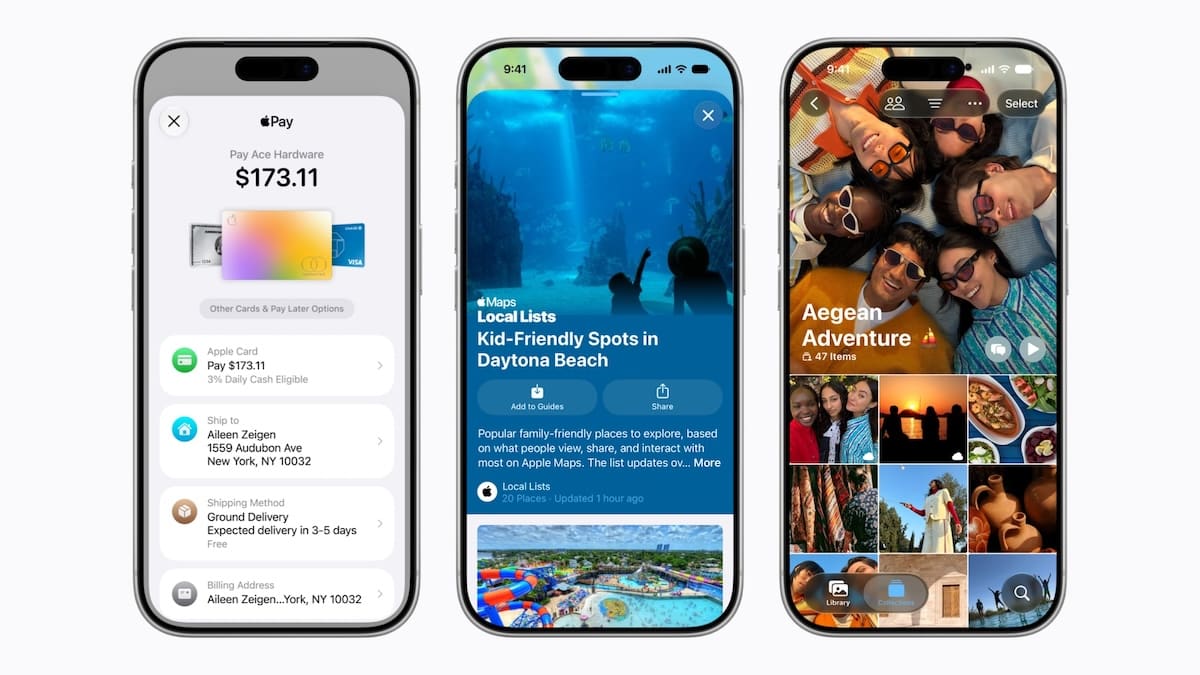
Apple Pay's checkout experience on the web and in apps is being overhauled. Users will be able to swipe between stored payment cards while viewing rewards balances, debit account balances, and pay-later options in a single interface. Later in the year, Apple plans to let users add funds directly to eligible debit cards during checkout or from within Wallet.
The changes address a common drop-off point in mobile commerce: confusion over which card to use and whether a rewards program or installment plan applies. By surfacing that context at the moment of decision, Apple reduces cognitive load and, in theory, increases conversion rates for merchants who support Apple Pay.
For in-person transactions, Apple is expanding Tap to Pay on iPhone with a feature called Tap to Share. Customers can tap their device against a merchant's iPhone to securely transmit loyalty account details, shipping addresses, and contact information. The feature sidesteps the need to type or scan a barcode, streamlining checkout in physical retail. It also keeps transaction metadata within Apple's ecosystem rather than funneling it through a third-party point-of-sale system.
Maps Chases Social Discovery
Apple Maps is receiving two notable additions. Flyover, the feature that renders immersive three-dimensional views of cities and landmarks, has been refreshed with higher-detail visuals and smoother navigation, according to Apple. More significant is the introduction of Local Lists, a discovery tool that surfaces trending restaurants, attractions, and other points of interest.
Local Lists is a direct play for the behavior that has migrated to Instagram, TikTok, and even Google Maps user reviews. Younger users in particular treat social platforms as search engines for dining and nightlife recommendations. Apple's implementation appears designed to pull that activity back into Maps by curating what's popular without requiring users to leave the app or cross-reference multiple sources.
The success of Local Lists will hinge on data freshness and editorial curation. Google has spent years building review density and real-time crowdsourced information; Apple is arriving late but with the advantage of deep integration across iPhone, Watch, and CarPlay. If the recommendations prove reliable, the feature could reduce reliance on third-party discovery apps. If they feel stale or algorithmically generic, users will ignore them.
Find My Adds Granular Sharing Controls
Find My is gaining the ability to share location for a custom duration - minutes, hours, days, or until a specific date and time - according to Apple. Users can also temporarily pause location sharing with individual contacts until the end of the day.
The changes acknowledge that location sharing is context-dependent. Coordinating a meetup requires real-time visibility for an hour; a family road trip might warrant sharing for several days; planning a surprise event demands the ability to pause sharing without triggering suspicion by turning it off permanently. Existing tools, including Apple's own, have treated location as binary: always on or always off. Granular control better matches how people actually use the feature.
The addition also reflects broader privacy expectations. Users increasingly want to grant access in limited slices rather than blanket permissions. iOS 27's implementation gives them that lever without requiring them to remember to manually revoke access later, reducing privacy fatigue.
Music and Podcasts Expand Language and Format Support
Apple Music is extending Lyrics Translation to seven additional language pairings, including English translations for French, German, Italian, Korean, Spanish, and Japanese songs, according to Apple. Lyrics Pronunciation, which displays phonetically translated lyrics to help users sing along in unfamiliar languages, is expanding across five new pairings.
The features cater to a global user base where cross-language listening is common, particularly in markets such as South Korea, Japan, and parts of Europe where English-language pop coexists with robust local music industries. Spotify has invested heavily in localized playlists and podcast content; Apple is countering with tooling that makes foreign-language tracks more accessible without requiring users to switch services.
AutoMix, which creates smoother transitions between songs, is being enhanced and extended beyond iPhone to Apple TV and HomePod. Apple Music subscribers will also gain access to high-resolution lossless audio on Apple TV 4K, enabling studio-quality playback for users with compatible sound systems.
In Podcasts, Apple is adding search within individual shows, allowing users to query episodes of a specific podcast across iPhone, iPad, Mac, Apple Vision Pro, and the web. Video podcasts are coming to Mac and Apple TV, reflecting the format's growing popularity. Platforms such as Spotify and YouTube have leaned into video-first podcasting; Apple's move ensures feature parity and keeps creators from abandoning its ecosystem.
iCloud Shared Albums Become More Collaborative
iCloud Shared Albums is gaining full-resolution photo sharing, support for additional file types, emoji reactions, improved activity feeds, and per-album activity views, according to Apple. Temporary albums are being introduced for short-term projects and events, designed to facilitate group collaboration without consuming iCloud storage indefinitely.
Notably, people without Apple devices will be able to contribute photos through the web. This is a meaningful concession. Apple's ecosystem lock-in has historically excluded non-Apple users from collaborative features, creating friction in mixed-device social groups. Opening Shared Albums to the web reduces that barrier and makes the feature more competitive with Google Photos, which has long supported cross-platform sharing.
Fitness Plus Targets a Demographic Shift
Fitness Plus is launching Strong Through Menopause, a three-week program combining guided yoga and strength workouts aimed at people navigating perimenopause and menopause, according to Apple. The program focuses on building strength, improving mobility and balance, and managing stress. A new Time to Walk episode features actor Busy Philipps discussing her experiences with perimenopause.
The programming reflects demographic and market realities. Women over forty represent a significant and underserved segment in digital fitness, and menopause-related content has gained traction across wellness platforms and social media. By addressing the topic explicitly, Apple signals that Fitness Plus is not solely targeting younger, high-intensity workout enthusiasts. It's a bid for sustained subscription revenue from an aging user base.
What the Quiet Features Reveal
Taken individually, none of these updates are transformative. Collectively, they illustrate a platform strategy: identify points where users leave the Apple ecosystem for a specialized app, then build a native alternative that's good enough and deeply integrated. Receipt splitting competes with Venmo. Local Lists competes with Instagram and Google. Full-resolution web sharing in Photos competes with Google Photos. Video podcasts compete with Spotify and YouTube.
The approach has limits. Apple rarely out-features a category leader on the first try. But it doesn't need to. It only needs to make the native option convenient enough that users stop bothering to install the third-party app. Over time, that convenience compounds, especially for users who already own multiple Apple devices and benefit from cross-device sync.
iOS 27 is available now for developers through the Apple Developer Program, with a public beta expected next month and general release in the fall. The true test will come not in reviews but in behavioral data: whether users actually scan receipts in Wallet, whether Local Lists get tapped, whether location sharing controls get used. Features that solve real friction will stick. Features that solve hypothetical friction will be ignored, no matter how polished the interface.
For competitors, the message is clear. Apple is not retreating to AI moonshots. It's still grinding away at the everyday edges of mobile life, one feature at a time.