SanDisk Prices 8TB PlayStation SSD at Nearly Three Grand
The Optimus GX Pro 850P tops out at $2,960, more than triple a PS5 Pro's sticker - a stark reminder of how memory shortages are reshaping console economics.
The Price Shock
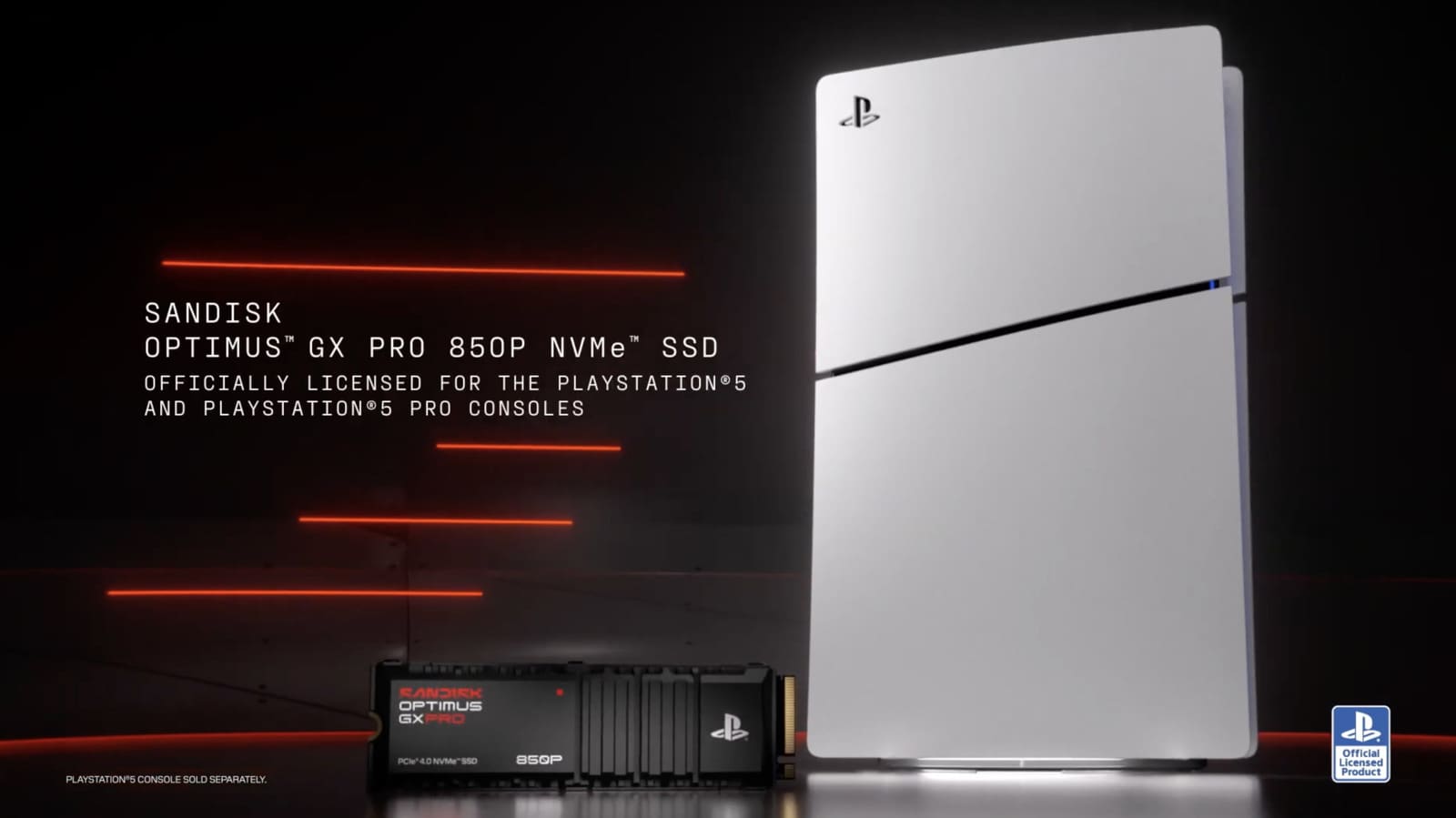
SanDisk launched its Optimus GX Pro 850P NVMe SSD this week with four capacity tiers, and the top-end 8TB model carries a retail price of $2,960 - marked down, according to SanDisk, from a list price of $3,700. That figure places the drive at more than three times the current US retail of Sony's PlayStation 5 Pro, which ships with 2TB of internal storage. Even the 2TB variant of the new SanDisk drive, priced at $760, exceeds the cost of a standard PlayStation 5 with disc drive by over a hundred dollars.
The pricing reveals how far storage economics have shifted in the past year. At DailyTechWire, we've tracked memory markets across Asia-Pacific for two decades, and the velocity of this repricing cycle stands out. The WD_Black SN850X - the predecessor drive that the Optimus GX Pro 850P appears to replace - sold for under $600 in its 8TB configuration as recently as last year. The new model shares near-identical specifications: PCIe 4.0 interface, read speeds of 7,300 MB/s, write speeds of 6,300 MB/s, and an integrated heatsink optimized for PlayStation 5 thermal envelopes.
Rebranding Amid Shortage
SanDisk repositioned its gaming storage portfolio in recent months, retiring the WD_Black naming convention in favor of the Optimus GX branding. The 850P is among the first officially licensed PlayStation expansion drives under the new identity, available in 1TB, 2TB, 4TB, and 8TB capacities. The drive slots into the PlayStation 5's M.2 expansion bay, which Sony opened to third-party NVMe modules in 2021, and meets Sony's minimum sequential read requirement of 5,500 MB/s.
The resemblance to the SN850X is more than superficial. Controller architecture, NAND configuration, and thermal design all suggest the 850P is a rebadged iteration rather than a ground-up redesign. That continuity makes the price delta especially stark: a five-fold increase year-on-year for what is functionally the same silicon and firmware stack. The shift underscores how branding and market conditions - not bill-of-materials cost - now govern retail pricing in the memory segment.
Memory Crisis Mechanics
Global NAND flash supply tightened sharply over the past eighteen months, driven by three converging pressures. First, leading fabs in South Korea and Taiwan curtailed expansion plans in 2024 amid softening smartphone demand, leaving the industry with less buffer capacity when AI infrastructure orders surged in 2025. Second, hyperscale data-center operators began stockpiling high-density modules to support training clusters and inference workloads, pulling supply away from consumer channels. Third, yield issues at several 200-layer and 232-layer NAND production lines - particularly at facilities in Xi'an and Yokkaichi - reduced output just as demand rebounded.
The result is a market where spot prices for 1TB modules have more than doubled since early 2025, and contract pricing for OEMs has climbed nearly as fast. Consumer SSD makers face a choice: absorb margin compression or pass costs downstream. SanDisk and its parent Western Digital have opted for the latter, repricing the entire Optimus GX lineup to reflect current wafer costs and allocation scarcity. The $2,960 sticker on the 8TB model is less a reflection of manufacturing expense - NAND cost per gigabyte remains below ten cents at the die level - and more a function of scarcity rent and channel markup in a constrained environment.
Console Storage in Context
Sony's PlayStation 5 Pro, priced at $699 in the United States, includes 2TB of internal storage - a doubling from the original PlayStation 5's 825GB. That capacity is enough for roughly fifteen to twenty AAA titles, depending on installation footprint. Games such as Call of Duty, Final Fantasy, and Baldur's Gate III routinely exceed 100GB installed, and the shift toward higher-fidelity assets and uncompressed audio has kept file sizes climbing. For players maintaining libraries of thirty or more titles, expansion becomes necessary.
Sony's decision to support M.2 expansion rather than proprietary modules - a contrast to Microsoft's approach with Xbox Series X|S - opened the door to competitive pricing in 2022 and 2023. Drives from Crucial, Samsung, and Western Digital routinely sold below $100 per terabyte, making 2TB expansions accessible for under $200. That window has closed. The current pricing environment puts even modest 2TB upgrades above $700, and the 4TB tier - previously a sweet spot for enthusiasts - now approaches $1,500.
Ecosystem Ripple
The SanDisk pricing arrives in the context of broader hardware inflation across gaming platforms. Sony raised PlayStation 5 and PlayStation 5 Pro prices by approximately 10 percent earlier this year, citing component costs and foreign-exchange headwinds. Microsoft adjusted Xbox Series X and Series S pricing twice in 2025, each time by $50 increments. Nintendo held the line longer, but announced last month that the Switch 2 will retail at $500 in the United States starting in September, a $50 increase from its original launch price. Valve repriced its Steam Deck OLED lineup in May, with the 1TB model climbing by $300.
These moves reflect a recalibration of console economics. For two decades, platform holders subsidized hardware to drive software attach rates, banking on recurring revenue from game sales and subscription services. That model assumed stable or declining component costs over a console generation. The current cycle has inverted that assumption: memory, storage, and advanced packaging costs are rising, not falling, and the AI boom has introduced a new competitor for fab capacity. Console makers are left with fewer options to absorb cost increases, and storage - once a low-margin accessory - has become a high-ticket line item.
What the Market Will Bear
The $2,960 price on an 8TB SSD invites the question of elasticity. How many PlayStation 5 owners will pay nearly three times the cost of the console itself for additional storage? The answer likely segments by use case. Casual players with a handful of installed titles have little reason to expand. Enthusiasts managing large libraries, particularly those who stream or create content, may view high-capacity expansion as a necessary investment, even at inflated prices. The secondary market for used drives and previous-generation modules offers an alternative, though supply there is limited and prices have climbed in parallel with new hardware.
SanDisk's pricing also signals confidence that the memory shortage will persist through at least the end of 2026. List prices above $3,000 and promotional pricing near $3,000 suggest the company expects limited near-term relief in NAND supply. Industry forecasts from Seoul and Taipei point to new fab capacity coming online in late 2027, but that timeline offers little comfort for consumers shopping today. In the interim, storage pricing will remain a function of allocation and willingness to pay, not underlying cost structure.
Regional Variance and Availability
Pricing for the Optimus GX Pro 850P varies by region, though the gap between US and Asia-Pacific markets has narrowed compared to previous product cycles. In Japan, the 8TB model retails at approximately ¥440,000, roughly in line with dollar parity after tax adjustments. South Korean pricing sits near ₩4,200,000, reflecting similar dynamics. Availability in Southeast Asia remains constrained, with major retailers in Singapore and Jakarta listing the drive as pre-order only. That distribution pattern mirrors the broader memory shortage: high-margin markets receive priority allocation, while secondary markets face longer lead times and limited inventory.
The official PlayStation licensing that SanDisk secured for the Optimus GX Pro 850P adds a margin premium but also guarantees compatibility and thermal performance within Sony's specifications. Unlicensed M.2 drives remain an option for cost-conscious buyers, though Sony's firmware updates have occasionally flagged non-certified modules, and thermal throttling can degrade performance in drives without adequate heatsink design.
Forward Outlook
The trajectory of storage pricing over the next twelve months will hinge on three factors: NAND supply expansion, AI infrastructure demand, and macroeconomic conditions in key markets. If hyperscale operators slow their purchasing pace - either due to data-center build-out delays or shifts in training workloads toward inference - consumer channels may see supply return. Conversely, if AI demand remains elevated and new gaming platforms continue to prioritize high-capacity storage, prices could stay inflated or climb further.
For now, SanDisk's $2,960 drive stands as a benchmark for how far storage costs have moved in a constrained environment. Whether that price represents a peak or a new baseline will depend on forces well outside the gaming industry - forces that originate in semiconductor fabs across East Asia and in the data centers reshaping global compute infrastructure. Console players, for their part, face a choice: pay the premium, manage their libraries more carefully, or wait for a market correction that may not arrive anytime soon.