Insta360 X6 Brings Pro-Grade Color to the Spherical Camera Market
The $700 flagship adds 10-bit i-Log and Dolby Vision to a redesigned body, but onboard storage and AI editing still leave room for refinement.
A Shift Toward Professional Filmmaking
The dual-lens spherical camera category has quietly matured beyond its virtual reality origins. Where these devices once served a niche audience interested in immersive content, they now compete directly with action cameras and gimbals for the attention of content creators who value stabilization and flexible framing. Insta360's newest flagship demonstrates this evolution clearly: the X6 arrives with a larger sensor, professional color grading options, and a redesigned chassis that signals the company's intent to serve filmmakers who need more than point-and-shoot convenience.
At $700, the X6 positions itself at the premium end of a market that includes DJI's Osmo 360 at roughly $400 and GoPro's Max 2 at around $300. The price gap reflects Insta360's bet that creators will pay more for features like Dolby Vision support, 10-bit i-Log recording, and a more sophisticated editing ecosystem. Whether that bet pays off depends largely on how much control users want over their final output and whether they're willing to invest time in color grading workflows.
Hardware Refinements and Sensor Upgrades
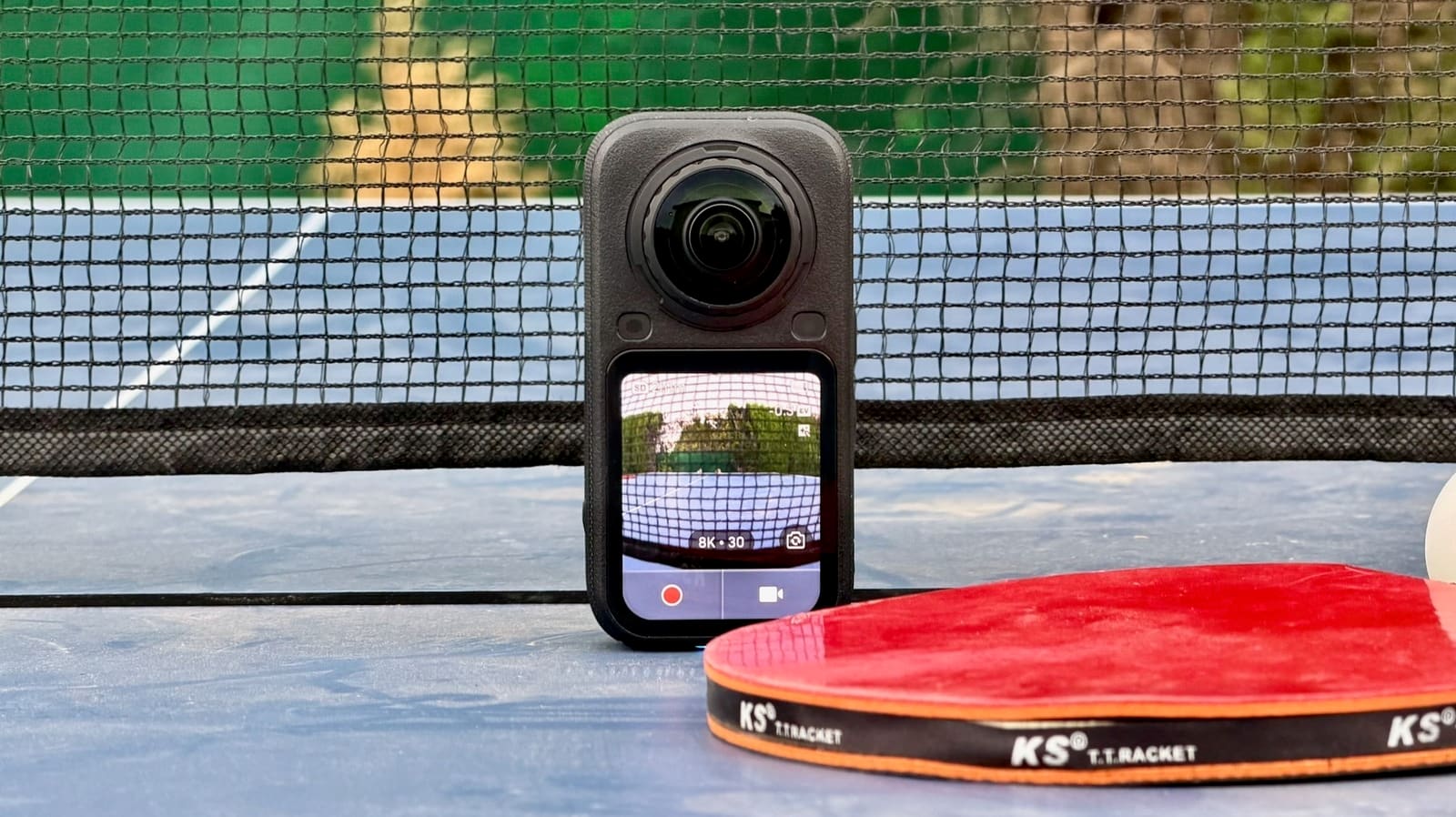
Insta360 has moved away from the tall, narrow form factor that characterized earlier X-series models. The X6 adopts a shorter, wider profile that makes it easier to pack alongside other equipment and less conspicuous during recording sessions in public spaces. The redesign accommodates a 2.32-inch OLED display that offers improved visibility for framing shots and navigating settings, along with on-screen controls for recording and mode selection that supplement the physical buttons on the device's edges.
The core upgrade centers on the sensor. Insta360 equipped the X6 with a 1/1.1-inch imaging chip, which the company describes as 1-inch equivalent. This represents a meaningful step up in light-gathering capability and allows the camera to capture 8K video at 50 frames per second in 360-degree mode, 120-megapixel spherical stills, and flat video at up to 4K/120fps. For users interested in post-production color work, the X6 introduces 10-bit i-Log recording, a first for Insta360's consumer spherical cameras.
The device also includes 47GB of onboard storage, a feature that addresses the inconvenience of forgotten memory cards but falls short of the roughly 100GB DJI offers in its competing model. The built-in capacity provides a useful backup option, though users shooting extended sessions will still need to rely primarily on removable SD cards.
Image Quality and Persistent Challenges
In practical testing, the X6 delivers noticeably improved image fidelity compared to its predecessor. Colors appear more accurate, edge sharpness improves, and the overall detail level rises, particularly when working with the 10-bit color profiles and applying light grading in post-production. The Dolby Vision capability provides an additional pathway for creators working within HDR-compatible delivery pipelines.
However, the fundamental constraints of spherical imaging persist. The warping effect inherent to ultra-wide field-of-view modes remains visible, though Insta360's Dewarp and Linear export options mitigate the distortion to varying degrees. More problematic are the occasional stitch lines that appear where the two lenses overlap. While the X6 handles stitching better than many earlier models, the seam still becomes apparent when subjects position themselves directly at the junction point between the two lenses.
When compared against dedicated action cameras or gimbal-stabilized devices, the X6 shows its compromises. A direct comparison with GoPro's Mission 1 Pro or DJI's Osmo Pocket 4P reveals that traditional single-lens cameras produce richer, more cinematic imagery. That gap is expected given the different optical architectures, but it's worth acknowledging for creators weighing whether the framing flexibility of a 360-degree camera justifies the trade-offs in absolute image quality.
The dual-lens design also introduces mechanical vulnerability. While the X6 shares the ruggedness and stabilization benefits of action cameras, it doubles the risk of lens damage during drops or impacts. Users planning to shoot in demanding environments should consider lens guards or protective accessories.
AI Editing Tools and Workflow Integration
Insta360 has invested heavily in automated editing features, branding its approach as a "Triple AI chip system" that processes footage and delivers edited clips without manual intervention. The X6 offers two modes: AI Director, which autonomously assembles a highlight reel from a day's worth of shooting, and Auto Edit 2.0, which allows users to pre-select clips for inclusion before the algorithm takes over.
The results are mixed. The system successfully identifies moments with visual interest or motion, but it frequently misjudges framing priorities. In one test, the AI focused on the camera operator holding the extension pole rather than a more dynamic action happening in the background. Music selection tends toward generic, and the pacing doesn't always match the energy of the footage.
That said, the automated edits function effectively as rough cuts. With a few minutes of adjustment in Insta360's mobile app, users can refine the AI's output into something worth sharing. For creators who might otherwise abandon footage due to the time investment required for editing, the feature provides a useful starting point.
Insta360's desktop Studio software remains the more reliable tool for serious editing. The application makes it straightforward to locate specific moments within spherical footage and export flat video with custom framing. The workflow integrates smoothly with third-party editing platforms like DaVinci Resolve or Premiere Pro, which matters for users who need precise control over their final cuts.
The X6's InstaFrame 2.0 mode offers a middle path. It records primarily in single-lens mode with subject tracking enabled, while simultaneously capturing a lower-resolution 360-degree backup. This approach dramatically accelerates the export process since framing decisions happen during capture, yet it preserves the option to revisit the spherical footage for alternate angles or B-roll. In extended use, this became the most practical mode for balancing convenience with creative flexibility.
Battery, Storage, and Ecosystem Considerations
The X6 ships with a 2,600mAh battery that Insta360 rates for approximately 140 minutes of 8K/30fps recording. Real-world testing confirmed that estimate when alternating between 8K and InstaFrame modes. Fast charging support allows users to recover roughly 45 minutes of recording time during short breaks, which helps during extended shooting days.
The 47GB of onboard storage provides useful redundancy but limits flexibility compared to the larger capacity DJI includes in its spherical cameras. For multi-day trips or high-volume shooting, the onboard space fills quickly, making removable SD cards the primary storage solution.
Insta360 continues to build out an accessory ecosystem designed for cross-compatibility. The X6 works directly with the company's Mic Pro wireless microphone system without requiring a separate receiver, and it supports the head-tracking mount at launch. These integrations matter for users already invested in the Insta360 platform, though they also create switching costs for creators considering alternatives from DJI or GoPro.
Competitive Positioning and Value Calculation
The X6 enters a market where price gaps have widened significantly. At $700, it costs nearly double what DJI charges for the Osmo 360 and more than twice GoPro's Max 2. The premium reflects genuine capability differences, particularly the 10-bit color options, Dolby Vision support, and more sophisticated editing tools. For creators who plan to grade their footage or deliver in HDR formats, those features justify the additional expense.
However, the DJI alternative offers substantially more onboard storage and a lower barrier to entry, while GoPro's offering provides basic 360-degree capability at a fraction of the cost. Users who don't need professional color profiles or extensive post-production control may find better value in the less expensive options.
The X6 makes the most sense for creators already committed to spherical shooting who need the incremental improvements in image quality and color flexibility. It also appeals to filmmakers transitioning from action cameras or gimbals who want stabilization and reframing options without abandoning the possibility of serious color work. For casual users or those just exploring 360-degree capture, the price premium is harder to justify given the strong alternatives available at lower price points.
Insta360 has built a camera that pushes the category toward professional use cases, but it arrives at a moment when competition has made budget-conscious options genuinely capable. The X6 succeeds at what it sets out to do, yet its success in the market will depend on whether enough creators value its advanced features over the savings available elsewhere.