Meta Brings Threads to Quest VR Headsets
The social platform's expansion into virtual reality follows its AR debut and signals Meta's push to unify its social apps across emerging hardware.
A Social Layer for Virtual Spaces
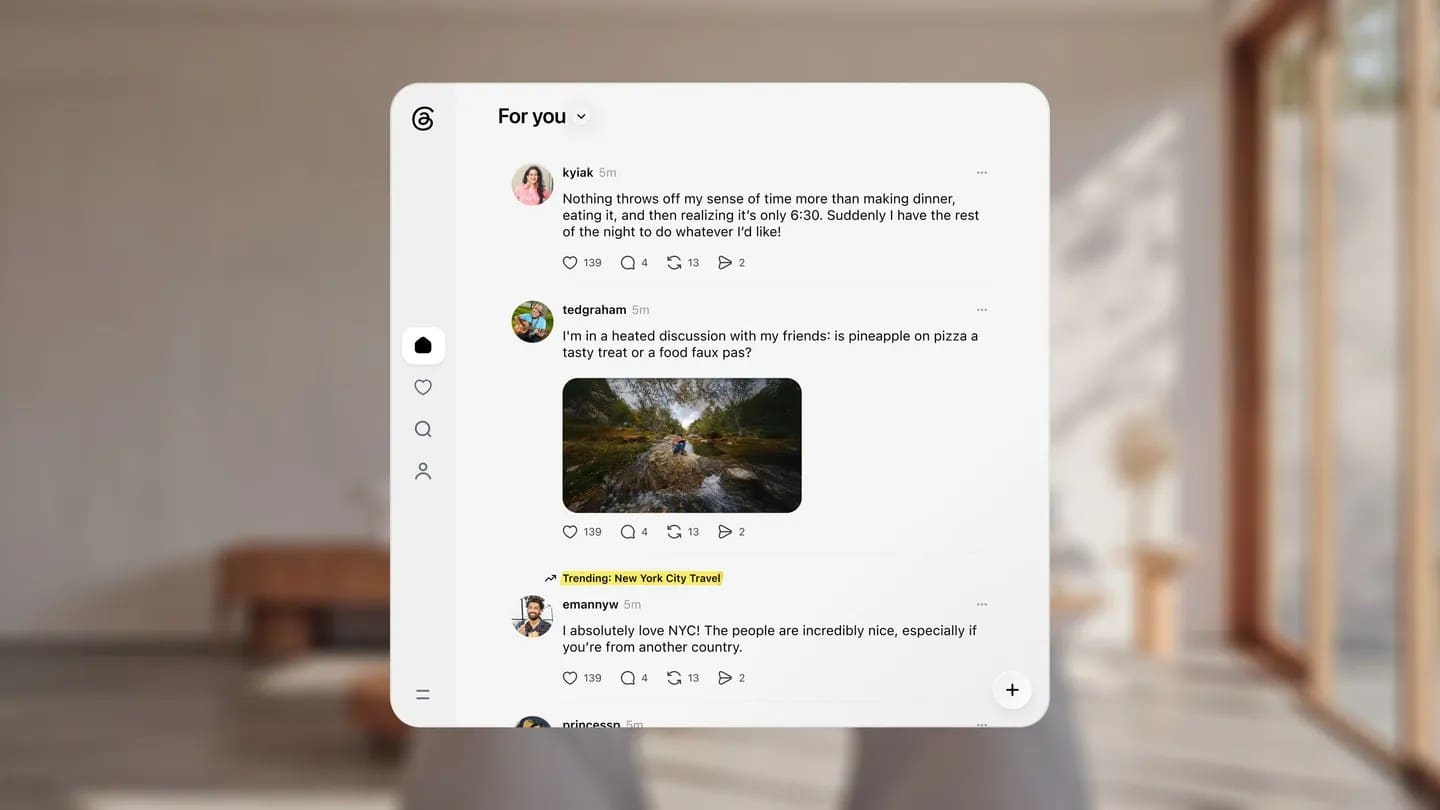
Meta introduced a dedicated Threads application for its Quest VR headsets this week, marking another step in the company's effort to weave its social platforms into wearable computing hardware. The move positions Threads as more than a text-based Twitter alternative; it's becoming infrastructure that spans phones, AR glasses, and now immersive headsets.
The Quest app arrives roughly a month after Meta deployed Threads on its Ray-Ban Display augmented reality glasses. That timing isn't coincidental. At DailyTechWire, we've tracked Meta's hardware roadmap closely, and the pattern is clear: the company is building a unified social layer that follows users across form factors, rather than treating each device category as a silo.
What the VR App Actually Does
According to Meta, the Quest version of Threads supports the platform's core functions. Users can scroll through their feeds, compose and publish posts, interact with content through likes and replies, navigate to profiles, conduct searches, and watch video content. In practical terms, this means someone wearing a Quest 3 or Quest Pro can check Threads during a VR gaming session or while using productivity apps, without removing the headset or reaching for a phone.
The feature set mirrors what's available on mobile, which suggests Meta prioritized functional parity over creating VR-specific interaction models. That's a pragmatic choice. The company needs Threads to feel consistent wherever it appears, especially as it competes with established platforms that have spent years refining their mobile experiences.
The 500-Million-User Context
Meta disclosed last month that Threads has surpassed 500 million monthly active users, a milestone that validates the platform's viability eighteen months after its July 2023 launch. That user base makes Threads one of the fastest-growing social apps in history, though it still trails X (formerly Twitter) and remains far behind Meta's flagship properties, Facebook and Instagram.
Bringing Threads to Quest makes strategic sense at this scale. With half a billion users already familiar with the interface, Meta can leverage that installed base to drive engagement on hardware that has struggled to retain casual users. Quest headsets have sold well, with estimates suggesting Meta has shipped over 20 million units since the Quest 2's 2020 debut, but usage patterns skew heavily toward gaming. A native social app gives users another reason to keep the headset charged and within reach.
Multi-Device Play in an AR-VR Transition
Meta's approach reflects a broader bet: that the line between AR and VR will blur over the next five years, and that users will move fluidly between devices depending on context. The Ray-Ban Display glasses, which layer simple graphics onto the real world, suit quick checks and notifications. Quest headsets, with their fully immersive environments, fit longer sessions where users might want to browse Threads while taking a break from a workout app or a virtual meeting.
This multi-device strategy isn't unique to Meta. Apple positioned Vision Pro as a spatial computing platform that integrates familiar iOS apps, and Snap has iterated on AR glasses for years, though with limited distribution. What sets Meta apart is its willingness to move fast and push social features into hardware that's still finding its audience. The company can afford to experiment; it shipped 2.7 million Quest units in the first quarter of this year alone, according to industry analysts, giving it a dominant share of the consumer VR market.
The Social Calculus
Meta framed the Quest app as a way to "make using VR more social than ever," language that echoes the company's decade-long insistence that virtual reality is fundamentally a shared experience, not a solitary one. That vision has always been aspirational. Most VR usage today is single-player gaming or passive media consumption. Multiplayer VR spaces like Horizon Worlds have attracted modest audiences, but they haven't reached the scale Meta hoped for.
Threads on Quest sidesteps that problem. Instead of building new social behaviors from scratch in VR, Meta is importing an existing, proven platform. Users don't need to learn new conventions or find their friends all over again. They just open Threads, and their existing network is there. It's a lower-risk path to adding social utility to VR sessions.
What This Signals
The timing and scope of this rollout suggest Meta views Threads as a cross-platform anchor, not just a standalone app. By deploying it across mobile, web, AR glasses, and now VR headsets, the company is creating a persistent social presence that can follow users through their day, regardless of which Meta device they're using.
That persistence is critical as Meta navigates a hardware transition. The company has poured tens of billions of dollars into Reality Labs, the division responsible for Quest, Ray-Ban Display, and future AR glasses. Revenue from that division remains a fraction of Meta's advertising business, and the path to profitability is long. Every additional use case for Quest, and every integration that makes the hardware feel less like a novelty and more like a utility, helps justify that investment.
For competitors, the move raises the stakes. Platforms like Bluesky, Mastodon, and the still-dominant X don't have hardware divisions or the resources to build native apps for emerging form factors. Meta does, and it's using that advantage to embed Threads deeper into users' routines before anyone else can establish a foothold in wearable social software.
Whether users actually want to check Threads in VR is an open question. The app is available now, and the data Meta collects over the next few quarters will reveal whether this expansion drives meaningful engagement or simply checks a box in the company's hardware-software integration playbook.