IBM Ships Three New Granite Models Built for On-Premise Inference
The 4.2 family spans 3B to 30B parameters, with native 128K context and agentic training on the two larger variants - a bet that enterprises will run LLMs inside the firewall.
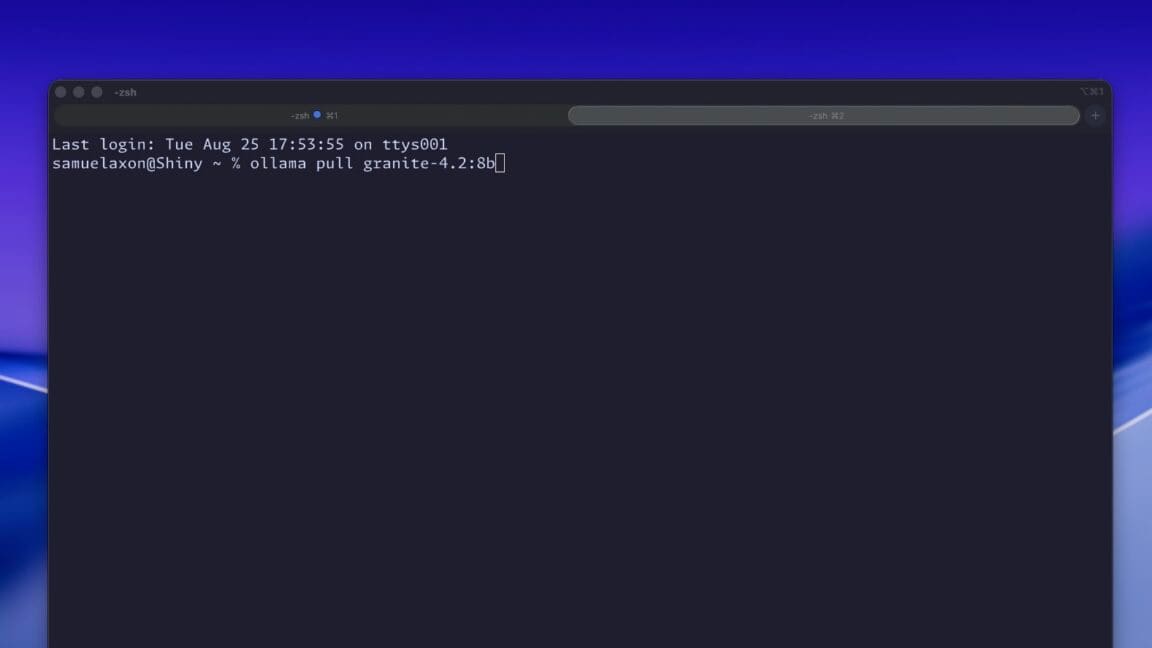
A Three-Model Stack for Enterprise Self-Hosting
IBM has added three new releases to its Granite series of open-weight large language models, each sized for different deployment constraints. The 4.2 generation arrives in 3-billion, 8-billion, and 30-billion parameter configurations, all built with a decoder-only architecture and a native context window of 128,000 tokens. At DailyTechWire, we've tracked the steady expansion of self-hosted model options across the region - from Tokyo research labs to Singapore fintech teams - and the new Granite lineup reflects a wider enterprise bet: that regulated industries and cost-conscious IT departments will choose to run inference on their own hardware rather than route every query through a cloud API.
The design philosophy here is deliberate fragmentation by scale. The smallest 3B variant fits on edge devices and older server GPUs; the 8B model targets the sweet spot of throughput and quality on mid-tier hardware; and the 30B release aims at teams willing to allocate more compute for stronger reasoning. Each model ships with the same extended context length, which IBM positions as a hedge against the context-truncation problems that plague smaller-window models when handling long documents, codebases, or multi-turn conversations.
Agentic Training on Two of Three Models
The 8-billion and 30-billion parameter variants incorporate an additional training phase that IBM describes as agentic reinforcement learning. That block teaches the models to invoke external tools - terminal commands, web search, or third-party APIs - rather than generating pure text completions. The 3B model retains basic tool-calling support but skips the specialized reinforcement phase, a pragmatic cut that keeps training costs and inference latency lower for edge deployments.
In practice, agentic capabilities let a model decide mid-inference to execute a shell script, fetch live search results, or query a database, then fold that output into its next tokens. The technique has become table stakes in the latest wave of assistant-oriented models, but implementation quality varies widely. IBM has not published benchmark scores for tool-use accuracy or latency overhead, so early adopters will need to profile the models against their own task distributions. The decision to reserve the full agentic block for the two larger models suggests IBM sees tool orchestration as compute-intensive - both during training and at inference time - and expects most edge use cases to favor raw speed over multi-step workflows.
The Decoder-Only Bet and Regional Adoption Patterns
IBM continues to build Granite on a decoder-only transformer architecture, the same design that powers GPT-style autoregressive models. That choice prioritizes generation fluency and simplicity over encoder-decoder hybrids, which can excel at structured tasks like translation or summarization but add architectural complexity. Decoder-only models are easier to fine-tune with standard causal language modeling objectives, and they slot cleanly into existing inference stacks built around libraries like vLLM or TensorRT-LLM.
Across Asia-Pacific, we've seen uneven adoption of self-hosted LLMs. Seoul-based gaming studios have experimented with on-premise models for narrative generation and localization, keeping character dialogue and plot data inside the studio network. Singapore financial-services firms cite data-residency rules and latency requirements as drivers for local inference, particularly when embedding models into real-time trading or compliance workflows. In contrast, smaller startups in Jakarta and Manila still lean on cloud APIs from Anthropic, OpenAI, or regional providers, where the marginal cost per token undercuts the fixed expense of GPU clusters. IBM's three-tier Granite release acknowledges this spectrum: the 3B model is cheap enough to run on a single consumer GPU, while the 30B variant demands multi-GPU setups or high-memory accelerators.
Context Windows, Memory, and the 128K Trade-Off
All three Granite 4.2 models ship with a 128,000-token context window, a figure that has become a competitive baseline as Anthropic, Google, and others push context lengths into the hundreds of thousands or low millions. A longer context window lets a model ingest entire codebases, legal contracts, or research papers in a single forward pass, reducing the need for retrieval-augmented generation pipelines. But extended context also scales memory usage and attention computation quadratically - or close to it, depending on the attention mechanism - so inference providers must balance window size against throughput and cost.
For enterprise teams running Granite on-premise, the 128K window means they can feed multi-file codebases or lengthy customer transcripts without chunking, but they will pay in VRAM and latency. A 30B model with 128K context can easily exceed 80 GB of GPU memory at float16 precision, pushing deployments toward A100 or H100 clusters and making quantization - 8-bit or 4-bit - a practical necessity for cost control. IBM has not disclosed whether the models were trained with techniques like sparse attention or grouped-query attention to mitigate the quadratic penalty, so users should expect to tune batch sizes and sequence lengths carefully in production.
Open Weights, Licensing, and the Self-Hosting Wave
IBM releases Granite under an open-weight license, meaning the model weights are downloadable but the training data, code, and intermediate checkpoints remain proprietary. This sits between fully open-source projects like LLaMA and closed commercial APIs. Open-weight models let enterprises audit inference behavior, fine-tune on proprietary data, and avoid per-token API fees, but they do not provide the full reproducibility or transparency of models trained on public datasets with published recipes.
The self-hosting wave has gathered momentum in the past eighteen months, driven by three forces: falling GPU prices in the secondary market, regulatory pressure in Europe and parts of Asia to keep sensitive data on-premise, and growing skepticism about the long-term pricing stability of cloud LLM APIs. We've followed funding rounds across the region - Seoul's Upstage, Singapore's AI Singapore, Bengaluru's Sarvam AI - where the pitch centers on local-language models or deployment flexibility, often with an explicit contrast to San Francisco hyperscalers. IBM's Granite family targets the same anxiety, offering a brand name and enterprise support structure that startups cannot match, even if the models themselves trail frontier benchmarks.
What the 4.2 Release Signals About IBM's AI Strategy
The Granite 4.2 launch is less about breakthrough architecture and more about product-market fit: IBM is betting that a significant slice of enterprise IT will choose on-premise LLMs over cloud APIs, and that a three-tier model family - cheap, mid-range, expensive - covers enough deployment scenarios to win deals. The agentic training on the 8B and 30B models reflects IBM's view that tool use, not raw text generation, is the next battleground for enterprise assistants. By skipping that training phase on the 3B variant, IBM signals that edge deployments will prioritize speed and cost over multi-step reasoning.
The real test will come in the next six months, as teams benchmark Granite 4.2 against Llama 4, Qwen, and other open-weight competitors on domain-specific tasks - legal document review, code generation, financial analysis - and measure total cost of ownership against cloud APIs. IBM's advantage lies in its existing enterprise relationships and support infrastructure; its risk is that the models themselves do not keep pace with the rapid iteration cycles of Meta, Alibaba, or newer entrants. For now, Granite 4.2 gives IBM a credible story in the self-hosted LLM conversation, and it gives regulated industries in Asia and Europe another option when data gravity or compliance rules make cloud APIs untenable.