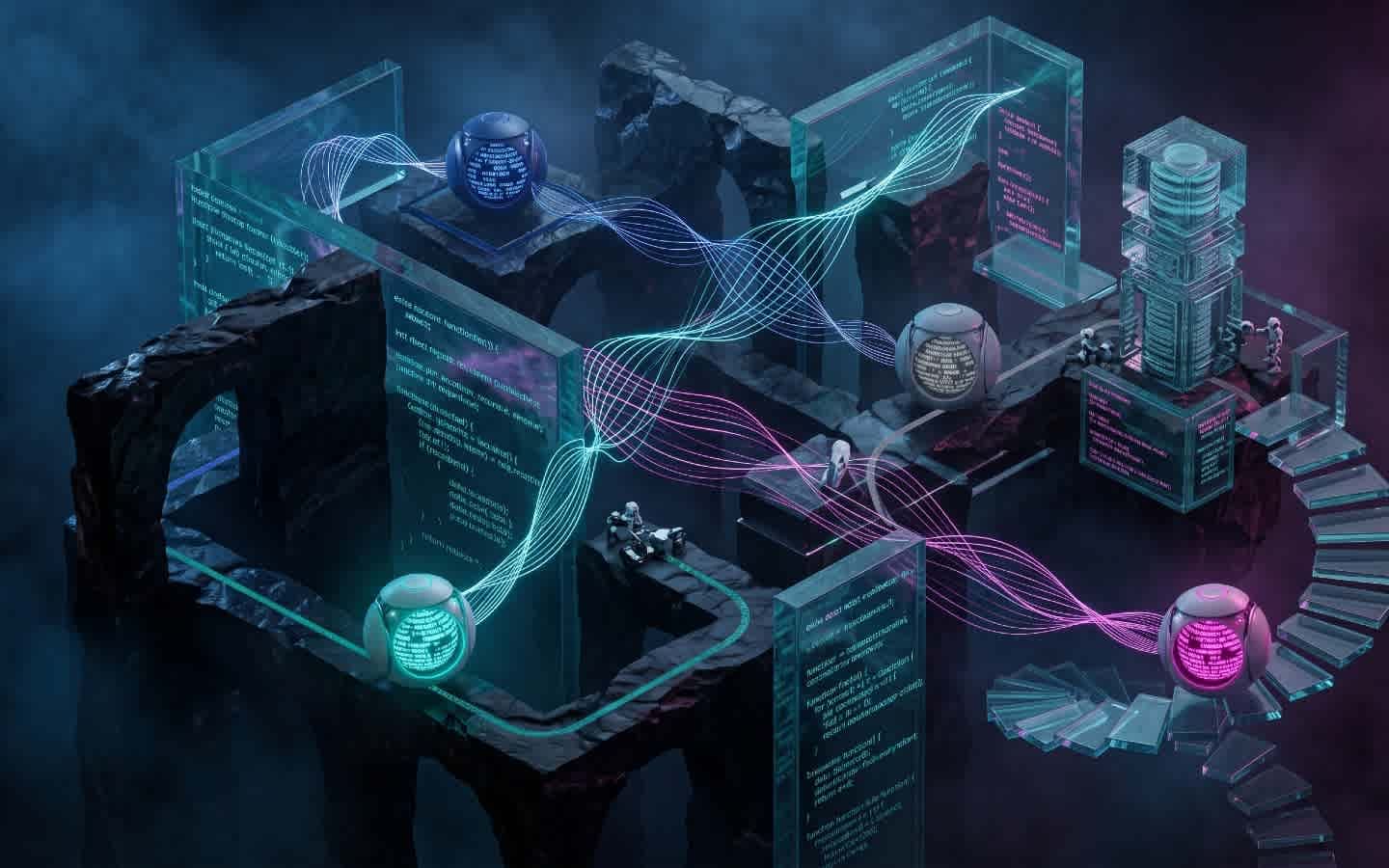
How 37,000 Specialized Agents Built a Drug Candidate Merck Later Validated
Stanford's multi-agent biotech infrastructure reveals why orchestration, not model size, is the next scaling frontier for enterprise AI systems.
When One Agent Becomes 37,000
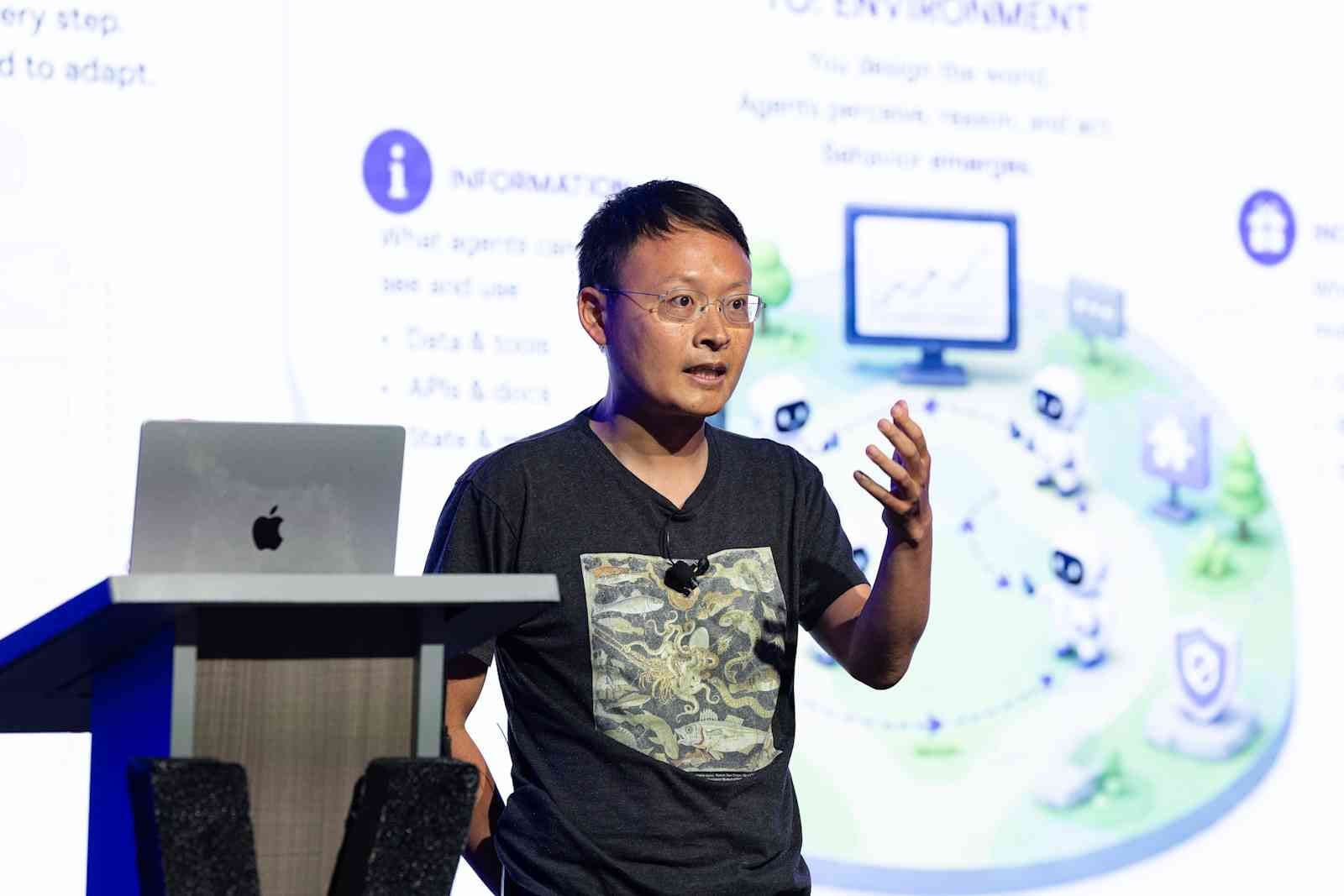
At DailyTechWire, we've tracked the steady march from single-model inference to agentic workflows. Yet most enterprise deployments still assume a one-to-one relationship: one engineer, one assistant, one coding companion. That assumption is breaking. James Zou, an associate professor of biomedical data science at Stanford, recently presented research showing that the next inflection point isn't building a smarter agent, it's coordinating tens of thousands of them.
His team didn't stop at a proof of concept. They built a virtual biotech company staffed entirely by AI agents, scaled it to 37,000 specialized workers, and watched it autonomously design a cancer therapeutic. Months later, Merck independently developed and validated the same molecule, which subsequently received FDA breakthrough designation. The convergence wasn't coincidence; it was evidence that massive multi-agent systems can produce research-grade output when the orchestration layer is built correctly.
From Lab Replica to Corporate Structure
Zou's project started modestly. His team created a "Virtual Lab" with five to eight agents, each mirroring roles in his physical Stanford lab: an AI professor serving as principal investigator, AI students with distinct research specialties. The agents held group meetings, debated methodology, and even attended an "agent school" where they underwent supervised fine-tuning to deepen domain expertise.
The first milestone was tangible. The virtual lab designed new nanobody proteins targeting recent COVID variants. When tested in wet-lab conditions, these AI-generated proteins outperformed earlier human-designed nanobodies in binding affinity across multiple viral strains. That validation gave the team confidence to scale.
They transitioned from emulating a single research group to modeling a full biotech organization. The resulting Virtual Biotech employs a Chief Scientific Officer agent overseeing divisions that mirror real pharmaceutical companies: target discovery, molecule design, safety assessment, and clinical trial analysis. Within each division, agents specialize further. One examines genetic datasets, another parses single-cell genomics, a third synthesizes protein structure databases. The hierarchy isn't cosmetic; it's functional infrastructure that allows thousands of agents to work in parallel without collapsing into noise.
Why Thousands of Agents Beat One Supermodel
As foundation models grow larger and more capable, a natural question emerges: why distribute work across thousands of narrow agents instead of pouring compute into a single, all-knowing model? Zou's team ran head-to-head experiments to answer this.
They tasked a multi-agent team and a single monolithic agent with identical scientific challenges. The distributed system consistently produced superior results. The reason wasn't raw capability but interaction dynamics. Agents within the ecosystem debated hypotheses, challenged each other's reasoning, and forced iterative refinement. This friction reduced compounding errors and surfaced creative solutions that a single agent, working in isolation, failed to generate.
In scientific research, where false positives cascade and error correction is expensive, this resilience matters. A single model can hallucinate confidently. A team of specialized agents must convince peers, creating natural checkpoints that improve robustness. The architecture itself becomes a form of validation.
The Orchestration Bottleneck
Scaling to tens of thousands of agents exposes a different class of problem: orchestration. When thousands of specialized workers need to synthesize knowledge from disparate databases, research papers, clinical trial records, and genomic datasets, the integration layer becomes the primary bottleneck.
Many enterprise teams attempt to solve this by wrapping existing databases with an orchestration protocol, assuming that access equals usability. Zou's team discovered this approach fails at scale. Legacy databases and APIs were designed for human analysts or pre-transformer algorithms. Dropping a PDF into an agent's context window is inefficient. Standard text models struggle to parse complex figures, tables, and supplementary data, leading to hallucinations and wasted compute.
Zou described the core issue: even if you wrap an orchestration layer around existing infrastructure, the underlying interfaces remain hostile to agents. The solution isn't better wrappers; it's rebuilding the data layer to be AI-native.
His team developed Paperclip, a platform that digitizes unstructured scientific literature and maps fragmented databases into a unified virtual file system. Instead of forcing agents to navigate brittle, database-specific APIs, Paperclip leverages a core strength of modern language models: their ability to write code and traverse file systems. Agents access millions of research papers using standard file operations, reducing query time and cost by more than an order of magnitude while improving accuracy.
This infrastructure shift is subtle but foundational. It mirrors the transition from command-line interfaces to graphical user interfaces in the 1980s, when making systems legible to users unlocked new categories of work. Here, making data legible to agents unlocks new categories of synthesis.
37,000 Clinical Trial Agents and a Validated Therapeutic
To stress-test the architecture, the Virtual Biotech deployed 37,000 clinical trial agents to synthesize fragmented trial data spanning decades. These agents identified single-cell genomic features that predict trial success. Drug candidates targeting proteins with these features were approximately 50 percent more likely to reach market than comparable drugs lacking them.
The system then autonomously designed an antibody-drug conjugate targeting the CD276 protein for lung cancer treatment. The agents completed this design without human intervention, relying exclusively on scientific literature published before January 2025. The choice of target, linker chemistry, and payload configuration emerged from multi-agent deliberation, not human intuition.
Several months later, Merck independently developed and validated the same therapeutic design. The convergence wasn't coordination; Zou's team had no contact with Merck during the design phase. The molecule went on to receive FDA breakthrough designation, a classification reserved for therapies addressing unmet medical needs with preliminary clinical evidence of substantial improvement over existing treatments.
This external validation carries weight. Drug design is notoriously difficult, with failure rates exceeding 90 percent between preclinical and market approval. Independent replication by a major pharmaceutical company, followed by regulatory recognition, suggests the multi-agent system identified a genuinely promising candidate, not an artifact of overfitting or hallucination.
Environments, Not Workflows
As multi-agent systems scale beyond hundreds of participants, management paradigms shift. Zou advocates moving from workflow design to environment design. Workflows dictate specific steps, treating agents like junior employees who need explicit instruction. Environments provide infrastructure, guardrails, and incentives, then allow agents to self-organize around open-ended problems.
This distinction matters for optimization. In a workflow system, improving performance means fine-tuning individual models or adjusting prompts. In an environment system, optimization targets the parameters governing collaboration: communication protocols, resource allocation, incentive structures, and validation mechanisms. The environment itself becomes the object of iteration.
Zou's team found that while individual agents can improve through reinforcement learning or domain-specific fine-tuning at the agent school, the success of a massive multi-agent system depends more on environmental tuning than on incremental model improvements. This has practical implications for enterprise teams: investing in orchestration infrastructure and collaboration protocols may yield better returns than chasing the latest foundation model release.
What This Means for Enterprise Deployment
The Virtual Biotech experiment offers a concrete blueprint for organizations considering multi-agent architectures. First, legacy data infrastructure will bottleneck performance before model capability does. Teams should prioritize building AI-native data layers that expose information through interfaces agents can navigate fluently, rather than retrofitting APIs onto systems designed for human consumption.
Second, specialization and division of labor unlock capabilities that monolithic models cannot easily replicate. Distributing work across agents with narrow expertise, then orchestrating their collaboration, produces more robust outputs than centralizing all inference in a single general-purpose model. This isn't just theoretical; it's measurable in error rates and output quality.
Third, validation mechanisms must be baked into the environment. The friction of inter-agent debate, peer review, and iterative refinement serves as a natural error-correction layer. Systems that skip this step risk amplifying hallucinations at scale.
Finally, external validation remains the ultimate test. Zou's team didn't claim success when the virtual lab generated a molecule; they claimed success when an independent entity replicated and advanced the design through regulatory milestones. In an era where AI-generated output is often indistinguishable from plausible-sounding noise, third-party replication is the benchmark that matters.
The Scaling Frontier Shifts
The race to build larger models continues, but Zou's work suggests a parallel frontier: orchestrating exponentially more agents within carefully designed environments. The compute cost of running 37,000 agents is non-trivial, but the architecture is fundamentally different from scaling a single model to trillions of parameters. It trades monolithic inference for distributed synthesis, betting that coordination overhead is cheaper than marginal capability gains in ever-larger models.
This shift has implications beyond biotech. Legal research, financial analysis, chip design, and supply chain optimization all involve synthesizing fragmented, domain-specific knowledge. If the bottleneck isn't model intelligence but orchestration infrastructure, then the next wave of enterprise AI investment should flow toward platforms that make multi-agent collaboration legible, debuggable, and scalable.
Merck's independent validation of a molecule designed by 37,000 agents isn't just a milestone for drug discovery. It's a signal that the one-engineer, one-agent assumption is already obsolete. The question now is how quickly enterprises can rebuild their data and orchestration layers to support the coordination demands of systems that think in thousands.