Agent Teams Beat Flagship Models When They Can Talk Mid-Task
A lightweight coordination layer lets coding agents share discoveries without waiting for review rounds, turning interdependent subtasks into structural advantage over raw compute.
The Context Ceiling in Enterprise Code Analysis
Production repositories push AI agents into a failure mode that more parameters cannot fix. When a single agent attempts repository-wide investigation, its serial path through files and execution traces creates what researchers now call a coverage problem: late-stage findings rarely propagate back to reshape early assumptions. The agent executes steps correctly but loses track of dependencies, conflicting evidence, and obligations that span dozens of files. On benchmark tasks requiring live software execution and multi-file tracing, a single instance of a recent flagship model resolves just over half of attempts, even with expanded context windows.
At DailyTechWire, we've tracked how enterprises respond to this ceiling. The instinct is to split work across multiple agents, each operating in a smaller context. That instinct is correct, but only if the subtasks are genuinely independent. Repository understanding is not. A configuration file discovered by one agent can invalidate the entire hypothesis pursued by another. The question becomes: how do agents share that invalidation before the second agent completes a dead-end path?
Why Existing Multi-Agent Setups Miss the Window
Most frameworks that orchestrate agent teams fall into predictable patterns, and all of them sacrifice timing. Some run agents in parallel but provide no communication channel. Others enforce synchronized rounds, forcing every agent to halt and wait before exchanging findings. Round-based synchronization assumes discoveries can queue until the next checkpoint, an assumption that breaks down when one agent uncovers evidence that redirects another's work.
A third category offers limited asynchrony: top-down task dispatch or shared memory that agents must actively poll. None of these architectures solve the core exclusion problem. An agent executing a command cannot simultaneously listen for updates from peers. By the time a review phase convenes, agents have already invested compute in paths that new evidence would have ruled out minutes earlier.
Researchers at Coral AI Labs, working with collaborators across universities, identified this bottleneck and built a solution around a simple premise: agents need passive awareness. They should be able to continue their primary work while absorbing messages from teammates in the background, without blocking or polling.
A Message Layer That Does Not Block Execution
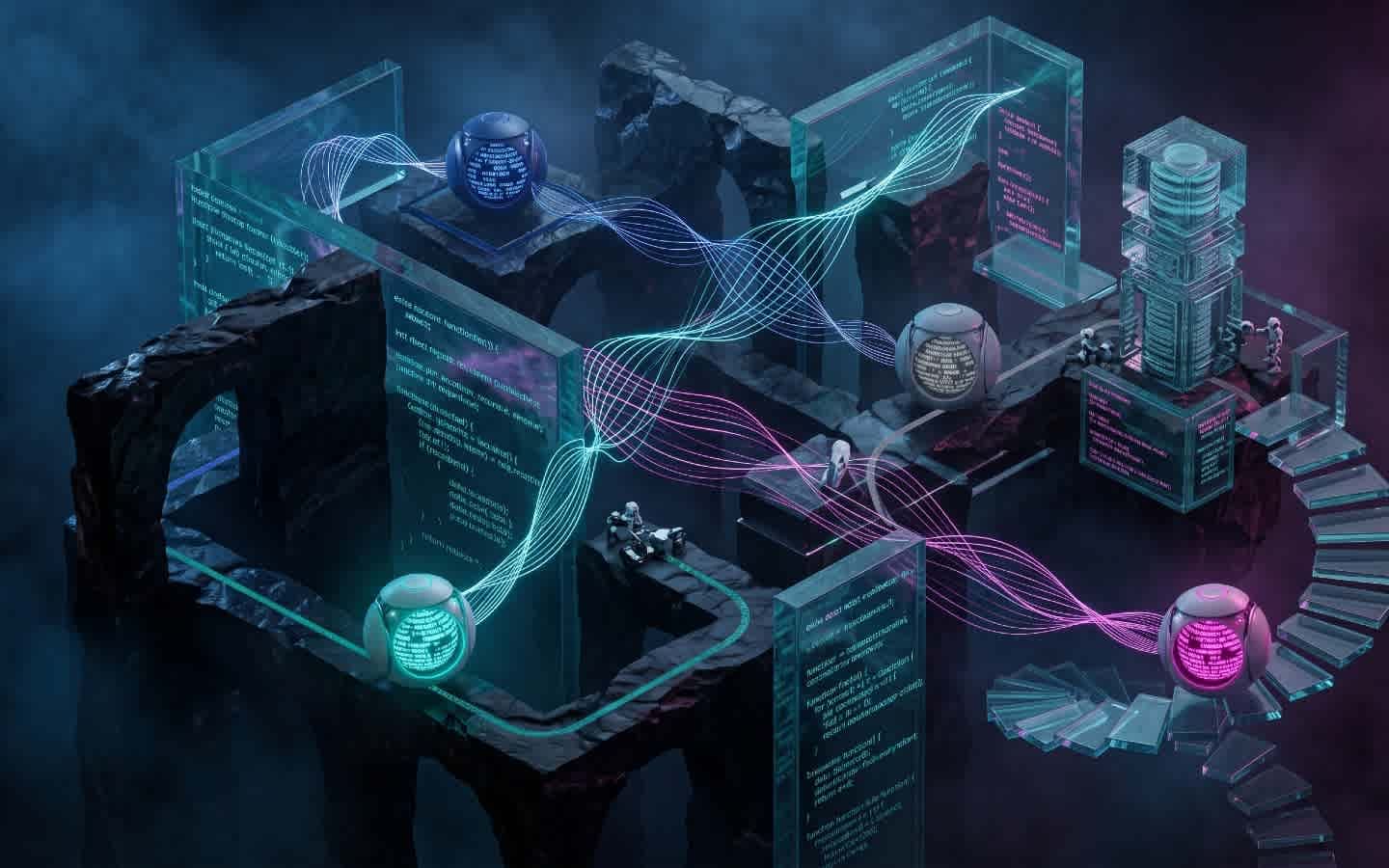
The resulting architecture, AgentRadio, introduces three lightweight primitives that plug into existing agent harnesses without modifying the underlying model. The first primitive opens a conversation thread among participating agents. The second appends a message to that thread and returns immediately, ensuring the sender does not pause its own work. The third blocks an agent's background watcher process until a relevant mention arrives, then delivers the message alongside a full snapshot of all active threads.
This trio creates a state where agents remain engaged in their primary tasks while a background listener continuously checks for updates. When a mention arrives, the agent incorporates the new information at its next decision point, not at the end of a round or review phase. The message server itself is a standalone process that stores threads and mentions; integration requires only that the agent harness support background shell commands.
The design deliberately avoids heavyweight orchestration. Teams need a thin adapter to start workers, assign identities, and connect them to the shared server, but the coding agent itself requires no internal changes. The architecture is open source under Apache 2.0, and the primitives map to three shell scripts.
Benchmark Results: Structure Over Scale
Testing on 124 long-horizon questions from a production repository benchmark revealed a clear pattern. A single agent using an earlier flagship model resolved roughly one-third of tasks. Upgrading to a newer, more capable model lifted that figure to 57 percent. A team of four agents using the older model, coordinated by AgentRadio, resolved 62 percent of tasks, surpassing the newer single-agent baseline.
The same architecture boosted a different backbone model from 29 percent to just over 50 percent. When researchers allocated equivalent token budgets to six independent runs of the flagship model, accuracy reached only 38 percent, far below the coordinated team. The performance gap is structural, not a product of brute-force scale.
One task in the benchmark required checking per-request server logs, a step agents did not anticipate during initial planning. In configurations without asynchronous messaging, two agents independently realized the need for these logs mid-execution but could not broadcast the discovery. One agent abandoned the approach privately; the other failed to propose it during review. The team converged on an incorrect answer, missing five evaluation rubrics.
With AgentRadio enabled, the same discovery occurred, but one agent immediately posted the server-side log requirement to the shared worklog. Because teammates were passively listening, they absorbed the evidence without interrupting their current commands. The final synthesis incorporated the logs, and the team achieved a perfect score across all rubrics. The difference was timing, not additional agents or review rounds.
When Coordination Justifies the Token Tax
Running multiple agents multiplies token costs. In the benchmark experiments, average API spend rose from under three dollars per task for a single agent to roughly nineteen dollars for the full coordinated team. That tax is measurable, and teams should weigh it against the structural benefit.
The useful heuristic is whether a task contains responsibility breakpoints: places where a competent engineer would involve another person because the work crosses an ownership boundary, requires an independent hypothesis, or carries enough risk to justify separate verification. Repository-wide architecture questions, cross-service incident investigations, security audits, dependency migrations, and multi-module refactors all exhibit these breakpoints. Subtasks in these domains remain interdependent even after decomposition, and an incomplete or incorrect answer imposes downstream costs that exceed the token premium.
Conversely, bounded and reversible work, such as a known single-file change or boilerplate generation, does not benefit from coordination overhead. A single agent remains the cleaner choice when one context can own the problem without compressing evidence or crossing ownership lines.
The Risk of Inter-Agent Churn
Communication can redirect agents toward better evidence, but it can also distract them from valid paths. Researchers noted instances where an agent abandoned a promising hypothesis after receiving a message that introduced doubt without offering a superior alternative. This churn is a second-order cost that does not appear in token bills but shows up in task completion rates.
Mitigating churn requires discipline in message content. Agents should broadcast discoveries that invalidate assumptions or unblock peers, not speculative commentary. The architecture itself is neutral; the quality of coordination depends on the prompts and guardrails teams impose on when and why agents send messages.
Implications for Enterprise AI Engineering
AgentRadio's results suggest that model selection is only one lever for improving AI performance on complex tasks. The right coordination structure can outmatch raw parameter count or context length, especially when subtasks are interdependent and evidence arrives incrementally.
For AI engineering teams, this shifts the design question from "which model should we use?" to "does this task benefit from parallel investigation with real-time discovery sharing?" If the answer is yes, a lightweight message-passing layer may deliver more value than waiting for the next model release or scaling token budgets linearly.
The architecture also clarifies where multi-agent systems add genuine value versus where they introduce unnecessary complexity. Fixed multi-agent teams should not become the default. The decision hinges on whether the task can be decomposed, whether the resulting parts remain interdependent, whether single-agent reliability is insufficient, and whether incomplete answers carry meaningful costs.
From Research Implementation to Production Use
The research team validated AgentRadio using a fixed four-agent configuration and a structured five-phase protocol. That setup served as a controlled environment for isolating the effect of asynchronous messaging. Production deployments will likely adapt the architecture to variable team sizes, dynamic task allocation, and domain-specific coordination rules.
The core insight, however, transfers directly: when agents can share discoveries without blocking their own execution, interdependent subtasks become a structural advantage rather than a coordination nightmare. Enterprises analyzing large codebases, investigating incidents across services, or conducting security assessments now have a tested pattern for turning agent teams into a viable alternative to single-agent scaling.
The token tax is real, but the performance gap suggests that coordination, when applied to the right tasks, is not an expense. It is a purchase of structural capability that raw compute alone cannot replicate.