Google Discover Adds Conversational AI to Personalize Your Content Feed
The company is rolling out a chatbot interface that lets users describe their interests in natural language, moving beyond algorithmic curation toward explicit preference management.
A New Layer of Control
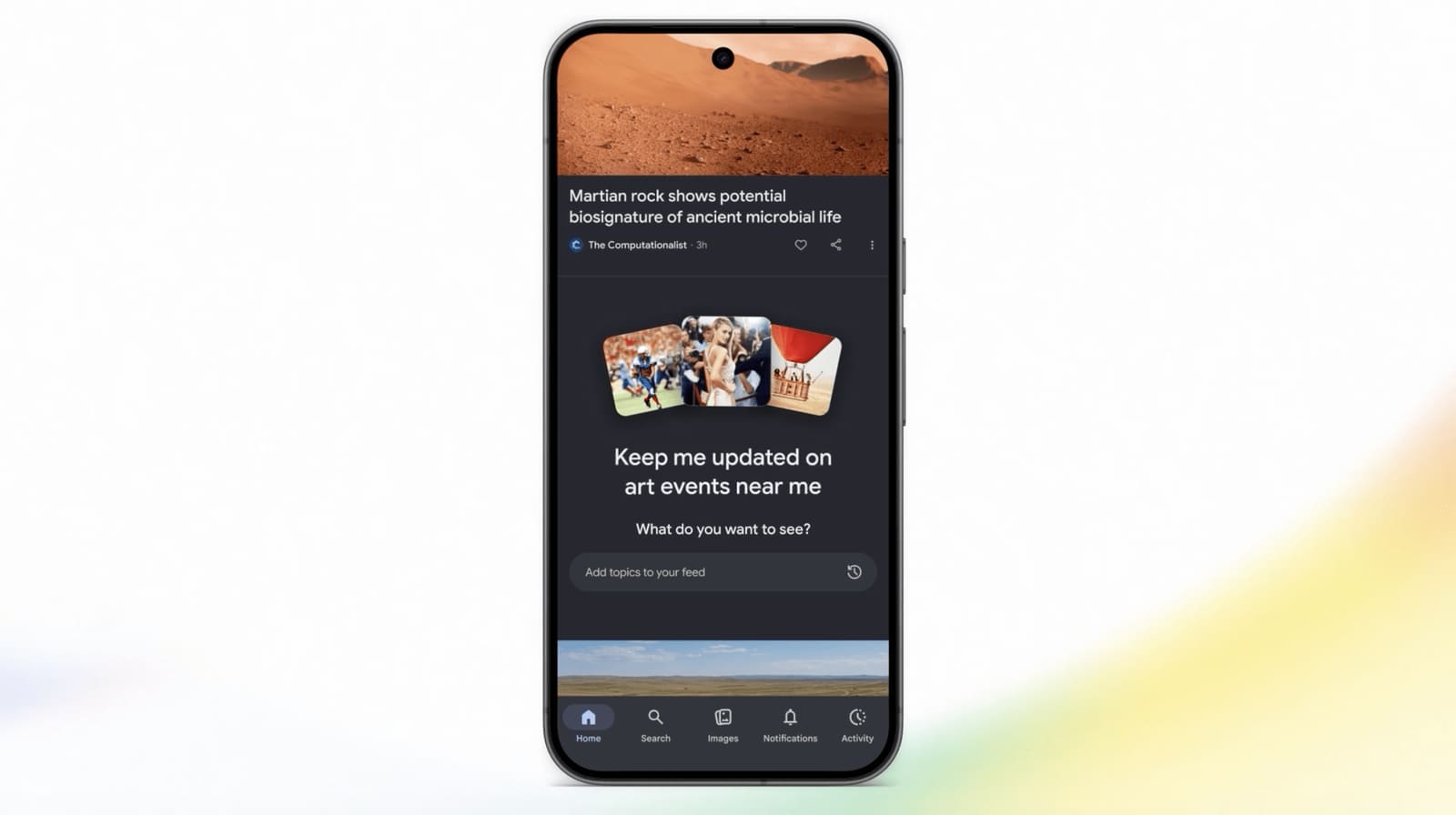
Google is introducing a conversational interface to its Discover feed, allowing users to describe their content preferences in natural language rather than relying solely on algorithmic inference. The feature, set to arrive in the Google app within days, represents a subtle but meaningful shift in how one of the world's most-used content surfaces handles personalization.
At DailyTechWire, we've watched recommendation engines evolve from simple collaborative filtering to multi-armed bandits and transformer-based models. What's interesting here isn't the underlying AI, which Google has deployed at scale for years, but the decision to surface explicit user control through a chat paradigm. It's a design choice that acknowledges a growing tension: algorithmic feeds are powerful, but users increasingly want steering wheels, not just passenger seats.
How the Interface Works
The new feature lives behind the three-dot menu in Discover. Tapping it opens a chatbot-style dialog where users can type requests like "show me more long-form tech analysis" or "prioritize climate innovation stories from Southeast Asia." The system confirms the instruction, outlines what it will prioritize, and allows follow-up refinements if the interpretation misses the mark.
Google says the preferences will persist across sessions, meaning the feed will "remember" these instructions over time. That memory layer is critical. Without it, the feature would amount to a one-time filter, no different from a search query. With it, users are effectively co-authoring the ranking function that governs their daily content diet.
The implementation is straightforward, almost mundane. But mundane can be strategic. Google is betting that a low-friction, language-based control surface will appeal to users who find traditional preference toggles too granular and algorithmic feeds too opaque.
The Broader Context of Feed Control
This rollout arrives as platforms across the industry grapple with the same problem: how to give users agency without overwhelming them. Meta has experimented with "Why am I seeing this?" explainers and preference dials in Instagram and Facebook. TikTok offers a "Not Interested" button but keeps the core algorithm opaque. X (formerly Twitter) has toggled between chronological and algorithmic feeds, often to user backlash.
Google's approach is distinct in its use of natural language as the input layer. Instead of asking users to navigate preference menus or rate individual items, the system invites them to describe intent. That's a design pattern lifted directly from the success of conversational search and, more recently, large language model interfaces. The hypothesis: people find it easier to say what they want than to configure it.
From a product perspective, this also serves Google's strategic interest in making chat interfaces ubiquitous. Every interaction with the Discover chatbot is a micro-training session, teaching users that talking to Google's AI is normal, useful, and low-stakes. It's a stepping stone toward deeper integration of Gemini and other conversational agents across Google's product stack.
Technical Implications and Latency Concerns
Under the hood, the feature likely relies on a lightweight language model that parses user intent, maps it to content categories or embeddings, and adjusts ranking weights in real time. The challenge is doing this without introducing latency. Discover feeds load quickly today because ranking happens server-side with pre-computed signals. Adding a user-specific, language-parsed layer means either running inference at query time or maintaining per-user ranking overrides that merge with the base model.
Google hasn't disclosed the architecture, but the most plausible approach is a hybrid: user instructions are encoded into a preference vector that modulates the existing ranking model, rather than replacing it. That keeps latency low and allows the system to balance explicit preferences with implicit signals like dwell time and click-through rate.
The risk is drift. If user-stated preferences diverge too much from observed behavior, the feed could become less engaging over time. Google will need to monitor whether people actually consume the content they ask for, or whether their stated preferences reflect aspirational rather than actual interests. The gap between "I want to read more about climate policy" and "I actually click on celebrity gossip" is well-documented in behavioral research.
Privacy and Data Retention Questions
One unanswered question is how Google will store and use these conversational inputs. Are the chat transcripts retained? Are they tied to user profiles for ad targeting? Do they feed back into broader training datasets for Google's language models?
Google's privacy policies allow for broad data use within its ecosystem, but the conversational nature of this feature makes the data more semantically rich than traditional engagement signals. A user who types "show me more about venture capital in India" is revealing interest in a way that's more explicit, and potentially more sensitive, than someone who passively scrolls past a funding announcement.
The feature will likely fall under Google's existing data-use frameworks, but the lack of transparency around how these instructions are processed, stored, and potentially monetized is worth noting. As chat interfaces proliferate, the boundary between user assistance and data extraction becomes harder to parse.
What This Means for Content Creators
For publishers and creators, this feature introduces a new variable into the Discover traffic equation. Until now, appearing in Discover was largely a function of content quality signals, engagement metrics, and topical relevance inferred by Google's algorithms. Now, there's a user-preference layer that could override those signals.
If a user explicitly asks for "fewer product reviews" or "more investigative reporting," Google will have to balance that instruction against its confidence in what the user will actually engage with. That creates both opportunity and risk. Niche publishers who serve specific, articulable interests (e.g., "deep dives on semiconductor policy") may benefit if users know to ask for them. Broader, algorithmically optimized content may lose ground if users start steering away from clickbait or viral fluff.
The net effect will depend on adoption. If only a small fraction of users engage with the feature, its impact on traffic distribution will be minimal. If it becomes a default interaction pattern, it could reshape which types of content win in Discover, rewarding clarity of niche over broad appeal.
The Long Game: Making AI Interfaces Habitual
Step back, and this feature is less about Discover and more about normalizing conversational AI as an interface layer across Google's products. The company has spent the past two years racing to integrate generative AI into search, Gmail, Docs, and now content feeds. Each deployment is a small behavioral nudge: talk to the machine, and it will help you.
The strategy is sound. As OpenAI, Anthropic, and others build standalone chat products, Google's advantage is distribution. It can embed conversational AI into surfaces people already use daily, making the interaction feel incremental rather than disruptive. A chatbot that tunes your Discover feed is lower-stakes than a chatbot that replaces your search engine, but it builds the same muscle memory.
Whether users will actually adopt this feature at scale remains to be seen. Personalization tools tend to have low engagement unless the value proposition is immediate and obvious. Google will need to make the feedback loop tight: ask for something, see the feed change instantly, feel the benefit. If the effect is too subtle or delayed, the feature will fade into the background, another unused toggle in a sea of settings.
But if it works, it's a template for how Google can layer AI onto existing products without ripping up the foundations. Not a revolution, but a series of small, deliberate steps toward a more conversational, user-steered internet.