Amazon Scales Drone Delivery to Half a Thousand Cities
Prime Air's six-fold expansion targets 500 US metro areas by year-end, as the e-commerce giant races to normalize autonomous last-mile logistics alongside Walmart and Wing.
Six-Fold Expansion After Years of Fits and Starts
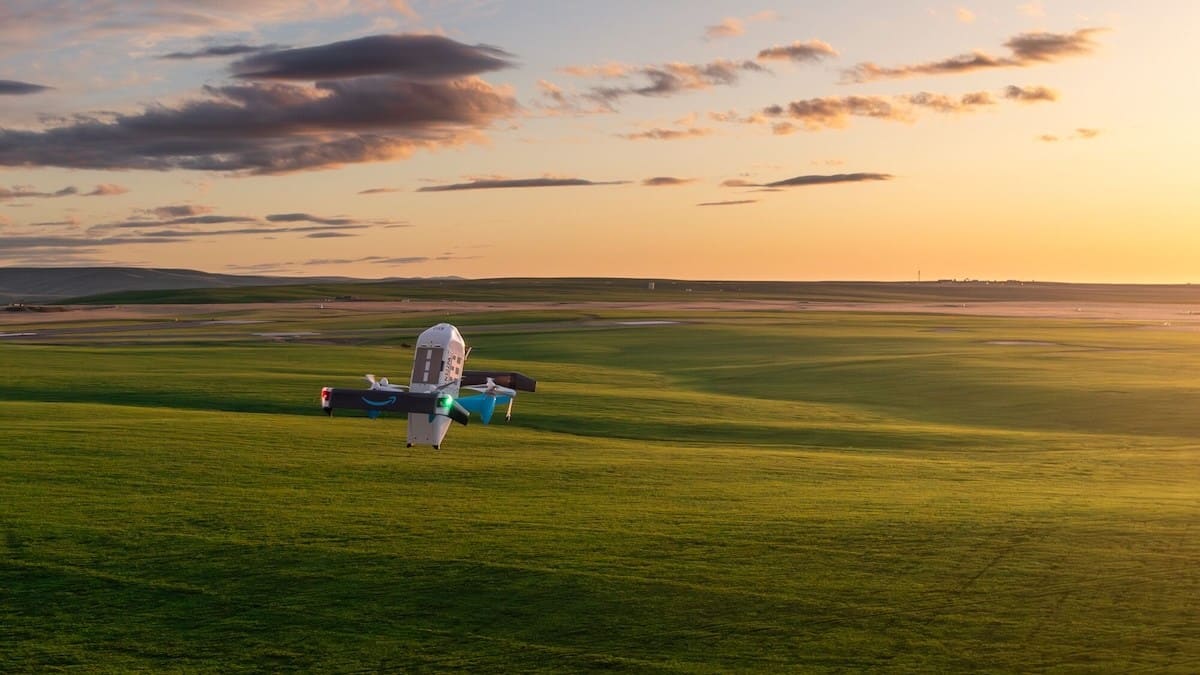
Amazon announced this week that Prime Air, its long-gestating drone delivery service, will reach nearly 500 cities across the United States before 2026 closes, a six-fold leap from its current footprint. Eleven new metro areas are joining the network in the coming months: Tolleson in Arizona, Ruskin in Florida, Kansas City in Kansas, Papillion in Nebraska, Baton Rouge in Louisiana, Hazel Park and Pontiac in Michigan, plus Richmond, San Antonio, Richardson, and Waco in Texas.
That list includes a return to Tolleson, the Arizona suburb where two Prime Air drones collided with a crane boom in October 2025. The accident was one of several high-profile incidents that have shadowed the program, including a severed internet cable, a garden crash, and a collision with an apartment building. At DailyTechWire, we've tracked how these mishaps amplified scrutiny from local regulators and raised questions about whether autonomous aerial delivery can clear the safety threshold needed for dense urban rollout.
Safety Infrastructure Moves to the Fore
Amazon is now leaning hard on its Detect-and-Avoid system, which the company describes as an industry-leading suite that continuously scans airspace and terrain around each aircraft. Onboard cameras and sensors handle navigation, obstacle detection, and the final handoff at the customer's doorstep. The drones are also rated to fly in light rain and across a range of temperatures, a nod to the reality that last-mile logistics cannot pause for weather.
The program operates under Federal Aviation Administration Part 135 certification, the same regulatory umbrella that covers commercial air carriers. That distinction matters: Part 135 demands higher operational standards than the experimental waivers that governed earlier drone pilots, signaling that Prime Air has graduated from research project to revenue-generating infrastructure.
David Carbon, vice president of Amazon Prime Air, said the service has already delivered hundreds of thousands of packages by drone in 2026. For context, that volume remains a rounding error against Amazon's total parcel count, but it represents the largest deployed autonomous aerial delivery fleet in the company's history.
The Economics of 30-Minute Delivery
Prime members qualify for free drone delivery on orders of fifty dollars or more; below that threshold, the fee is $2.99. Non-Prime customers pay $4.99. Nearly every item weighing five pounds or less is eligible, a ceiling that captures a significant share of Amazon's catalog, from phone chargers to cosmetics to paperback books.
The 30-minute delivery promise is the headline, but the real play is margin. Ground-based same-day delivery requires dense networks of sortation centers, gig drivers, and route optimization software. Drones, once capital costs are amortized, offer a structurally lower variable cost per package in low-density suburbs where driving a van three miles for a single drop-off erodes profitability. The question is whether Amazon can achieve the utilization rates needed to justify the upfront investment in airspace coordination, charging infrastructure, and fleet maintenance.
The Competitive Landscape: Walmart and Wing
Amazon is not alone in the race to normalize drone delivery. Walmart and Wing, the drone subsidiary of Alphabet, have built what they call the largest autonomous aerial delivery network in the United States. In June, the partnership added seven markets, including Phoenix, Philadelphia, and the Bay Area, putting them on a collision course with Amazon in several overlapping geographies.
Wing has historically focused on partnering with retailers rather than operating its own e-commerce platform, a model that allows faster expansion but cedes control of the customer relationship. Walmart, meanwhile, brings its own dense network of physical stores, which can serve as micro-fulfillment hubs within urban clusters. Amazon's vertical integration, from warehouse to airspace, offers tighter margin control but demands heavier capital deployment.
The competitive dynamic is less about technology differentiation and more about operational execution: who can secure airspace approvals faster, who can staff maintenance crews at scale, and who can convince suburban homeowners that a buzzing hexacopter overhead is a feature, not a nuisance.
What Comes Next: Georgia, Ohio, Illinois, Idaho, New York
Amazon signaled that launches in Georgia, Ohio, Illinois, Idaho, and New York are in the pipeline, though no firm dates were disclosed. Those states represent a mix of regulatory environments and population densities. New York, in particular, will test whether the Detect-and-Avoid system can handle the electromagnetic interference, high-rise corridors, and unpredictable weather that define the Northeast corridor.
The broader question is whether 500 cities by year-end is a ceiling or a floor. If Prime Air can demonstrate that autonomous delivery reduces cost per package while maintaining safety benchmarks, the addressable market expands to thousands of zip codes. If utilization lags or incidents spike, the program risks becoming a high-profile science project that never escapes the shadow of its own hype.
For now, Amazon is betting that the combination of Part 135 certification, a Detect-and-Avoid moat, and six-fold geographic expansion will be enough to shift perception from experiment to infrastructure. The next twelve months will reveal whether customers in Waco and Pontiac see drones as a convenience or a curiosity.