Calendly Enters the Crowded AI Note-Taker Market With Workflow Automation Bet
The scheduling platform is banking on post-meeting automation to differentiate itself in a space already packed with Otter, Fireflies, and Granola.
The Scheduling Giant Makes Its Move
Calendly has stepped into one of the most contested arenas in workplace software: AI-powered meeting note-taking. The company, which built its reputation on simplifying how professionals schedule appointments, now wants to own what happens during and after those meetings. Its new note-taking product does what rivals already do - join calls, record audio and video, transcribe conversations, generate summaries, extract action items, and draft follow-up emails. But CEO Tope Awotona believes the real opportunity lies not in transcription accuracy, but in automating the workflow that follows.
At DailyTechWire, we've tracked the explosion of meeting assistant tools over the past eighteen months, watching as nearly every productivity vendor rushed to ship transcription features. Calendly's entry signals that the category has matured from novelty to table stakes, yet it also raises the question: can a scheduling-first company carve out defensible territory in a market where pure-play note-takers and productivity suites are already entrenched?
What Calendly Is Building
The note-taking product operates similarly to existing tools. An AI assistant joins scheduled meetings, captures audio and video streams, and produces transcripts. From there, the system generates summaries, identifies action items, and can compose follow-up emails based on meeting content. Calendly is also testing a feature that mirrors Granola's approach, using system audio to transcribe meetings without requiring a bot to visibly join the call.
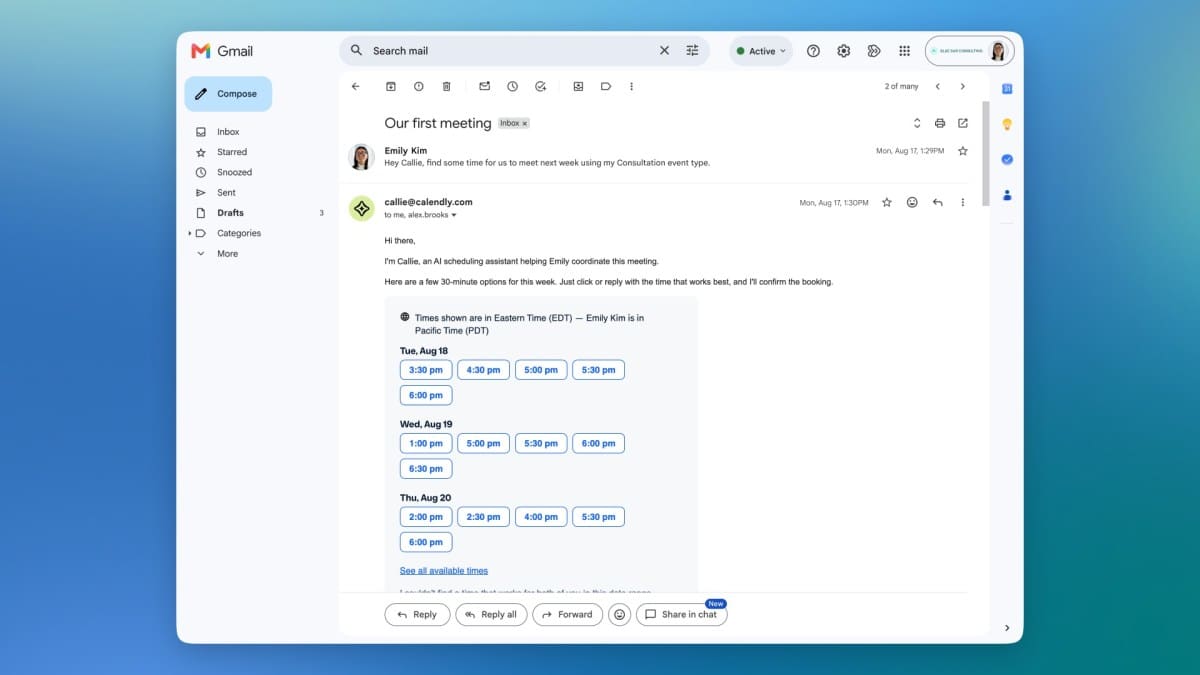
Beyond transcription, Calendly plans to introduce an AI assistant named Callie. This agent will tap into the company's existing scheduling and meeting data to handle tasks like setting up appointments, checking participant availability, and surfacing context from previous interactions. The concept parallels an email-based assistant that Read AI introduced earlier this year, suggesting a broader industry trend toward agentic assistants that operate across communication channels.
Awotona framed the product as a solution for outward-facing roles - sales representatives, account managers, and marketing professionals whose calendars overflow with client calls and prospect meetings. For these users, the volume of meetings creates a bottleneck: time spent recapping conversations, updating CRM systems, and drafting follow-ups often exceeds the duration of the meetings themselves.
A Brutally Competitive Landscape
The meeting note-taker category is crowded to the point of saturation. Standalone apps like Fireflies, Otter, Fathom, Granola, and Read AI have each staked out positions, while horizontal productivity platforms - Notion, ClickUp, and Wispr among them - have layered note-taking capabilities into their existing suites. Each player is racing to prove that transcription alone isn't enough; the winner will be whoever can turn meeting data into automated downstream actions.
Awotona acknowledged the density of competitors but argued that most tools stop at transcription. "There's a litany of note-takers, and all of them do a great job of recording and transcribing notes," he said. "But a lot of work happens after the meetings. And we think that really that's where the opportunity for our note-takers to be efficient."
That thesis - post-meeting automation as the differentiator - is sound in principle. In practice, it means Calendly must integrate deeply with the tools its users already depend on: CRMs like Salesforce and HubSpot, project management platforms, and email clients. The company's existing scheduling infrastructure gives it a head start on context: it already knows who meets with whom, how often, and what the meetings are about. The question is whether that scheduling graph translates into a meaningful advantage once the meeting starts.
Privacy and Consent in a Sensitive Space
Meeting recording tools have drawn scrutiny over privacy practices. Otter and Granola have both faced allegations related to how they handle user data and whether their recording practices adequately inform participants. Calendly is attempting to preempt these concerns by building consent mechanisms into its product from the start.
The note-taking assistant sends a message in the meeting chat to notify all participants that recording is active. Any attendee can request that the bot leave the call. Because the tool integrates with Calendly's scheduling system, it can also inform invitees before the meeting begins that the session will be recorded, giving participants the option to decline or request an alternative format.
These safeguards are table stakes in regulated industries and increasingly expected in enterprise contexts where data governance and compliance are non-negotiable. Calendly's approach won't eliminate friction - some users will still balk at the presence of a recording bot - but it does align with emerging best practices in the category.
The Integration Advantage and Its Limits
Calendly's core asset is its scheduling graph: a map of who books time with whom, how frequently, and for what purpose. If the company can layer meeting intelligence on top of that graph, it could surface insights that standalone note-takers cannot. For example, identifying patterns in client conversations over time, flagging deals that are stalling based on meeting cadence, or automatically preparing briefing materials for recurring check-ins.
But that advantage is conditional. It depends on users consolidating their scheduling, meeting participation, and post-meeting workflows within Calendly's ecosystem. In reality, many professionals use multiple scheduling tools, join meetings via direct links, and manage follow-ups in systems Calendly doesn't touch. The value of integration is real, but it's not universal.
Moreover, the post-meeting automation thesis assumes that transcription and action-item extraction are solved problems. They aren't. Transcription accuracy still varies by accent, audio quality, and technical jargon. Action-item detection remains hit-or-miss, especially in meetings where decisions are implicit or deferred. If Calendly's models don't outperform incumbents on these basics, the workflow automation won't matter.
The Agentic Assistant Gambit
Callie, the planned AI assistant, represents a more ambitious play. Rather than simply processing meeting data, an agentic assistant would act on it - scheduling follow-ups, updating records, drafting communications, and potentially even negotiating meeting times on behalf of users. This vision aligns with the broader shift in enterprise AI from passive tools to active agents.
The challenge is execution. Effective agents require high-quality training data, robust guardrails to prevent hallucinations or errors, and tight integrations with the systems they're meant to manipulate. Calendly has the scheduling data, but extending an assistant's reach into email, CRM, and project management tools means navigating API limitations, permission models, and user trust.
Read AI's email-based assistant, launched earlier this year, offers a preview of both the promise and the pitfalls. Users appreciate the convenience of delegating routine tasks, but they also report anxiety about the assistant making mistakes or misinterpreting intent. Calendly will need to thread that needle carefully, especially if Callie is positioned as a front-line representative in client-facing workflows.
Market Timing and Strategic Risk
Calendly's timing is both late and opportune. Late because the note-taker category is already saturated, and early movers have locked in user bases and refined their products through thousands of hours of real-world feedback. Opportune because the category is still immature in terms of monetization and retention - many users churn between tools, and few have demonstrated strong pricing power.
The strategic risk for Calendly is distraction. The company built a focused, profitable business around scheduling. Expanding into meeting intelligence and workflow automation broadens the product surface and introduces new competitors, some of which - like Microsoft with Teams and Copilot - have far deeper resources and distribution advantages. If Calendly's note-taker becomes a me-too feature rather than a compelling reason to consolidate workflows, it risks diluting the brand without capturing meaningful share.
On the other hand, if Calendly can deliver on the post-meeting automation promise, it could redefine its value proposition from "schedule meetings" to "orchestrate meeting workflows end-to-end." That's a larger, more defensible market - but it's also a harder problem to solve, and one that will require sustained investment in AI capabilities, integrations, and go-to-market execution.
The note-taking arms race is far from over. Calendly's entry adds another well-funded, well-distributed player to the mix, but it doesn't fundamentally change the dynamics. The winner in this space won't be the company with the best transcription engine. It will be the one that turns meeting data into automated, reliable workflows that save users hours every week. Calendly has the distribution and the scheduling context to make a credible run at that vision. Whether it can execute quickly enough to matter is the open question.