CMF Clip Pro Test the Budget Ceiling for Open-Ear Audio
Nothing's sub-brand delivers clip-on earbuds at half the price of incumbents, but the physics of open-air sound remain undefeated.
The Sub-$100 Gambit
CMF introduced its first clip-on earbuds this week, entering a category where comfort and acoustic compromise have always shared the same design envelope. The Clip Pro retail for under one hundred dollars, positioning them directly beneath the Bose, Sony, and Shokz models that command twice that amount. At DailyTechWire, we've tracked the slow maturation of open-ear audio as manufacturers chase runners, cyclists, and office workers who value ambient awareness over isolation. The question CMF now poses is whether aggressive pricing can expand the addressable market faster than incremental acoustic refinement.
Clip-style earbuds sit outside the ear canal rather than sealing it. The form factor appeals to users who find traditional in-ear tips uncomfortable during extended wear or who need to monitor their surroundings for safety or workflow reasons. The trade-off manifests in two domains: bass response suffers because low frequencies require sealed air chambers to resonate properly, and sound leakage increases because nothing blocks the driver from radiating outward. To compensate, users typically raise volume, which compounds the leakage problem and drains battery faster. CMF has not rewritten physics, but the company has priced its attempt at navigating these constraints low enough that the calculus shifts.
Design and Fit
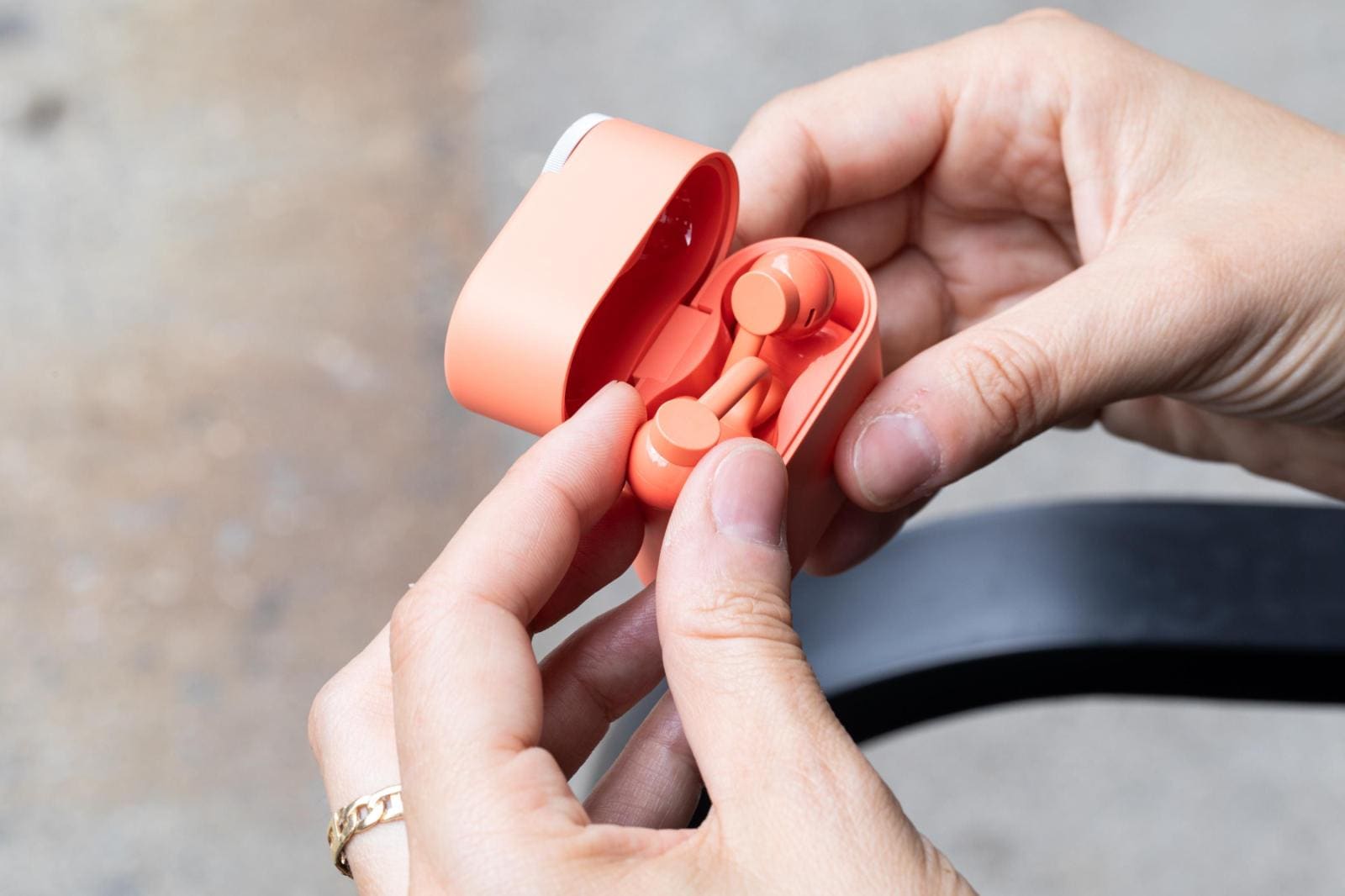
The Clip Pro use a hook mechanism that rests over the ear's upper curve, with the driver unit positioned just outside the canal opening. CMF ships three sizes of hook attachments in the box, allowing users to adjust for ear geometry. The housing is plastic, finished in matte black or white, and the total weight per earbud sits below six grams. This matters in a category where even modest imbalance translates to fatigue over multi-hour sessions.
Build quality aligns with the price point. The hinge that secures the earbud to the ear feels adequate rather than premium, and the charging case uses a friction-fit lid instead of a magnetic snap. Neither choice undermines daily function, but both signal where CMF trimmed cost. The case itself is compact enough for a jacket pocket and charges via USB-C. Battery life reaches approximately seven hours per charge with the case adding two full cycles, landing the Clip Pro in the middle of the pack for its category.
Acoustic Performance and the Limits of Open Air
Sound quality in clip earbuds is a negotiation between physics and user expectation. CMF equips the Clip Pro with 14.2-millimeter dynamic drivers, larger than the units found in many sealed in-ear models. The size helps push more air, but without a seal, bass energy dissipates before it reaches the eardrum. The result is a sound signature that tilts toward mids and highs, serviceable for podcasts and vocal-forward music but thin when reproducing kick drums or synthesizer sub-bass.
Leakage becomes audible to bystanders at around seventy percent volume in quiet environments. On public transit or in open offices, that threshold rises, but so does the risk of long-term hearing fatigue. CMF does not market the Clip Pro as audiophile hardware, and that restraint is appropriate. The product serves users who prioritize situational awareness and comfort over fidelity, a trade-off most acute in urban commuting and collaborative workspaces where hearing a colleague or an approaching vehicle outweighs bass extension.
Active noise cancellation is absent, which is consistent with the open-ear design philosophy. Passive isolation is minimal by definition. CMF includes a transparency mode toggle in its companion app, but the feature is redundant given how much ambient sound already passes through. The app itself offers a five-band equalizer and firmware update delivery, both functional but unremarkable.
Competitive Context and the Price Wedge
Bose and Sony have spent years refining their clip and open-ear offerings, incorporating adaptive EQ, multipoint Bluetooth, and premium materials. Those models retail between 180 and 200 dollars. Shokz, which pioneered bone-conduction audio and later pivoted to air-conduction designs, occupies a similar range. CMF undercuts all of them by more than fifty percent, a gap wide enough to pull in first-time buyers and users willing to sacrifice incremental fidelity for cost savings.
The broader context is Nothing's strategy of using CMF as a volume play in markets where brand loyalty is less entrenched. Clip earbuds remain a niche within the broader true-wireless category, but their growth trajectory in Asia-Pacific has been steeper than in North America, driven by urban density and the prevalence of two-wheeler commuting. CMF's pricing positions the Clip Pro as an accessible entry point in those geographies, where a hundred-dollar purchase represents a lower barrier than in higher-income markets.
Where the Clip Pro Succeeds
Comfort is the Clip Pro's strongest argument. Users who experience irritation from silicone tips or who develop ear canal inflammation after prolonged in-ear wear will find the hook design significantly less intrusive. The open format also eliminates occlusion effect, the hollow sensation that occurs when your own voice resonates inside a sealed ear canal. For video calls and voice-heavy workflows, that absence is meaningful.
Battery life and connectivity stability both meet baseline expectations. Bluetooth 5.3 provides reliable pairing with Android and iOS devices, and range extends to roughly ten meters in unobstructed environments. Call quality is adequate; the microphone array handles wind noise better than expected for the price, though it still struggles in high-traffic outdoor settings.
CMF also deserves credit for including multiple hook sizes and a carrying case at this price point. Competitors in the budget tier often skimp on accessories, shipping a single size and a drawstring pouch. The Clip Pro's case, while not premium, protects the earbuds and maintains charge, which is the functional floor.
The Acoustic Ceiling Remains Low
No amount of driver tuning or app-based EQ can overcome the fundamental constraint of open-air sound. Bass reproduction in the Clip Pro is serviceable for casual listening but falls apart under scrutiny. Genres that rely on low-frequency energy, from hip-hop to electronic, sound anemic. Leakage at higher volumes means the Clip Pro are poorly suited to library study sessions or late-night listening in shared spaces.
The absence of wear detection is another omission. Removing an earbud does not pause playback, a feature now standard in many sealed true-wireless models and present in some higher-end open-ear designs. For a product targeting convenience, the lack is notable.
CMF's app ecosystem is minimal. The equalizer offers basic adjustment, but the presets feel generic and the interface lags behind what OnePlus, Anker, and even Xiaomi deliver in their respective companion software. Firmware updates arrive over-the-air, but the release cadence and feature roadmap remain unclear.
Market Implications and the Volume Calculus
CMF's entry into clip earbuds signals that Nothing views the category as ripe for price disruption. The company has applied the same playbook it used with its Phone and Buds lines: identify a segment where incumbents charge a premium, strip features to the essentials, and undercut by forty to fifty percent. The strategy has worked in markets where brand prestige carries less weight than functional adequacy and price.
The risk is that clip earbuds, unlike sealed in-ear models, have a narrower enthusiast base. The acoustic compromises inherent to the form factor limit repeat purchase behavior; users who prioritize sound quality eventually migrate back to sealed designs or over-ear headphones. CMF's bet is that the addressable market of comfort-first and safety-conscious users is large enough to sustain volume, even if retention is lower than in other categories.
Competitors will likely respond with their own price compression, particularly in Asia-Pacific markets where CMF has distribution strength. Anker's Soundcore line and Xiaomi's Redmi Buds portfolio both have the supply chain scale to match CMF's pricing if the category shows momentum. The next twelve months will clarify whether clip earbuds can grow beyond niche status or remain a secondary option for users with specific use cases.
Verdict in Context
The CMF Clip Pro deliver what their price promises: a functional, comfortable open-ear listening experience with predictable compromises. They will not satisfy users who prioritize bass response or acoustic isolation, nor will they impress anyone seeking premium build quality. But for urban commuters, office workers who need to remain alert to their surroundings, and budget-conscious buyers exploring the category for the first time, the Clip Pro represent a rational entry point.
The product's success will depend less on its acoustic performance than on CMF's ability to communicate the trade-offs clearly and reach distribution channels where price sensitivity is high. In markets where a hundred-dollar purchase is considered carefully, the Clip Pro offer enough utility to justify the spend. In markets where twice that amount is trivial, the compromises will feel less forgivable. The gap between those realities is where CMF is building its business.