Insta360's Decade Bet: Letting AI Frame Your Shots
The X6 flagship marks a strategic pivot from manual controls to computational creativity - a move that could redefine prosumer imaging or alienate purists.
A Birthday Gift That Signals a Fork in the Road
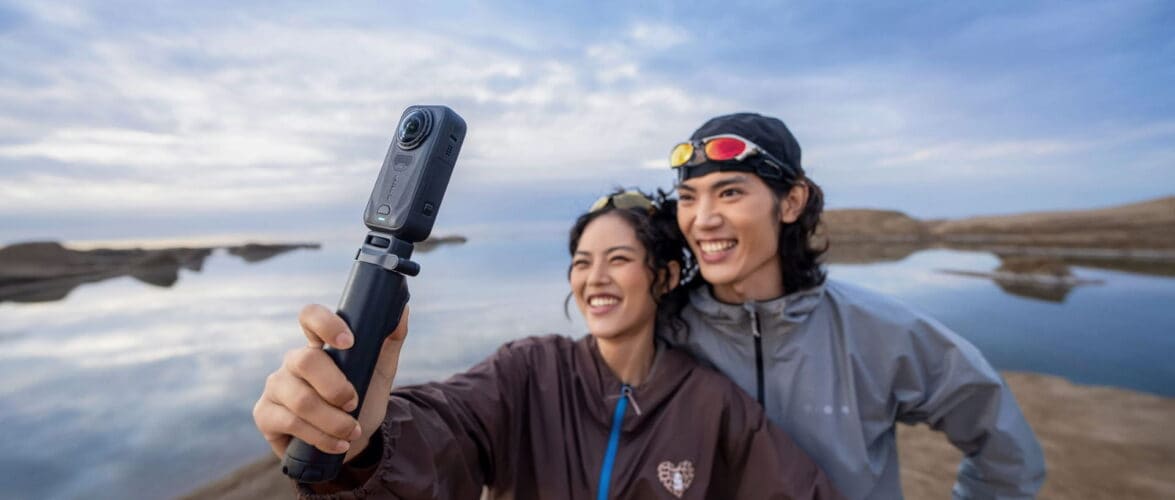
On its tenth anniversary in the 360 camera market, Insta360 released the X6, priced from 3,999 yuan (approximately USD 592) in mainland China. The device is not simply an incremental hardware refresh. At DailyTechWire, we've tracked the company's evolution from niche immersive-capture specialist to prosumer mainstay, and the X6 represents a strategic inflection: Insta360 is betting that the next wave of growth lies not in better glass or higher resolution, but in delegating creative decisions to the camera itself - and to the machine-learning models running inside it.
For a decade, the competitive axis in 360 imaging revolved around sensor fidelity, form factor, and ergonomics. Insta360's earlier flagships prioritized low-light performance, weatherproofing, and intuitive controls - features that mattered when the bottleneck was capture quality and user friction. The X6 still delivers on those fronts, but its headline proposition is different: automated subject tracking, intelligent reframing, and AI-assisted editing that claims to anticipate what the shooter would have chosen manually. In effect, the camera is becoming a co-author.
From Capture Tool to Creative Partner
The shift is architectural. Traditional action cameras and mirrorless bodies treat the photographer as the decision-maker: you frame, you expose, you edit. The X6 inverts that workflow. Its onboard processing pipeline analyzes the spherical footage in real time, identifies subjects of interest, and suggests - or in some modes, autonomously executes - crop and pan decisions that would historically require post-production labor in software like Premiere or Final Cut.
This is not entirely new. Computational photography has been mainstream on smartphones since Google's HDR+ and Apple's Deep Fusion. But 360 cameras present a unique problem: they capture everything, which means the editorial burden shifts entirely to post. A two-hour hike yields terabytes of omnidirectional video, and extracting a coherent three-minute highlight reel demands either algorithmic assistance or punishing manual scrubbing. Insta360's wager is that most prosumers - travel vloggers, action-sports creators, real-estate agents - will gladly trade editorial control for speed and ease.
The X6's AI modules handle subject detection (faces, vehicles, animals), motion prediction, and aesthetic scoring. If you mount the camera on a helmet during a mountain-bike descent, the system attempts to keep you centered in frame, smooth out jarring head movements, and select the most "dynamic" segments based on acceleration data and visual saliency. The output is a conventional 16:9 video file, ready for social upload, with minimal user intervention.
The Trade-Off: Speed Versus Authorship
The appeal is obvious for high-volume creators who treat cameras as productivity tools. A real-estate agent shooting ten property walkthroughs per day cannot afford to spend an hour editing each one. A travel influencer posting daily reels from Bali or Patagonia needs turnaround measured in minutes, not afternoons. For these users, the X6's automation is a margin-expander.
But the same automation poses a risk. Creative professionals - documentary filmmakers, brand agencies, cinematic vloggers - often resist black-box decision-making. If the algorithm decides which moments are "interesting" and how to frame them, the resulting edit reflects the training data and heuristics baked into Insta360's models, not the shooter's intent. A film-school graduate who spent years learning composition and pacing may find the AI's choices pedestrian or formulaic. And because 360 editing software typically allows manual override, the question becomes: does the AI save time, or does it simply add a layer of friction - requiring users to audit and correct its suggestions?
Insta360 has not disclosed the provenance or architecture of its models. We do not know whether they were trained on user-uploaded content, licensed stock footage, or synthetic data. We do not know whether they optimize for engagement metrics (watch time, click-through) or aesthetic principles (rule of thirds, leading lines). That opacity is standard in consumer electronics, but it becomes consequential when the product claims to make creative judgments on your behalf.
Competitive Context: DJI, GoPro, and the Prosumer Squeeze
Insta360 operates in a compressed market. DJI's Osmo Action series and GoPro's Hero lineup dominate the action-camera segment, and both have experimented with AI stabilization and auto-editing features. GoPro's Quik app, for instance, has offered algorithmic highlight reels since 2019. But neither competitor has leaned as heavily into full-frame AI authorship as the X6 proposes.
The differentiation may reflect Insta360's narrower product focus. While DJI spans drones, gimbals, and cinema rigs, and GoPro has diversified into subscriptions and media licensing, Insta360 remains anchored in 360 capture. That specialization allows it to invest more engineering bandwidth into software differentiation - but it also leaves less room for hardware commoditization. If the X6's AI features fail to resonate, the company has fewer fallback revenue streams.
Pricing is competitive but not disruptive. At just under USD 600, the X6 sits between GoPro's Hero 13 Black (around USD 400) and DJI's Osmo Action 5 Pro (around USD 500), while offering a fundamentally different capture paradigm. The question is whether the 360 form factor - and the AI editing promise - commands a premium in a market where most social platforms still favor traditional aspect ratios and where vertical video has become the default for mobile-first audiences.
The Broader Trajectory: Cameras as Inference Engines
Insta360's direction is part of a broader industry pattern. Computational photography has migrated from flagship smartphones to dedicated cameras, and the next frontier is computational creativity: devices that not only enhance images but generate editorial decisions. Adobe's Sensei, Runway's Gen-2, and OpenAI's Sora all point toward a future where "shooting" and "editing" collapse into a single, AI-mediated step.
The X6 is an early experiment in that convergence. If users embrace it, we should expect competitors to follow - and for the feature set to expand. Future iterations might offer voice-driven editing ("give me a 30-second reel with upbeat pacing"), style-transfer filters ("edit this like a Wes Anderson film"), or even collaborative AI that learns individual users' preferences over time. The technical capability exists; the open question is whether creators want it.
At DailyTechWire, we see two plausible trajectories. In the optimistic case, AI-assisted editing democratizes high-quality content production, lowering the skill floor and enabling a new cohort of creators who lack formal training but possess compelling stories. In the pessimistic case, it homogenizes output, as everyone's videos begin to look like everyone else's - because they were all framed and paced by the same model.
What to Watch
Insta360's tenth-anniversary release is a referendum on how much creative agency prosumers are willing to cede. The X6's success will hinge not just on hardware specs - sensor size, battery life, weatherproofing - but on whether its AI makes users feel empowered or displaced. Early adopters will vote with their wallets, and their feedback loops - reviews, forum discussions, tutorial ecosystems - will shape the product roadmap for the next generation.
For now, the X6 represents a clear thesis: that the future of prosumer imaging is less about capturing everything and more about letting algorithms decide what matters. Whether that thesis holds will depend on execution, transparency, and the willingness of a creative community to trust a camera that increasingly thinks for itself.