Intel's Panther Lake Chip Breathes New Life Into Portable Gaming PCs
MSI's latest handheld outperforms rivals in power efficiency and sleep reliability, yet gaps remain before Windows portables can match the Steam Deck's polish.
A Benchmark Shift in Portable Gaming Hardware
Portable gaming PCs have spent the past three years chasing Valve's 2022 playbook. The Steam Deck established the category's physics: acceptable performance, manageable thermals, battery life measured in hours rather than minutes. Every AMD-powered competitor since has iterated within those constraints, trading incremental clock speed gains for slightly thinner bezels or fractionally better screens.
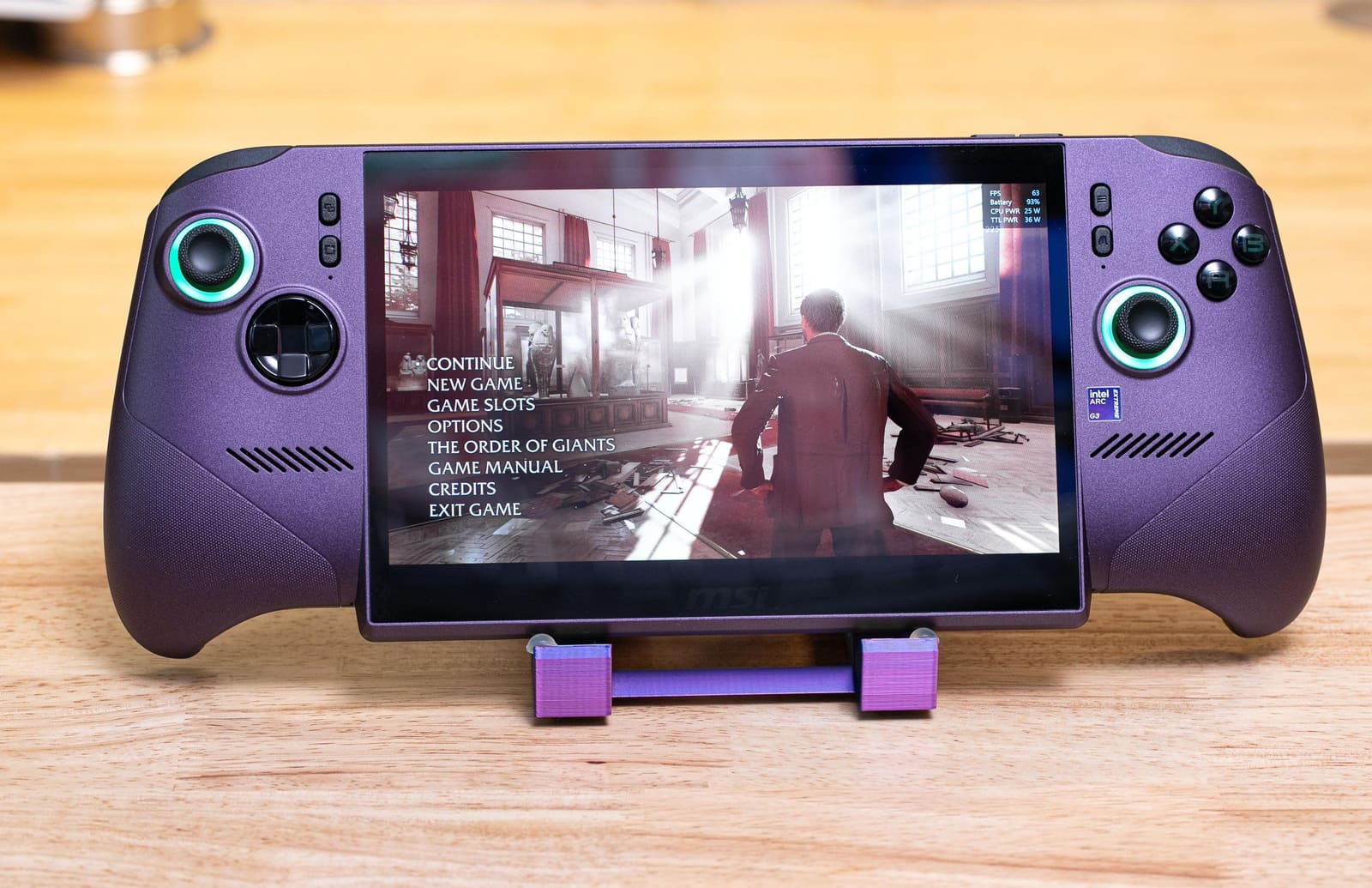
MSI's Claw 8 EX AI Plus breaks that pattern. The device centers on Intel's latest silicon, a chip architecture that appears to have solved the two problems that have plagued Windows handhelds since their inception: power draw under load and sleep-state reliability. For the first time, a non-Valve portable offers both higher sustained performance than the Steam Deck and longer runtime between charges.
At DailyTechWire, we've tracked the handheld arms race across Asia's manufacturing hubs - from Shenzhen assembly lines to Taipei's component supply chains. The Claw EX represents something rarer than a spec bump: a genuine platform advancement that changes what portable x86 gaming can be.
Power Efficiency as the Real Differentiator
The performance story here isn't about peak frame rates. It's about maintaining playable performance across an entire cross-country flight without tethering to an outlet. Intel's next-generation architecture, built on a refined process node, delivers watts-per-frame efficiency that previous Meteor Lake chips couldn't approach.
In practical terms, this means running AAA titles at medium-to-high settings for stretches that would have drained earlier handhelds to critical battery levels. The thermal envelope stays manageable - no hand-scorching exhaust vents, no thermal throttling that tanks frame times mid-session. MSI's cooling solution, likely benefiting from lessons learned in their laptop division, keeps the SoC within operational sweet spots even during sustained loads.
The battery life advantage compounds over time. Where competing devices force players into a mental calculus - Do I have enough charge left to start this dungeon? Should I drop settings now to stretch another thirty minutes? - the Claw EX pushes those anxieties further into the background. It's still a finite resource, but the margin is wide enough that gameplay decisions stop being battery decisions.
Windows Sleep Mode Finally Works
The more significant engineering achievement may be sleep state management. Every Windows handheld before this has treated suspend-and-resume as a dice roll. Press the power button, and you might return to your paused game - or to a drained battery, a crashed driver, or a device that refuses to wake without a hard reset.
MSI and Intel have apparently solved this at the firmware and driver level. The Claw EX enters a true low-power state that persists for days, not hours. Wake it up, and your game session resumes within seconds, save state intact, battery drain negligible. This isn't novel for Steam Deck owners - Valve's custom Linux stack has delivered this since launch - but it's transformative for Windows portables.
The implications extend beyond convenience. Reliable sleep makes a handheld device genuinely portable in the way a smartphone is portable: you can close it mid-thought, throw it in a bag, and trust it will be ready when you pull it out three days later. That behavioral shift matters more than benchmark numbers. It's the difference between a device you plan sessions around and one you grab opportunistically.
Why It Still Doesn't Win
For all its technical merit, the Claw EX remains a Windows handheld, and that carries structural disadvantages no hardware upgrade can erase. The operating system wasn't designed for seven-inch touchscreens and thumbstick navigation. Game launchers assume mouse input. Driver updates arrive on unpredictable schedules, sometimes breaking compatibility with specific titles until patches trickle through.
Valve's Steam Deck runs a custom Linux distribution tailored pixel-by-pixel for handheld use. Every menu, every system setting, every background process is optimized for the form factor. Windows on a portable PC is a retrofit, no matter how much MSI polishes the overlay software. The Claw EX performs better and lasts longer, but it still requires more troubleshooting, more manual configuration, more tolerance for jank.
The device also arrives at a price point that undercuts its own argument. Competing handhelds from ASUS and Lenovo have narrowed their efficiency gaps with firmware updates and revised cooling designs. The Steam Deck OLED, meanwhile, offers a more cohesive software experience at a lower entry cost. MSI's engineering achievements are real, but they don't translate into a clear purchase recommendation for most players.
Intel's Stake in the Handheld Market
The Claw EX matters less as a must-buy product than as a proof point for Intel's roadmap. The company ceded the handheld market to AMD by default - Ryzen Z1 chips powered nearly every major release in 2023 and 2024. This device demonstrates that Intel can compete on the metrics that matter in portable gaming: performance per watt, idle power draw, thermal design.
If Intel's next-generation architecture scales down to handheld TDPs without sacrificing these gains, the competitive landscape shifts. AMD's semi-custom chip dominance in portables has mirrored its position in game consoles: a combination of early investment, developer relationships, and power efficiency that competitors struggled to match. Intel now has a viable counter-narrative.
For OEMs across Taipei and Shenzhen, that means renewed negotiating leverage and potential cost advantages as Intel fights for design wins. The handheld category remains small compared to laptops or desktops, but it's growing, and it serves as a proving ground for low-power architectures that eventually filter into ultrabooks and tablets.
The User Experience Gap Persists
Hardware capabilities have never been the primary barrier to Windows handheld adoption. The Steam Deck succeeded because Valve controlled the entire stack - silicon partnerships, operating system, storefront, controller layout, suspend/resume behavior. Every element reinforced the others. Windows handhelds succeed despite their software, not because of it.
MSI has done admirable work on its overlay interface, the software layer that attempts to paper over Windows' handheld inadequacies. It's still a band-aid. You'll still occasionally need to pull up the full Windows desktop to adjust a setting, troubleshoot a driver conflict, or force a game launcher to behave. You'll still encounter titles that don't scale UI elements properly for small screens. You'll still wait through Windows updates that reboot the device at inconvenient moments.
These friction points compound. Individually, none is disqualifying. Cumulatively, they erode the pick-up-and-play ease that defines a successful handheld. The Claw EX reduces that friction more than any previous Windows portable, but it doesn't eliminate it.
What Comes Next for Portable x86
The handheld category is fragmenting. Valve has staked out the integrated, opinionated approach. ASUS, Lenovo, and now MSI are iterating on high-performance Windows devices for players willing to tinker. A third path may emerge from custom Linux distributions like Bazzite or ChimeraOS, which attempt to replicate the Steam Deck experience on third-party hardware.
MSI's engineering choices point toward a future where Windows handhelds don't need to apologize for battery life or sleep reliability. Those were existential problems two years ago; they're mostly solved now, at least on devices using cutting-edge silicon. The remaining gaps are software and ecosystem issues - harder to fix, slower to improve, but not insurmountable.
The Claw EX won't dethrone the Steam Deck. It will, however, raise the floor for what players should expect from a Windows handheld. Reliable sleep, all-day battery, and sustained performance are no longer theoretical goals - they're shipping features. That shifts the conversation from "Can Windows handhelds work?" to "When will the software experience catch up to the hardware?"
For Intel, that's a win. For MSI, it's a credible statement of capability. For players, it's a device that does most things very well but still asks you to meet it halfway.