SpaceX Shrinks Starlink Terminal by 73% as It Chases Scale
The V5 dish weighs 2.4 pounds and draws half the power of its predecessor, but SpaceX is reserving it for entry-tier subscribers in a quiet rollout that signals shifting economics in satellite broadband.
A Terminal Built for Manufacturing, Not Speed
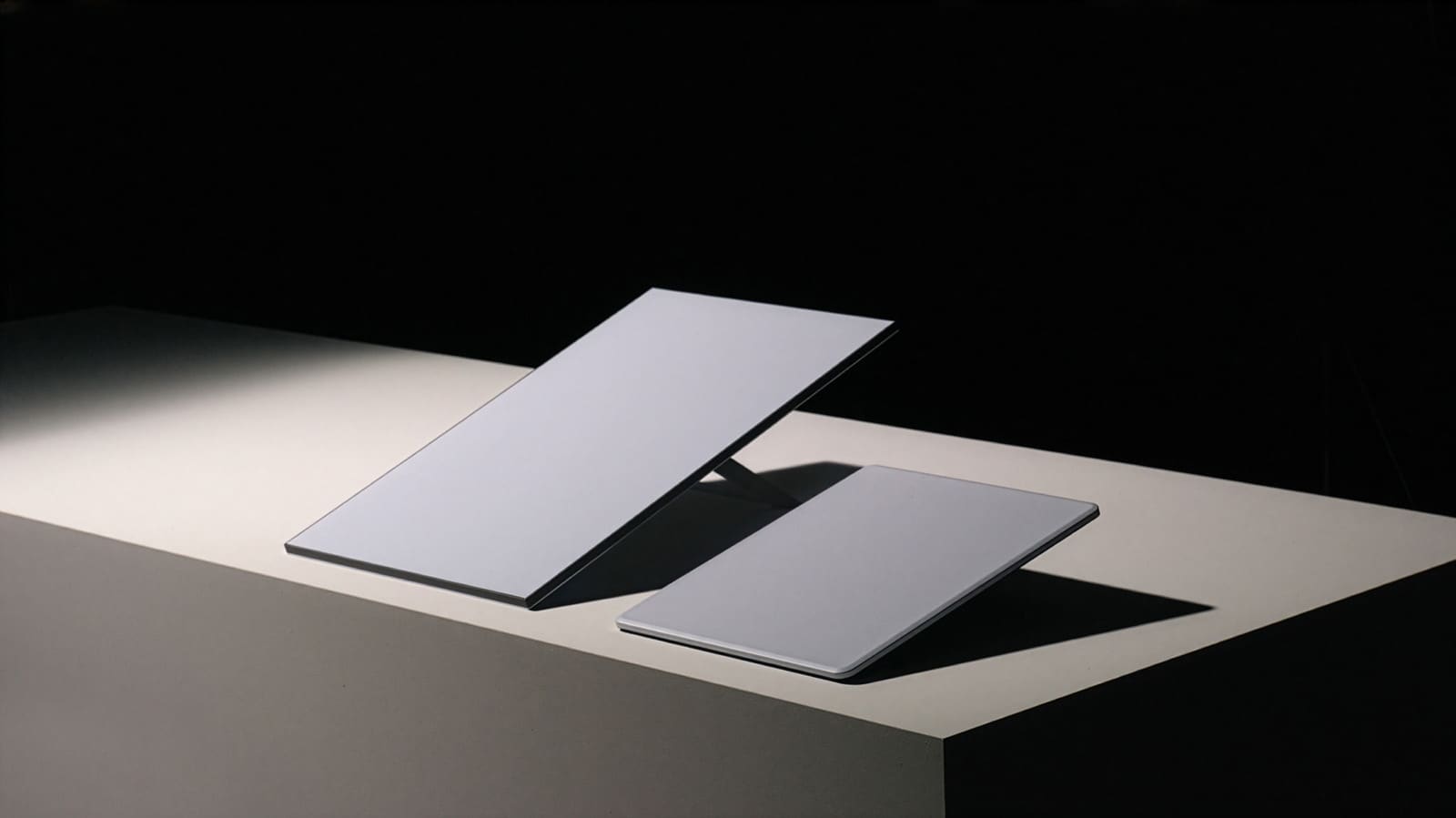
SpaceX has begun shipping its fifth-generation residential satellite dish this week, and the headline isn't throughput - it's footprint. The V5 terminal measures 5.12 by 12.05 by 1.34 inches and weighs 2.4 pounds, a 73 percent reduction in volume and 63 percent drop in mass compared to the 23.4-inch V4 dish that arrived in 2023. Power draw falls by roughly half, landing between 35 and 50 watts versus the V4's 75 to 100 watts.
The trade-off is modest: maximum downlink speed drops from over 400 Mbps on the V4 to 375 Mbps-plus on the V5. For a company that has historically used each hardware generation to unlock higher data rates, the decision to prioritize size and efficiency over raw speed marks a strategic inflection. Elon Musk alluded to the reasoning in a recent video, noting that the V5 will be produced in "much higher volume" than existing terminals. That language points to manufacturing cost as the binding constraint - SpaceX needs cheaper, faster-to-build hardware if it's going to serve tens of millions of subscribers rather than hundreds of thousands.
Entry-Tier Rollout in Select Markets
The V5 is appearing first in limited U.S. regions, bundled exclusively with SpaceX's $55-per-month 100 Mbps Residential plan - the lowest tier in the Starlink lineup. Subscribers in Drummond, Montana, for instance, now see the V5 offered alongside the compact Router Mini and a pipe adapter for rooftop mounting. Higher-priced Residential and Residential Max plans continue to ship with the larger V4 dish and the more capable Router 3.
This segmentation is unusual. Typically, a next-generation terminal replaces its predecessor across all service tiers; here, SpaceX is running two product lines in parallel, each mapped to a different price band. The move suggests the company is testing whether cost-conscious customers - those willing to accept 100 Mbps caps - will tolerate a smaller performance ceiling in exchange for lower hardware cost and easier self-installation. If adoption proves strong, SpaceX may eventually retire the V4 altogether, but for now the bifurcation lets the company hedge: premium subscribers still get the faster dish, while the mass market gets a terminal optimized for volume production and logistics.
Power Efficiency and the Economics of Off-Grid Deployment
Halving power consumption has implications beyond the electric bill. Many Starlink users live in rural or off-grid locations where solar panels and battery banks are the primary energy source. A 35-watt terminal can run nearly twice as long on the same battery capacity as a 75-watt unit, which in turn allows smaller, cheaper solar arrays. For SpaceX, lower power draw also eases thermal design and component stress, potentially extending hardware life and reducing warranty claims - both meaningful levers when unit economics are under scrutiny.
At DailyTechWire, we've tracked similar dynamics in the cellular base-station market, where operators have spent the past decade driving down watts-per-bit to make rural 4G and 5G economically viable. SpaceX is applying the same calculus to satellite ground equipment: if you can't easily raise subscription revenue, you tighten the cost structure on both ends - hardware and operating expense.
What the V5 Shares with Starlink Mini, and Where It Differs
The V5's 2.4-pound weight nearly matches the portable Starlink Mini, yet SpaceX explicitly states the V5 is not rated for in-motion use. The Mini employs different antenna phasing and tracking algorithms to maintain lock while moving in a vehicle or RV; the V5 lacks that firmware and likely uses a simplified feed design to cut cost. This distinction matters for product positioning: the Mini commands a premium because mobility adds complexity, while the V5 is a stationary terminal stripped to essentials.
Both products, however, share a design philosophy - minimize material, maximize yield. The V5's slim profile suggests fewer layers in the phased-array substrate and possibly a shift to lower-cost RF front-end components. SpaceX has not disclosed the bill of materials, but industry estimates for earlier Starlink dishes ranged from $500 to over $1,000 per unit; driving that figure below $300 would be the threshold at which hardware subsidies become sustainable at scale.
Capacity Crunch and the 2027 Mobile Bet
The V5 arrives as SpaceX prepares to launch its next-generation Starlink Mobile network in mid-2027, promising up to 150 Mbps to smartphones and a user experience comparable to high-performance terrestrial 5G. That service will rely on a new constellation of larger, more powerful satellites - likely the V2 Mini and eventual V3 buses - that can deliver higher effective isotropic radiated power (EIRP) to small, low-gain antennas.
Residential terminals like the V5, by contrast, connect to the existing Gen2 constellation, which is capacity-constrained in many markets. By capping the entry-tier plan at 100 Mbps and offering a terminal that peaks at 375 Mbps, SpaceX is effectively rationing bandwidth: subscribers who need more speed must pay for a higher tier and use the V4 dish, which can better exploit available satellite capacity during off-peak hours. This tiered approach mirrors mobile carriers' use of QoS policies to manage congestion, and it will likely become more pronounced as SpaceX onboards millions of additional users before the mobile constellation is fully deployed.
Where This Leaves the Performance Tier
Last year SpaceX introduced a $2,000 Performance dish engineered for gigabit throughput, targeting business and enterprise customers. That product sits at the opposite end of the spectrum from the V5 - larger aperture, higher gain, active cooling - and serves a market willing to pay for guaranteed capacity and lower latency. The Performance dish underscores SpaceX's segmentation strategy: one hardware line for cost-sensitive residential users, another for commercial accounts where connectivity is mission-critical.
The question is whether the middle tier - the standard Residential plan with the V4 dish - remains viable long-term. If manufacturing and logistics costs continue to favor smaller terminals, SpaceX may eventually offer only the V5 for residential subscribers and reserve larger dishes exclusively for business plans. That would simplify the supply chain and inventory management, but it would also mean accepting a permanent speed ceiling for the consumer segment - a trade-off that competitors like Amazon's Kuiper and emerging low-Earth-orbit constellations will watch closely.
Volume Production as the Path to Profitability
Musk's emphasis on "much higher volume" production is the signal that matters most. SpaceX has poured billions into building and launching satellites; ground equipment has been the other half of the capital equation, and until now, manufacturing scale has lagged. The V5's compact design likely enables higher throughput on existing assembly lines - more units per hour, lower scrap rates, simpler quality control - and reduces shipping costs due to smaller packaging.
If SpaceX can drive terminal cost below $250 and maintain a $55 monthly subscription, the payback period drops to under five months, assuming gross margin above 50 percent on service revenue. That math makes customer acquisition scalable without venture or debt financing for every incremental subscriber. In markets like India, Southeast Asia, and sub-Saharan Africa - where terrestrial broadband remains sparse - a $250 terminal and $50-$60 monthly fee could unlock hundreds of millions of potential users, provided regulatory and spectrum hurdles are cleared.
The V5 is not a performance breakthrough; it's an industrialization play. SpaceX is betting that the path to profitability runs through cheaper hardware, higher unit volumes, and tighter operational efficiency - even if that means capping speeds for the majority of subscribers. Whether that bet pays off will depend on how quickly competitors can match or undercut SpaceX's cost structure, and whether regulators in key growth markets allow unfettered access to Ka-band and Ku-band spectrum. For now, the V5 signals that SpaceX is prioritizing scale over speed, and manufacturing economics over headline specs.