Samsung Teases Wider Passport Design for Galaxy Z Fold 8 in Spider-Man Promo
A Marvel tie-in clip reveals the foldable's new form factor ahead of next week's Unpacked event, as Samsung races Apple to define the next generation of book-style devices.
A Foldable Emerges from the Printer
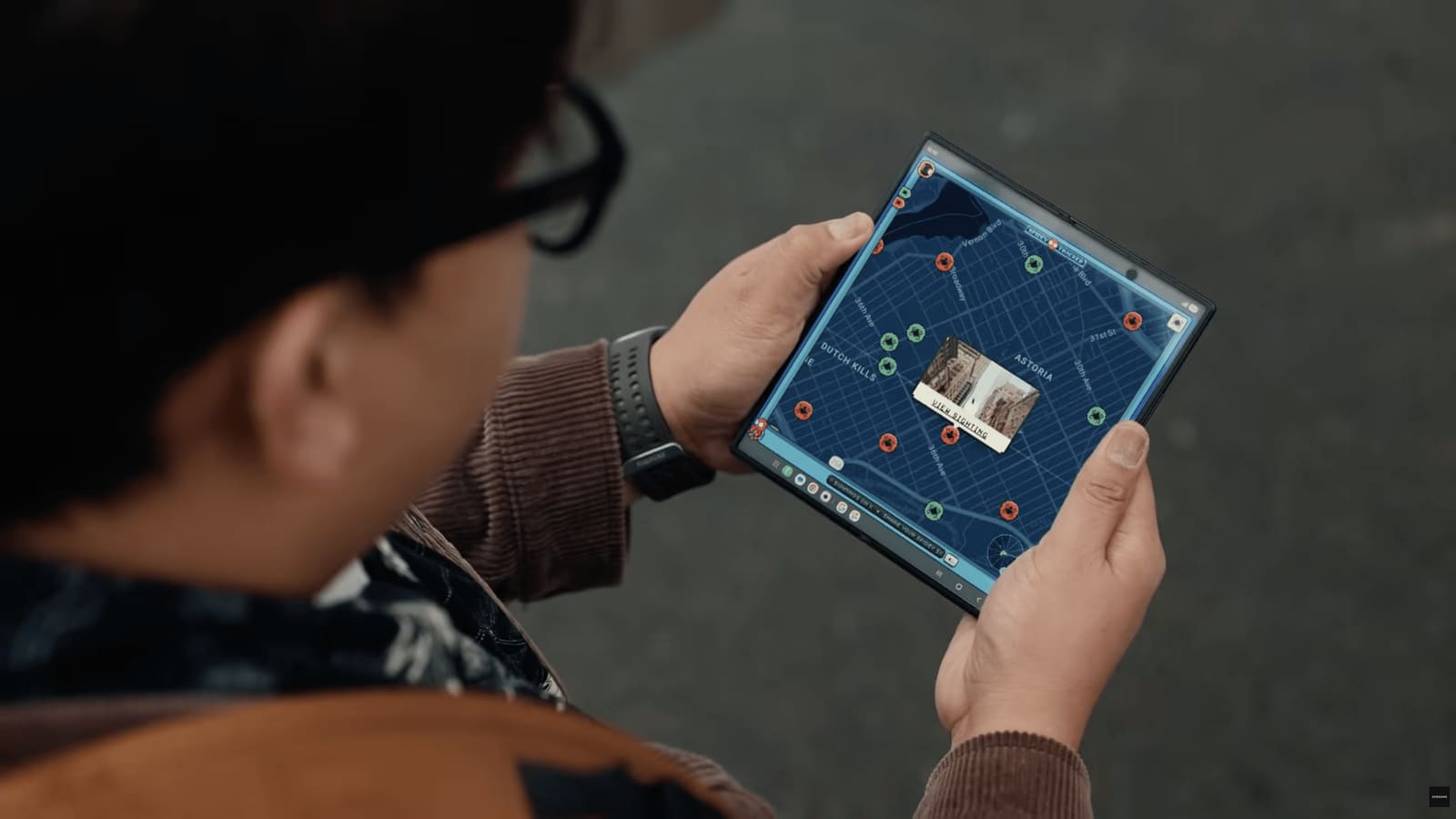
Samsung's latest product tease arrives not through a polished keynote slide, but through a superhero's hands. In a promotional clip for the upcoming Spider-Man: Brand New Day film, the web-slinger pulls a foldable device fresh from a 3D printer and unfolds it in book-style orientation. The footage is deliberately obscured by lens flares and quick cuts, but the silhouette tells a different story than the seven generations of Galaxy Z Fold that came before it.
The device appears noticeably wider than Samsung's current flagship foldable, suggesting the company has moved away from the tall, narrow external display that has defined the Z Fold line since its inception. Industry watchers have anticipated this shift for months, and the teaser confirms Samsung is ready to bet on a form factor that prioritizes usability over pocketability.
The Passport Gambit
The redesign represents Samsung's most significant departure from its established foldable formula. Current Z Fold models unfold to tablet-like proportions but close into a device with a cramped, pencil-thin cover screen that many users find awkward for single-handed typing or quick tasks. A passport-style shape, by contrast, offers a more conventional smartphone aspect ratio when folded, at the cost of a slightly thicker profile overall.
This trade-off has divided the Android foldable ecosystem. Chinese manufacturers including Xiaomi, Oppo, and Honor have already embraced wider designs in their domestic markets, where consumer feedback has been overwhelmingly positive. Samsung, however, has held firm to its original vision, until now. The timing of this pivot is not coincidental. At DailyTechWire, we've tracked growing pressure on Samsung from both competitor momentum in Asia and persistent rumors that Apple is preparing to enter the foldable category with a device that mirrors these proportions.
Cupertino's Shadow
Apple's rumored foldable iPhone looms large over Samsung's decision calculus. While Cupertino has remained characteristically silent on its foldable ambitions, supply chain reports throughout the first half of 2026 have pointed to prototype testing of a book-style device with dimensions that closely match the "passport" descriptor. If Apple does launch such a product later this year, it would mark the company's first entry into a category Samsung has dominated since 2019.
The competitive dynamics are complex. Samsung holds a commanding lead in foldable shipments globally, but Apple's entry would instantly legitimize the form factor for millions of iPhone users who have remained skeptical. A wider design from Samsung could preempt Apple's narrative, positioning the Z Fold 8 as the device that "got it right" before Cupertino even arrived. Alternatively, it could signal that both companies have concluded, independently or otherwise, that the narrow design was a developmental dead end.
Unpacked on the Horizon
Samsung has scheduled its Galaxy Unpacked event for July 22nd, one week from the teaser's release. The company is expected to unveil not only the Z Fold 8 but also refreshed versions of its Z Flip clamshell, Galaxy Watch lineup, and possibly new earbuds. The Spider-Man collaboration is a familiar marketing play for Samsung, which has partnered with Marvel Studios on several previous device launches to reach younger, tech-forward audiences.
What remains unclear is how Samsung will position the design change to its existing customer base. Z Fold loyalists have spent years adapting to the narrow cover screen, and some may resist a form factor that sacrifices one-handed portability for broader usability. The company will need to articulate a clear value proposition that justifies the shift beyond "this is what everyone else is doing."
The Foldable Market Recalibrates
Samsung's apparent design pivot arrives as the foldable smartphone market enters a new maturity phase. Early adopters have already cycled through multiple generations of devices, and manufacturers are now competing for mainstream buyers who prioritize practical daily use over novelty. Durability has improved significantly, with hinge mechanisms and ultra-thin glass now lasting well beyond the 200,000-fold thresholds that initially seemed ambitious.
Yet adoption remains concentrated in specific geographies. Foldables have found strong footholds in South Korea, China, and parts of Southeast Asia, but penetration in North America and Europe lags. Pricing is one barrier; even with incremental cost reductions, foldables command premiums of 50 to 100 percent over comparable flagship slabs. Form factor confusion is another. Consumers who briefly handled a Z Fold in a retail environment often walked away uncertain whether the device would fit their usage patterns.
A wider Z Fold 8 could address the second concern by offering a more familiar smartphone experience when closed, reducing the learning curve for first-time foldable buyers. It also positions Samsung to compete more directly with Chinese rivals if those manufacturers expand aggressively into Western markets in the coming year.
What Samsung Must Prove
The teaser generates anticipation, but Samsung faces a steep burden of proof at Unpacked. The company must demonstrate that the new shape delivers tangible benefits in real-world scenarios: longer battery life enabled by a larger internal volume, improved app compatibility on the cover screen, better weight distribution, or enhanced durability. Marketing flash will not suffice for a product category where early missteps, such as the original Galaxy Fold's screen failures in 2019, still linger in collective memory.
Samsung must also navigate the software challenge. Android's large-screen optimization has improved, but many apps still struggle with seamless transitions between folded and unfolded states. A wider cover screen may ease some of these friction points, yet it also raises user expectations for parity with standard smartphone experiences. If the Z Fold 8 cannot deliver that parity, the redesign risks feeling like a lateral move rather than an evolution.
The Spider-Man teaser is clever brand theater, but the foldable market no longer rewards novelty alone. Samsung's next week will determine whether the passport shape is a genuine breakthrough or simply the industry's latest consensus on compromise.