SpaceX Alumni Launch Automated Steel Factory Targeting Data Centers and Nuclear Reactors
1872's Cincinnati facility aims to automate steel fabrication with AI-driven software and robotics, starting with modular infrastructure components.
From Rocket Engines to Steel Frames
Three engineers who spent years perfecting propulsion systems at SpaceX have pivoted to a decidedly terrestrial challenge: automating the fabrication of steel components for infrastructure. Their venture, 1872, opened its first production facility in Cincinnati in late July, betting that the same robotics and software discipline that powers launch vehicles can transform how the construction industry sources its steel foundations.
The company has set its sights on a narrow but lucrative segment: steel skids, the rectangular frames that serve as moveable bases for modular buildings and industrial equipment. At DailyTechWire, we've tracked the modular construction wave across Asia and North America, and the bottleneck has consistently been fabrication speed and precision. 1872's pitch is that AI-driven tooling can compress lead times and reduce the error rate that plagues traditional steel shops.
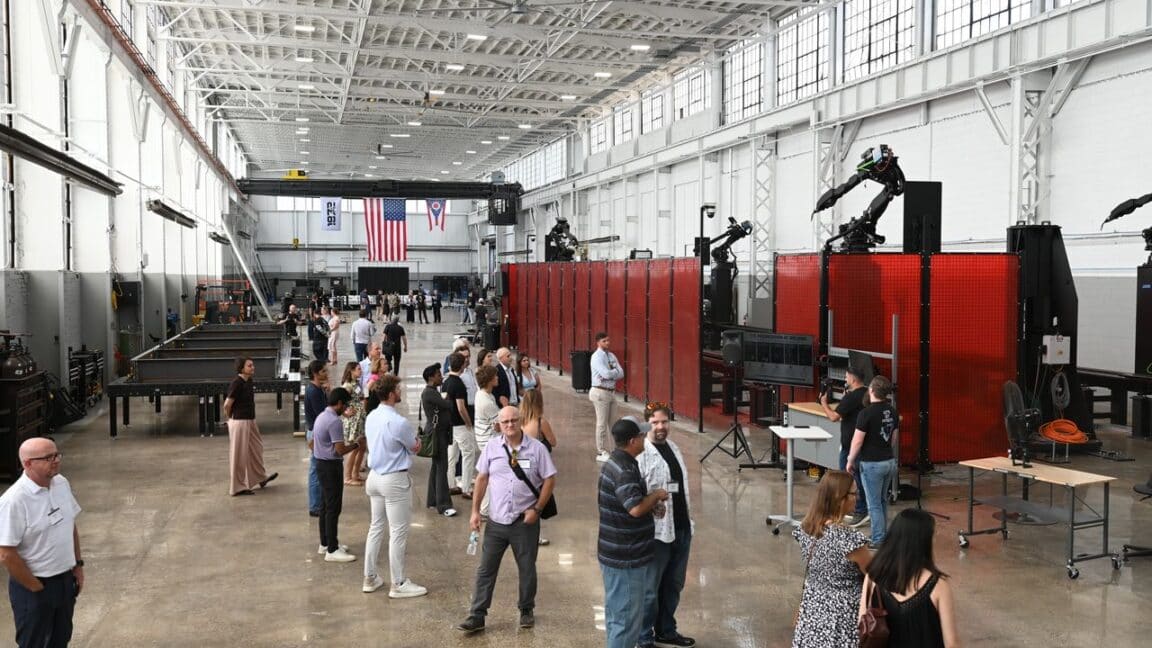
Dan Summers, who leads the startup as CEO, opened Factory One with a ribbon-cutting ceremony that underscored the company's dual ambitions: serve the hyperscale data-center buildout and the emerging small modular nuclear reactor market. Both sectors demand steel structures that meet tight tolerances and can be deployed rapidly, often in remote or constrained sites.
Pragmatic Autonomy, Not Dogma
Summers and his co-founders are steering clear of the full-autonomy rhetoric that has stumbled so many robotics ventures. Instead, 1872 is targeting roughly 80 percent autonomous operation by 2027, a threshold the team believes balances cost savings with operational flexibility. The remaining fifth of the workflow, Summers explained, may involve human oversight for quality checks, material handling edge cases, or order customization that software cannot yet economically handle.
This stance reflects a broader shift in industrial automation: companies are learning that the last 20 percent of autonomy often devours disproportionate capital and engineering time. By capping ambition at a pragmatic ceiling, 1872 can allocate resources to scaling throughput and refining the software stack that orchestrates cutting, welding, and finishing processes.
The prototype factory in Cincinnati will serve as both a production line and a live laboratory. The founders plan to iterate on robot task planning, sensor fusion for weld inspection, and inventory management algorithms, feeding real-world performance data back into the software. If the model works, subsequent factories can be replicated with shorter commissioning cycles, a playbook borrowed from SpaceX's own approach to manufacturing standardization.
Infrastructure Tailwinds: Data Centers and Nuclear
1872's timing aligns with two infrastructure surges. Hyperscalers and AI labs are racing to commission gigawatt-scale data centers, many of which rely on modular construction to shave months off project schedules. Steel skids anchor these modular units, supporting cooling systems, backup generators, and electrical switchgear. Demand has outstripped the capacity of legacy fabricators, creating an opening for automated entrants.
Parallel to that, small modular reactor developers are advancing toward commercial deployment, with several North American and European projects slated for the late 2020s. SMRs require precision-fabricated steel structures for reactor housings, heat exchangers, and auxiliary systems. Traditional steel shops struggle with the documentation rigor and traceability that nuclear applications mandate; software-driven manufacturing can embed compliance checks directly into the production workflow.
The Cincinnati facility is positioned within a day's truck haul of multiple Midwest data-center clusters and potential SMR sites in Ohio and Pennsylvania. Geography matters in steel: shipping costs and lead times can erode the economics of remote fabrication, so proximity to end customers will be a competitive lever for 1872 as it scales.
The SpaceX Pedigree and Its Limits
The founders' SpaceX background carries weight in venture circles and with early customers who associate the brand with execution speed and vertical integration. Rocket manufacturing demands tight tolerances, supply-chain control, and rapid iteration, all of which translate conceptually to steel fabrication. But the analogy has limits. Aerospace operates on unit economics that tolerate high touch labor and bespoke tooling; construction steel competes on price per ton and delivery predictability, with far thinner margins.
1872 will need to prove that automation can drive cost below incumbent fabricators while maintaining the quality standards that data-center operators and nuclear regulators require. Early pilot contracts will be the litmus test: if lead times compress and defect rates drop, the model validates. If software complexity or robot downtime erodes throughput, the venture risks becoming another well-credentialed team that underestimated manufacturing's operational grind.
The startup has not disclosed funding details, but the capital intensity of factory buildout and robotics development suggests institutional backing. The Cincinnati ribbon-cutting signals that at least seed and Series A capital are in place; reaching the 2027 autonomy target will likely require additional raises tied to production milestones.
What Comes After Skids
Steel skids are a beachhead, not an endgame. Once 1872 demonstrates autonomous fabrication at scale, adjacent product lines become viable: structural steel for modular housing, frames for energy storage systems, components for offshore wind platforms. Each category shares similar processes - cutting plate, forming, welding, finishing - but differs in specification and customer workflow.
The broader opportunity is a software platform that orchestrates distributed steel factories, allowing customers to submit CAD files and receive fabricated components within days, much as PCB manufacturers now operate. If 1872 can standardize the software and robot cell design, franchising or licensing the system to regional fabricators could multiply reach without the capital burden of owning every factory.
That vision, however, depends on solving hard problems in real time: robot dexterity for complex welds, sensor reliability in dusty environments, and software that gracefully handles the variation inherent in steel supply. The next eighteen months will reveal whether the SpaceX ethos of iterative engineering can bend the steel industry's cost curve, or whether manufacturing's stubborn realities will force a more incremental path.