Uber Bets on Zipline Drones to Reach One Million Daily Deliveries by 2029
The ride-hail giant's partnership with the San Francisco-based drone startup marks its latest play in quick commerce, targeting 5-10 minute fulfillment across dozens of U.S. cities.
The Scale Ambition
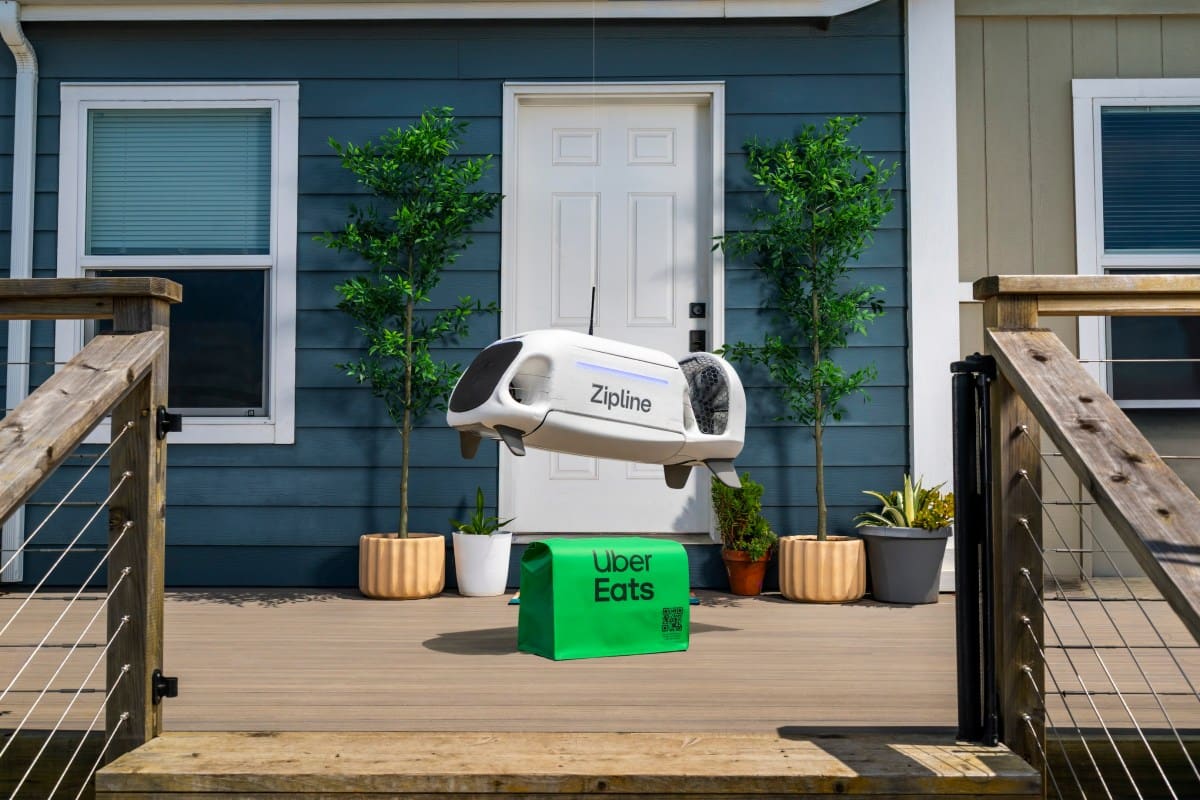
Uber has committed investment to Zipline and will integrate the drone delivery company's aircraft into its Eats platform, with a target of one million deliveries per day by the end of 2029. The first Zipline-powered orders will arrive on Uber Eats before the year closes, beginning in markets where the San Francisco startup already operates. From there, the companies plan to expand coverage to dozens of cities across the United States. Neither party disclosed the financial terms of the investment.
The scale target is aggressive. One million daily deliveries would represent a meaningful share of Uber Eats' order volume, particularly in the quick-commerce segment where speed determines competitive advantage. Zipline's drones are designed to complete deliveries within five to ten minutes of order placement, a window that compresses traditional courier logistics and opens new demand patterns for consumers expecting near-instant fulfillment.
At DailyTechWire, we've tracked Uber's gradual pivot from building its own autonomous systems to orchestrating a platform of third-party providers. The Zipline deal follows that template. Rather than develop proprietary drone hardware or operations, Uber is positioning itself as the demand aggregator, connecting Zipline's aerial infrastructure to millions of Eats users. The approach mirrors the company's strategy in robotaxis, where it has partnered with multiple autonomous vehicle providers instead of maintaining an in-house program.
Platform Play, Not Vertical Integration
Uber exited its own advanced mobility projects years ago. The company sold Uber Elevate, its aerial ridesharing unit, and spun out its Autonomous Technologies Group, which had been developing self-driving cars. Since then, it has committed more than ten billion dollars across dozens of autonomous vehicle companies, maintaining access to emerging technologies without bearing the full cost and risk of R&D.
The drone delivery push fits the same mold. Uber tested drone concepts during the Elevate era, then re-entered the space late last year through a partnership and small investment in Flytrex, an Israeli drone operator. Zipline represents a larger bet, both in capital commitment and operational scope. The startup closed an extended Series H round of eight hundred million dollars earlier this year, reaching a valuation of seven point six billion dollars, according to Zipline. That funding positions the company to scale manufacturing and service coverage at the pace Uber's timeline demands.
Uber CEO Dara Khosrowshahi framed the partnership as a growth lever for Eats, calling quick commerce "an even bigger market than the original food market." The logic is straightforward: faster delivery unlocks new categories and use cases. Consumers ordering a missing ingredient during meal prep or a last-minute item for a child's school project are less price-sensitive and more frequency-driven than those ordering a standard restaurant meal. Drones collapse the cost structure that makes sub-ten-minute delivery economically viable at scale.
The Limits of Partnership Models
Uber's platform strategy has delivered access and optionality, but it has also introduced friction. The company recently clashed with Waymo, one of its highest-profile autonomous vehicle partners. The two are expected to part ways when their contracts expire in 2028. They also sit on opposite sides of regulatory debates around autonomous vehicle deployment, with Uber advocating for looser local oversight and Waymo pushing for more structured frameworks that favor its technical lead.
Drone delivery carries similar regulatory complexity. Airspace rules, noise ordinances, and safety certification vary by jurisdiction. Zipline has built expertise navigating these layers through its earlier work in medical logistics, where it delivered blood products and vaccines in Rwanda, Ghana, and parts of the United States. That operational experience is part of what makes the company attractive to Uber, which prefers partners that can manage the regulatory burden independently.
Still, scaling to dozens of cities will test both companies. Urban airspace is contested, with delivery drones sharing altitude bands with hobbyist aircraft, emergency helicopters, and an expanding fleet of commercial operators. The Federal Aviation Administration has been slow to issue broad waivers for beyond-visual-line-of-sight operations, a requirement for the kind of autonomous, high-frequency flights Uber and Zipline envision. Each new city will likely require discrete approvals, community engagement, and infrastructure buildout, a process that can stretch timelines and inflate costs.
Quick Commerce Economics
The unit economics of drone delivery remain unproven at consumer scale. Zipline's aircraft are designed for repeated cycles, with battery swaps and minimal ground handling, but the capital cost per vehicle is high compared to a courier on a bike or scooter. The question is whether the speed premium and increased order frequency offset the fixed costs of drone fleets, charging stations, and maintenance crews.
Uber's bet is that they will, particularly in dense suburban markets where traditional delivery is inefficient. A drone can bypass traffic and take direct routes, cutting delivery time and allowing a single vehicle to complete more orders per hour. If the math works, the model could extend beyond prepared food to groceries, pharmacy items, and retail goods, categories where Uber has been expanding Eats' scope.
Zipline co-founder Keller Cliffton described the partnership as "the next step toward building a world where getting what you need is as fast and effortless as sending a text." That vision assumes ubiquitous aerial logistics, a future where drones are as common as delivery vans. Whether consumers and regulators will accept that density in residential airspace is still an open question.
What Comes Next
The initial deployments will serve as a proof of concept, both technically and commercially. Uber and Zipline will need to demonstrate that drone delivery can handle variable weather, navigate complex urban environments, and maintain the reliability consumers expect from Eats. They will also need to show that the service can scale without overwhelming customer support or generating negative externalities, such as noise complaints or safety incidents.
If the early markets succeed, the expansion to dozens of cities will accelerate. Uber has the demand-side advantage: millions of active users and a logistics platform already optimized for high-frequency, low-latency fulfillment. Zipline brings the supply-side capability: a fleet of autonomous aircraft and the operational know-how to deploy them. Together, they are testing whether aerial delivery can move from niche use cases to mainstream commerce.
The one-million-deliveries-per-day target is a benchmark, not a ceiling. If Uber and Zipline reach that milestone by 2029, it will signal that drone delivery has crossed the threshold from experiment to infrastructure. It will also set the stage for the next wave of competition, as other platforms and operators race to build their own aerial networks. For now, the partnership is a bet that speed, at scale, can redefine consumer expectations and unlock a new phase of growth in on-demand delivery.