Wispr Secures $280M as Dictation Wars Heat Up and Quality Stumbles Surface
The AI speech startup hit a $2B valuation ten months after its last raise, while users flag accuracy drops and rivals multiply across Android, web, and wearables.
A Fast Follow-On in a Crowded Field
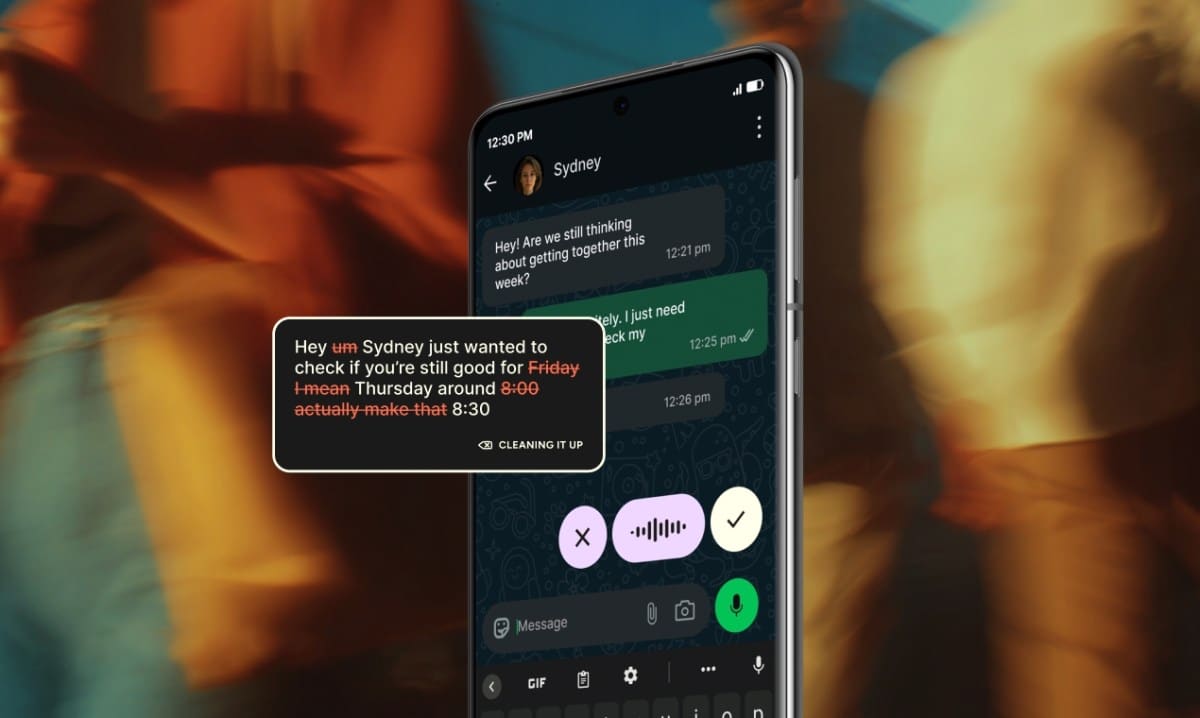
Wispr confirmed it has closed $280 million in Series B capital at a $2 billion post-money valuation, bringing total raised to $361 million. Menlo Ventures led the round, with participation from returning investors Notable Capital, NEA, Neo Ventures, 8VC, and MVP Ventures, plus a cohort of new names: Acrew, Forerunner, Goodwater, Peak XV, Together Fund, and PLUS Capital. The deal came together less than ten months after the startup's prior institutional round, a cadence that reflects both investor appetite for speech-interface plays and mounting pressure to outrun a swelling roster of competitors.
At DailyTechWire, we've tracked the shift from cloud-based transcription incumbents to local-first, sub-hundred-millisecond dictation tools over the past eighteen months. Wispr's original Flow product popularized on-device inference for text input, but the category has since fragmented: Willow, Monologue, Aqua, and Superwhisper all launched consumer or prosumer tiers in the same window, often at lower or zero price points. Several open-weight models now power community-built alternatives that run entirely offline, eroding the moat around proprietary pipelines. The new capital is earmarked for geographic expansion, deeper hardware partnerships, and a push into adjacent verticals, starting with meeting transcription and note-taking.
Quality Complaints and the Canto Response
Alongside the funding news, Wispr introduced Canto, a revised speech-understanding model designed to cut error rates from roughly 30 percent to below 10 percent. The timing is not coincidental. Over the past month, Flow users have posted complaints on community forums and social channels about degraded accuracy, citing higher rates of misrecognized words, dropped punctuation, and hallucinated phrases. Some attributed the issue to a silent backend swap or over-aggressive cost optimization; the company has not publicly detailed the root cause, but the launch of Canto suggests the prior model had hit a performance ceiling or was struggling with scale.
Accuracy remains the existential metric for dictation products. A 30 percent error rate crosses the threshold where manual correction becomes slower than typing, breaking the value proposition. Canto's sub-10 percent target would place Wispr back in line with best-in-class transcription services, but the real test will be sustained performance across accents, jargon-heavy domains, and noisy environments. The model rollout is phased, meaning not all users will see improvements immediately, and early adopters will effectively serve as the second wave of validation.
Platform Expansion and Hardware Bets
Since late last year, Wispr has shipped an Android version of Flow and scaled go-to-market teams in India and the United Kingdom, two regions where English-language dictation competes with multilingual keyboard habits and lower average selling prices for software subscriptions. India in particular presents a high-volume, price-sensitive market; success there often requires freemium tiers or carrier bundling, neither of which Wispr has announced.
The more distinctive move is the partnership with Oasis, a smart-ring manufacturer. The integration allows users to trigger dictation via a gesture or whisper-level speech, bypassing the need to hold a phone or speak at conversational volume. Wearable dictation has been attempted before, most notably by Humane's Ai Pin and early Alexa prototypes, but battery constraints, microphone fidelity, and social acceptability have kept adoption niche. If Oasis and similar form factors gain traction, Wispr's early positioning could open a channel that desktop and mobile rivals cannot easily replicate. Conversely, hardware partnerships introduce dependencies: if Oasis pivots, folds, or signs an exclusive deal elsewhere, Wispr's roadmap stalls.
Meeting Notes and a Broader Interface Thesis
Wispr's new meeting note-taker enters a space already occupied by Granola, Fireflies, and Read AI, each of which layers calendar integration, speaker diarization, and action-item extraction atop commodity transcription. The product displays summaries and tasks but does not yet push updates into project-management tools, draft emails, or auto-populate CRM fields. Those integrations are table stakes for enterprise adoption; without them, Wispr's note-taker risks becoming another passive log that users skim once and forget.
The broader strategic signal is Wispr Interface Labs, a new research unit led by Ariya Rastrow, an early contributor to Amazon's Alexa platform. The lab's charter is to explore novel interaction paradigms, a deliberately vague framing that could encompass everything from spatial audio interfaces to brain-computer input. The move suggests Wispr sees dictation as a beachhead rather than an end state. Voice input has historically suffered from a discoverability problem: users forget which commands work, and natural-language parsing breaks down in ambiguous contexts. If Interface Labs can demonstrate a step-function improvement in usability or unlock a new modality entirely, the current product portfolio becomes a data-collection and distribution engine for whatever comes next.
Capital, Competition, and the Valuation Question
A $2 billion valuation for a company with a single flagship product and nascent adjacencies invites scrutiny. Investors are pricing in category leadership, network effects from user data, and optionality around future interfaces. Yet the dictation market is bifurcating: prosumers are migrating to free or low-cost tools, while enterprises demand integrations and compliance guarantees that Wispr has not yet built at scale. The middle ground, where Wispr currently operates, may be narrower than the valuation implies.
The capital itself buys runway, but it also resets expectations. A $280 million Series B typically signals preparation for a public offering or a path to sustained profitability within twenty-four to thirty-six months. Wispr will need to demonstrate that Canto stabilizes quality, that the Android and hardware expansions yield meaningful user growth, and that the meeting product can compete on features and integrations rather than brand alone. The next twelve months will clarify whether the company is building a platform or defending a feature that larger incumbents can replicate.
What the Timing Reveals
The speed of this round, less than a year after the prior close, points to a mix of offensive and defensive motives. On offense, the capital allows Wispr to out-hire and out-market rivals in a land-grab phase. On defense, locking in a $2 billion valuation before the quality issues fully surfaced protects against a down round and gives the team breathing room to fix the model without existential fundraising pressure.
For the broader speech-tech ecosystem, Wispr's raise confirms that venture appetite for voice-interface infrastructure remains strong, even as generative AI hype cycles through boom and correction. The bet is that accurate, low-latency speech understanding will underpin a wave of ambient and wearable computing, and that the winner in dictation can extend into adjacent surfaces. Whether Wispr can defend that position against open-source alternatives, big-tech feature parity, and its own execution missteps will determine if this valuation was prescient or premature.