Acoustic Suppression Tech Raises $15M to Fight Fires With Sound Waves
Sonic Fire Tech's infrasonic system promises seconds-fast response without water damage, targeting commercial kitchens and wildfire defense as insurers watch closely
Fire Suppression Without the Flood
For more than a hundred years, the playbook for stopping fires has been straightforward: douse them with water or chemicals. Both work, but they leave behind their own form of destruction. At DailyTechWire, we've tracked dozens of fire-tech startups promising incremental improvements, yet the fundamental trade-off has persisted. Now an Ohio venture is attempting to sidestep that equation entirely by deploying infrasonic waves instead of liquids.
Sonic Fire Tech announced it has closed a $15 million Series A led by The O.H.I.O. Fund, with Khosla Ventures joining the round. The startup had previously secured $3.5 million in seed funding last October. The capital will fund hiring and, more critically, the multi-year certification process required by the National Fire Protection Association, whose model codes are adopted nationwide. Co-founder and CEO Geoff Bruder believes the timeline will be shorter than the typical three years, citing the absence of post-test cleanup as a logistical advantage during lab evaluations.
The company's system routes inaudible sound through ceiling-mounted PVC conduits. When sensors detect a fire, a generator emits infrasonic waves at roughly 20 Hz, bombarding flames within seconds. The mechanism creates its own suppressant effect without residue, a claim that differentiates it from sprinkler and chemical-agent systems. COO Remington Bixby Hotchkis noted that false alarms carry less downside because deployment leaves no mess to remediate.
Commercial Kitchens in the Crosshairs
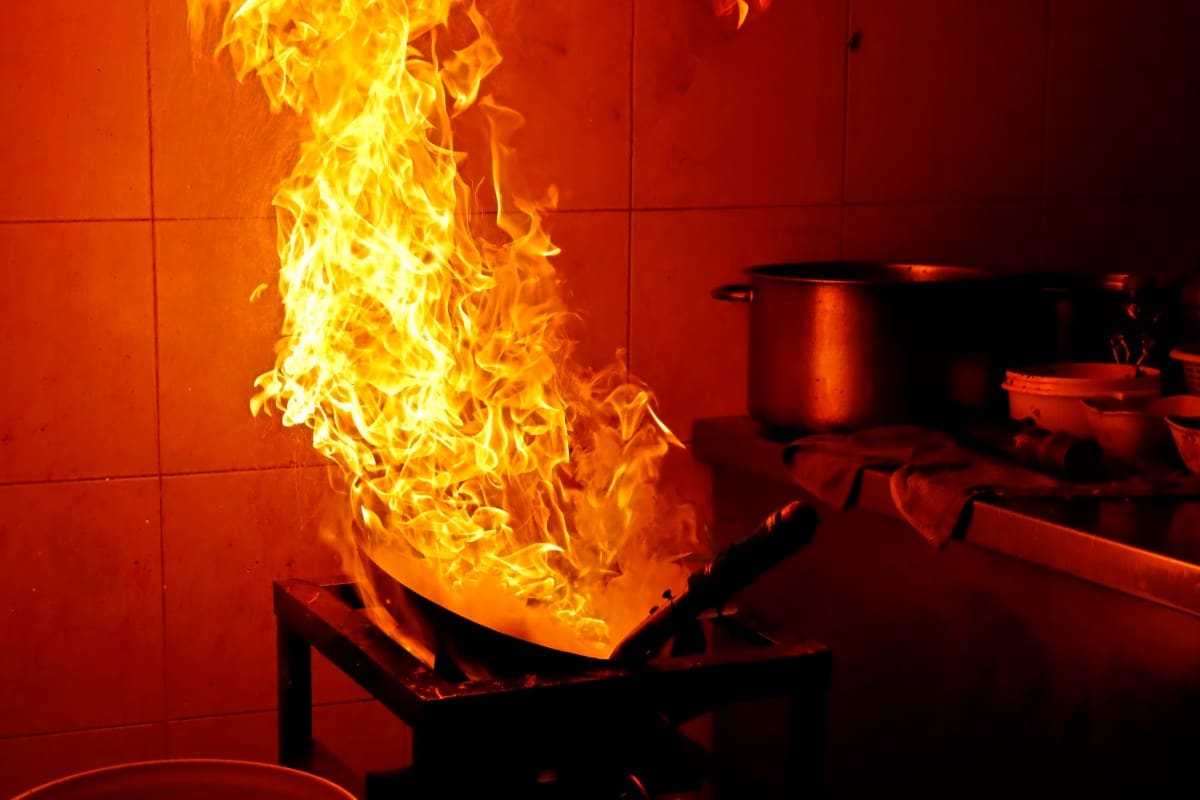
The startup is targeting commercial kitchens first, a segment where fire damage often proves terminal. Hotchkis cited data indicating that 75 percent of kitchens hit by fire never reopen, a statistic driven as much by water and chemical restoration costs as by flame damage itself. Months of downtime and deep cleaning can exhaust both insurance payouts and owner reserves, making prevention economics especially compelling.
Sonic Fire Tech's pitch hinges on speed and collateral avoidance. Traditional sprinkler systems take longer to activate and flood the space, while chemical agents require extensive decontamination. An acoustic system that deploys in seconds and leaves surfaces dry could meaningfully compress the window in which a small grease or electrical fire escalates into a total loss. The startup is in active discussions with insurers about premium discounts for properties equipped with the technology, a signal that underwriters see actuarial merit in the approach.
If insurers formalize those discounts, adoption could accelerate beyond early-adopter segments. Premium relief has historically been a powerful lever in fire-protection markets; sprinkler mandates in many jurisdictions were driven as much by insurance industry pressure as by regulatory fiat.
Lithium-Ion Fires and the Containment Question
Lithium-ion battery fires represent one of the hardest suppression challenges in modern fire science. Thermal runaway events generate extreme heat and can reignite even after apparent extinguishment. Sonic Fire Tech has run preliminary tests on battery fires and found that while the system does not fully extinguish them, it can contain the outer casing and potentially prevent cell-to-cell propagation. Bruder described the effect as limiting fire size rather than eliminating it outright.
That partial success is significant. Battery fires in data centers, warehouses, and residential energy-storage installations are growing as a risk category, and existing suppression methods often prove inadequate. A technology that can slow or halt thermal spread buys time for evacuation and manual intervention, reducing both injury risk and asset loss. The startup has not disclosed whether it will pursue a dedicated battery-fire product line, but the early results suggest a viable use case.
Regulatory Gauntlet and Market Entry
Sonic Fire Tech faces a lengthy certification path. The NFPA's approval process involves extensive lab testing under controlled conditions, and the association's standards carry de facto regulatory weight across the United States. Bruder's optimism about a shortened timeline rests on operational efficiency during testing, not on any formal fast-track mechanism. The lack of water or chemical cleanup between test runs could indeed compress the calendar, but the technical bar remains high.
The startup is developing systems for commercial interiors, kitchens, and residential applications, covering both new construction and retrofit scenarios. It is also working on an exterior system for wildfire defense, though that effort has progressed more slowly due to limited access to suitable testing facilities. Wildfire applications introduce additional variables, including wind, ember showers, and radiant heat, all of which complicate acoustic suppression dynamics.
Around 500 jurisdictions in the U.S. currently mandate interior fire-protection systems, typically sprinklers in multi-family and commercial buildings. Bruder pointed out that half of residential fires originate in kitchens, often from grease or electrical sources that sprinklers struggle to address effectively. A compact acoustic unit focused on the kitchen could reduce catastrophic fire risk and, by extension, insurance premiums. The value proposition is clearer in new construction, where installation costs can be amortized into the build, but retrofit economics remain uncertain.
Insurance as the Adoption Engine
The insurance industry's posture will likely determine Sonic Fire Tech's trajectory. Underwriters have historically been conservative about novel suppression technologies, requiring years of field data before adjusting premium structures. However, the cost burden of kitchen and wildfire claims has been rising sharply, creating pressure to support prevention technologies that demonstrably lower loss severity.
If Sonic Fire Tech can secure formal endorsements or premium discounts from major carriers, the technology could gain traction in high-risk commercial segments first, then migrate to residential markets. The reverse path, relying on consumer adoption to build the data set insurers require, would be slower and capital-intensive. The startup's decision to target commercial kitchens and interiors suggests it is betting on the former route.
The funding round positions Sonic Fire Tech to navigate the next phase of testing and early deployments. Whether acoustic suppression proves scalable beyond niche applications will depend on certification timelines, installation costs, and the willingness of insurers and building codes to embrace a departure from century-old norms. The technology works in the lab; the question now is whether it can work at scale in the field, where fires are unpredictable and stakes are unforgiving.