Samsung's Smart Glasses Will Run Nine Hours Between Charges
The Korean giant's first wearable AR play pairs Qualcomm silicon with Warby Parker frames and a bundled charging case that holds seven refills.
Battery First, Display Never
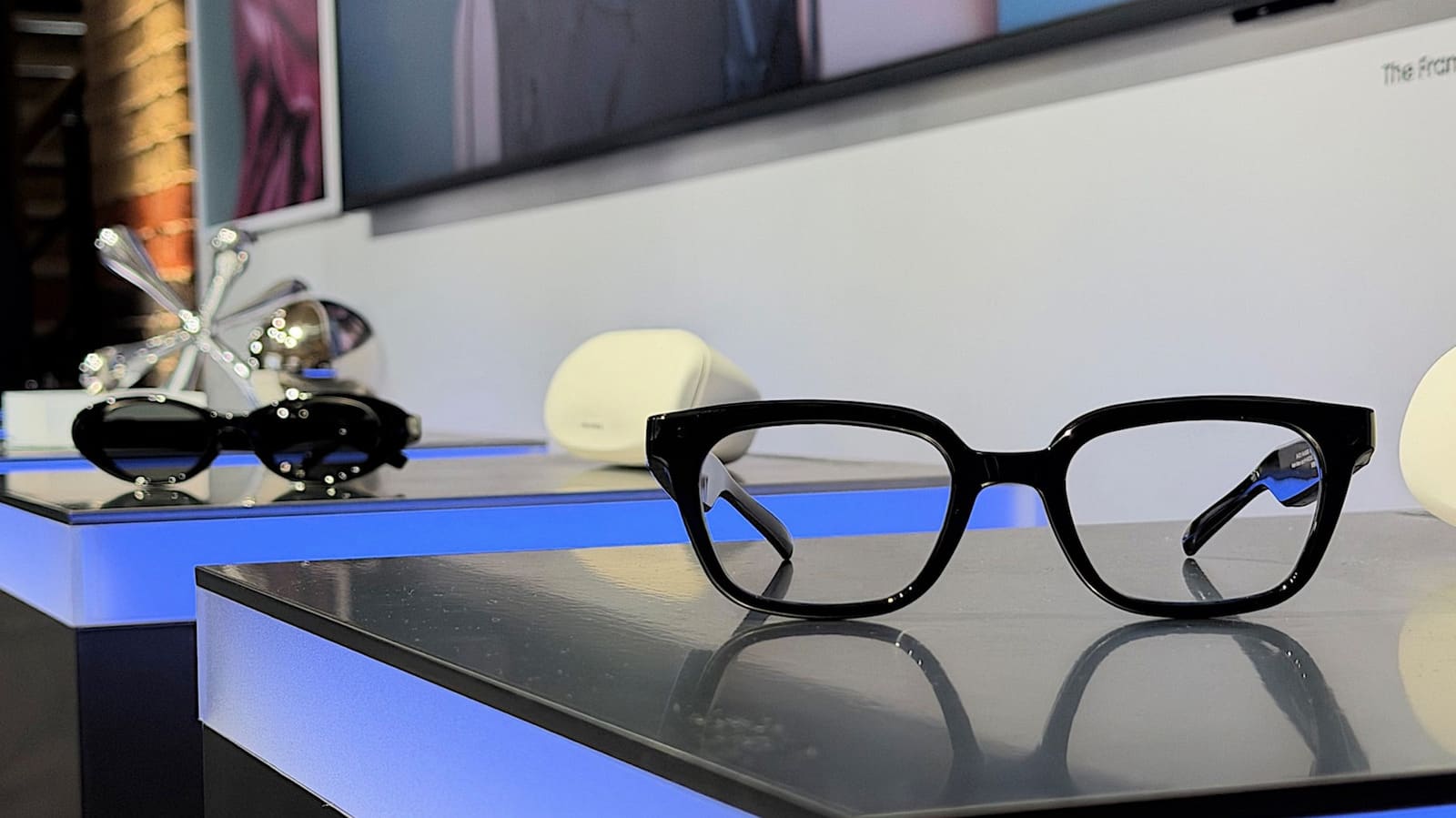
Samsung's smart glasses will ship with a charging case that holds enough power for seven full cycles, the company disclosed this week. Each charge delivers nine hours of use, according to Samsung, placing the device comfortably ahead of most Bluetooth earbuds but well short of passive eyewear's infinite uptime. The case design echoes the playbook that made Galaxy Buds ubiquitous: keep the wearable light, offload the battery bulk to a pocketable dock.
What won't drain that battery is a screen. Samsung confirmed the glasses carry no display panel of any kind. That decision keeps weight down and sidesteps the thermal load that sank earlier AR attempts, but it also means notifications, navigation overlays, and augmented layers all remain out of scope. Instead, the device leans on voice interaction, an integrated camera, and a tethered smartphone for output. It's a bet that the "ultimate personal assistant experience," as Samsung frames it, doesn't require pixels floating in your field of view.
Qualcomm's AR1 Gen 1 Inside
The glasses run on Qualcomm's Snapdragon AR1 Gen 1 platform, a chip the San Diego firm designed specifically for lightweight wearables. The silicon includes a Hexagon NPU, Qualcomm's neural processing unit, which handles AI inference tasks locally rather than round-tripping prompts to the cloud. That architecture should enable real-time translation and visual search, two features Samsung highlighted, without the latency penalty of remote servers.
Qualcomm has positioned the AR1 Gen 1 as "optimized for lightweight, battery-efficient" form factors, and Samsung's nine-hour claim suggests the chip delivers on at least half that promise. Efficiency here matters less for raw performance than for thermal comfort; nobody wants a hot temple piece pressed against their head for a commute. The AR1's power envelope also determines how much compute can run on-device before Samsung has to offload work to a paired Galaxy phone over Bluetooth 5.3 or Wi-Fi 7, both of which the glasses support.
A Camera With a Mandatory LED
The integrated camera is both the product's headline feature and its most contentious component. Samsung has included an LED indicator that lights up whenever the camera records, a design choice meant to signal recording activity to bystanders. The company went further: software disables the camera entirely if the LED is covered or obstructed, a failsafe against tape or stickers.
Meta adopted a similar LED-plus-lockout approach for its Ray-Ban smart glasses, and third-party services quickly appeared offering workarounds. Some involved hardware modifications; others exploited firmware gaps. Meta responded by adding tamper detection that bricks the camera if the LED circuit is altered, though it remains unclear whether that countermeasure has reduced surreptitious filming in practice.
Samsung will face the same adversarial dynamic. The appeal of covert recording is strong enough that a subset of buyers will search for disabling methods within days of launch, and the economics of tutorial videos guarantee someone will document a bypass. The LED and lockout mechanism raise the barrier, but they won't eliminate the behavior. At DailyTechWire, we've tracked this pattern across every consumer camera wearable released since Google Glass: the policy layer always lags the exploit layer.
Warby Parker and Gentle Monster Frames
Samsung partnered with Warby Parker and Gentle Monster for frame design, tapping two brands with established retail footprints and design credibility. Warby Parker brings a North American customer base and a direct-to-consumer model that could smooth distribution; Gentle Monster offers avant-garde aesthetics and a Seoul-to-Shanghai retail network. The collaboration signals Samsung's intent to avoid the "tech prototype" look that plagued earlier smart glasses and instead slot into existing eyewear purchase habits.
Frame choice matters more for smart glasses than for most wearables because the device sits on your face all day. If the industrial design reads as conspicuously tech-forward, adoption stalls; if it blends into current eyewear trends, the product has a chance at mass-market traction. Samsung's decision to outsource frame design rather than iterate in-house suggests the company learned from the stumbles of predecessors who treated eyewear as another electronics category.
No Display, No Problem?
The absence of a display is the product's defining constraint and its central design trade-off. Without an optical layer, Samsung can't show turn-by-turn directions, can't overlay product information during visual search, and can't render translated text in place. Every output must route through audio or through the paired phone's screen, which reintroduces the friction that smart glasses are supposed to eliminate.
That limitation also clarifies the use case. These glasses aren't AR in the HoloLens or Vision Pro sense; they're a camera, microphone, and wireless audio module in an eyewear form factor. The AI features Samsung promises, like real-time translation and visual search, will likely work as follows: you frame a scene, the camera captures it, the Hexagon NPU or a cloud endpoint processes the image, and results come back as synthesized voice or a notification on your phone. It's ambient computing, but with extra steps.
The display-free approach does buy Samsung two advantages: lower cost and regulatory simplicity. Waveguide optics and micro-OLED panels add hundreds of dollars in bill-of-materials expense, and they trigger medical device scrutiny in some jurisdictions if the product makes any vision-correction claims. By staying display-less, Samsung keeps the price accessible and the regulatory surface area small, even if it sacrifices the "augmented" half of augmented reality.
Pricing and Availability Still Unannounced
Samsung has committed to sharing pricing and a launch date this fall but offered no specifics beyond that seasonal window. The company's reveal cadence suggests a holiday 2026 release, timed to capture year-end shopping and to ship before competitors close the gap. Qualcomm's AR1 Gen 1 is a platform play, meaning other OEMs will use the same chip, so Samsung's lead time is measured in quarters, not years.
Pricing will determine whether these glasses compete with Meta's Ray-Ban collaboration, which starts at $299, or carve out a premium tier. The Warby Parker and Gentle Monster partnerships hint at multiple SKUs across price bands, but without display hardware to drive up cost, a sub-$400 entry price seems achievable. Anything above $500 would require Samsung to justify the premium with exclusive software features or brand cachet, a harder sell when the core hardware is a shared Qualcomm reference design.
The fall reveal will also clarify software exclusivity. If Samsung gates key AI features behind Galaxy phone pairing, the addressable market shrinks to the company's existing smartphone base. If the glasses work across Android or even support iPhone tethering, the product becomes a platform play rather than an ecosystem lock. That choice will shape whether these glasses become a Galaxy accessory or a category device.