Samsung's New Foldable Strategy: Two Sizes, Two Markets
The Galaxy Z Fold 8 and Z Fold 8 Ultra reveal Samsung's bet on form-factor diversity as Chinese rivals close in on global foldable leadership.
A Fork in the Foldable Road
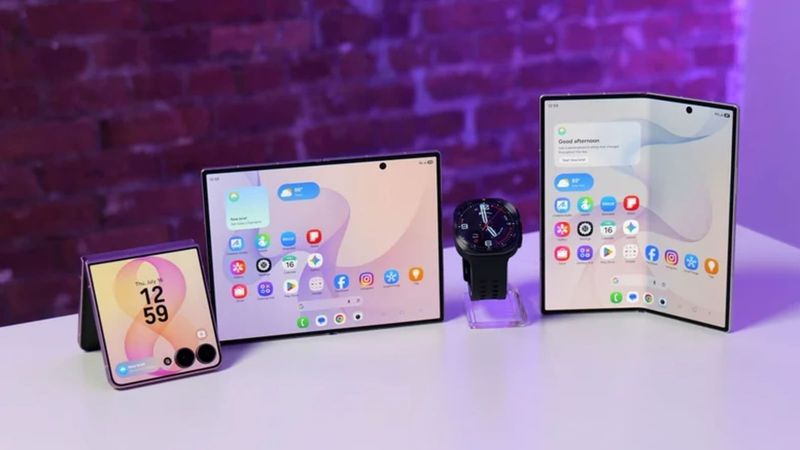
Samsung launched two book-style foldables at its London Galaxy Unpacked event, marking the first time the company has offered buyers a meaningful form-factor choice within a single generation. The Galaxy Z Fold 8 starts at $1,899.99 and adopts a shorter, wider stance. The Galaxy Z Fold 8 Ultra, priced at $2,099.99, follows the taller, narrower blueprint Samsung has refined since 2019.
Both devices share the new Flex Titanium display architecture, which Samsung says reduces the visibility of the center crease and improves durability under repeated folding. Yet the divergence in dimensions and camera hardware suggests Samsung is testing whether the foldable market can sustain two distinct user profiles: those who prize pocketability and tablet-like unfolded proportions, and those who want maximum screen area and imaging capability.
At DailyTechWire, we've tracked Samsung's foldable roadmap closely. The introduction of an Ultra tier mirrors the strategy Samsung deployed in its Galaxy S slab-phone line, where the Ultra variant commands a premium for camera and battery upgrades. Applying that segmentation to foldables is a logical next step, but it also reflects mounting pressure from Huawei, Xiaomi, and Honor, all of which have released thinner, lighter book-folds in China over the past year.
Dimensions That Define Use Cases
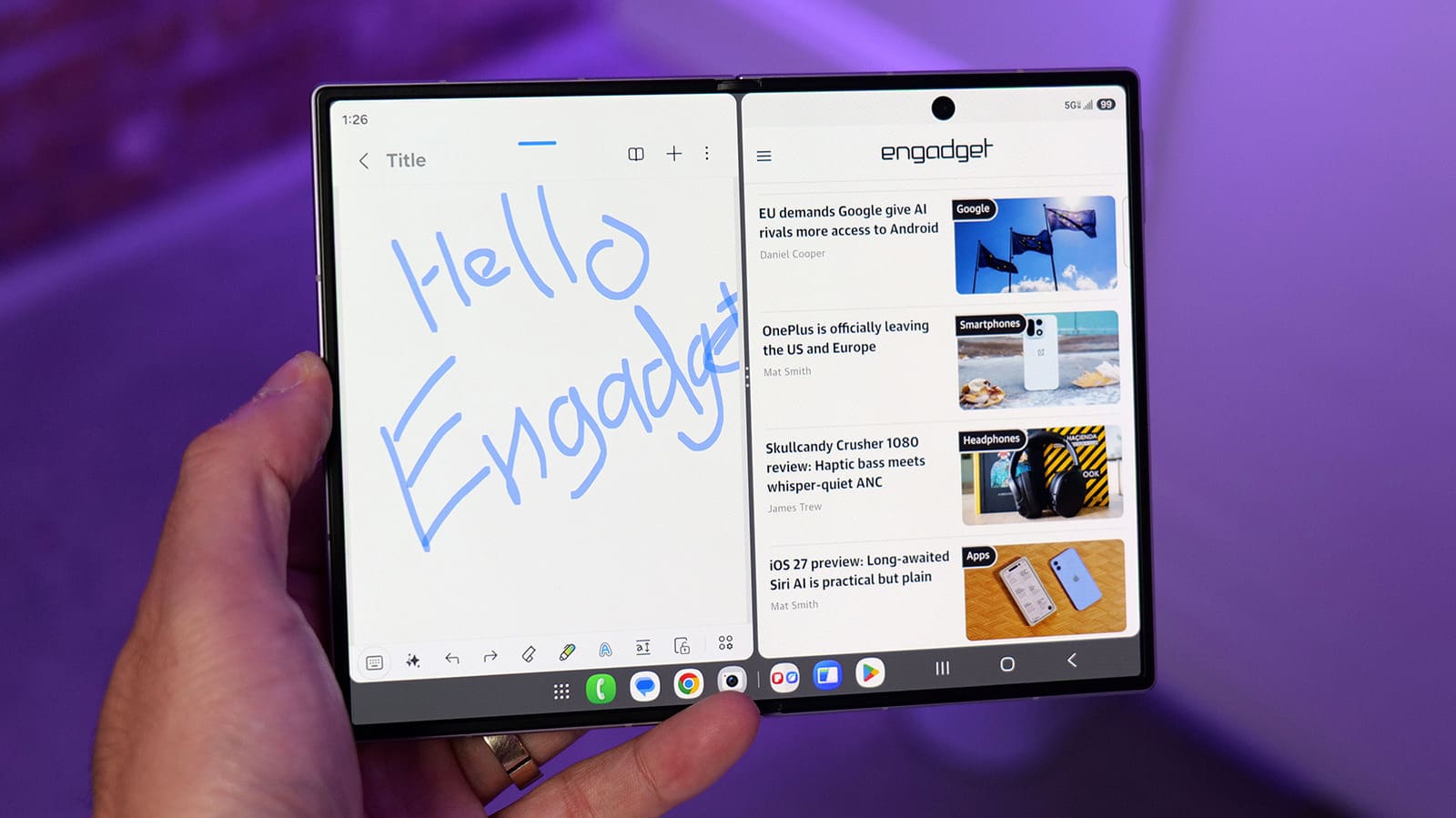
The Galaxy Z Fold 8 measures 123.9 x 81.9 x 9.7 mm when closed and opens to 123.9 x 161.4 x 4.5 mm. Its 5.5-inch cover screen and 7.6-inch main display offer a squarer aspect ratio than previous Fold generations. In practical terms, the outer screen is wide enough for two-handed typing without the cramped, narrow feel that has long been a criticism of Samsung's foldables.
The Z Fold 8 Ultra reverts to a taller, slimmer profile: 158.4 x 72.8 x 8.9 mm folded, expanding to 158.4 x 143.2 x 4.1 mm unfolded. Its 6.5-inch cover display and 8-inch main screen deliver more total surface area, but the aspect ratio skews narrower on the outside. Weight climbs to 215 grams versus 201 grams for the standard Fold 8.
Samsung appears to be addressing two criticisms at once. The Fold 8's wider external screen responds to years of feedback that the cover display on models like the Z Fold 7 was too narrow for comfortable one-handed use. The Fold 8 Ultra, meanwhile, offers a larger canvas for multitasking and media consumption, appealing to users who treat their foldable as a productivity device first.
Screen resolution differs as well. The Fold 8 Ultra's displays carry higher pixel density on both the cover and main panels, though Samsung has not disclosed exact figures. For users who prioritize sharpness in text rendering or high-resolution video playback, the Ultra's panels should deliver a perceptible edge.
Camera Differentiation Follows the Ultra Playbook
Photography is where the $200 price delta becomes most tangible. The Galaxy Z Fold 8 ships with a 50-megapixel main rear camera, a 50-megapixel ultra-wide, and dual 10-megapixel cameras for front-facing and cover-screen selfies. The Z Fold 8 Ultra upgrades the main sensor to 200 megapixels and adds a 10-megapixel telephoto lens with 3x optical zoom and 30x digital zoom.
That 200-megapixel sensor is the same unit Samsung has deployed in the Galaxy S24 Ultra and S25 Ultra. In those devices, the high-resolution sensor enables lossless cropping and improved low-light performance through pixel binning. For a foldable, the inclusion signals Samsung's intent to position the Ultra variant as a no-compromise flagship, not a device that sacrifices imaging to accommodate the hinge mechanism.
Telephoto capability has historically been a weak point in foldables. The internal volume required for a periscope or folded-optic zoom system competes with the hinge assembly and battery. By reserving the telephoto lens for the Ultra, Samsung sidesteps that trade-off in the standard Fold 8 while still offering a credible zoom option in the higher tier.
The 50-megapixel ultra-wide camera is shared across both models, as are the 10-megapixel selfie and cover cameras. For users who rarely shoot beyond the primary lens, the Fold 8's camera array will suffice. For those who want optical reach and the flexibility of a 200-megapixel sensor, the Ultra justifies its premium.
Battery and Charging: Marginal Gains
The Galaxy Z Fold 8 packs a 4,800 mAh battery, while the Fold 8 Ultra carries 5,000 mAh. Both support 45-watt wired Super Fast Charging 2.0 and 20-watt wireless charging. Neither device includes built-in magnets for Qi2 accessory alignment; Samsung labels them "Qi2 ready," which in practice means users need a compatible case to unlock magnetic attachment.
Wireless PowerShare remains present on both models, allowing reverse charging for accessories like Galaxy Buds cases. The feature has been a staple of Samsung's premium devices since 2019, though its utility is limited by the relatively slow 4.5-watt output.
The 200 mAh difference in battery capacity is unlikely to translate into meaningful endurance gains in real-world use. Both devices power the same Snapdragon 8 Gen 4 processor, and screen size tends to be the dominant variable in battery life. The Fold 8 Ultra's larger, higher-resolution displays may offset its slightly larger cell, resulting in similar longevity.
Samsung has not disclosed whether either device supports faster wired charging beyond 45 watts. Chinese competitors, including Oppo's Find N5 and Xiaomi's Mix Fold 4, have pushed foldable charging speeds to 67 watts and 80 watts respectively. Samsung's conservative stance on charging speed remains a point of differentiation, though the company has historically prioritized battery longevity over rapid top-up times.
Form Factor as Market Signal
The decision to split the Fold line into two distinct form factors reflects both opportunity and anxiety. Opportunity, because the foldable category is still young enough that no single design language has achieved dominance. Anxiety, because Samsung's share of the global foldable market has eroded as Chinese manufacturers have flooded their home market with thinner, lighter, and often cheaper alternatives.
Huawei's Mate X5, released in late 2023, measures 11.08 mm folded and weighs 243 grams despite an 8-inch main display. Honor's Magic V3, launched in early 2024, is 9.2 mm folded and weighs just 226 grams with a 7.92-inch screen. Both devices undercut Samsung's previous-generation Fold 7 on thickness and weight while matching or exceeding screen size.
The Galaxy Z Fold 8's 9.7 mm folded thickness and 201-gram weight represent incremental progress, but the device is still thicker and heavier than several Chinese rivals. The Fold 8 Ultra, at 8.9 mm folded, closes the gap slightly, though it sacrifices compactness in height and width.
Samsung's advantage lies in software maturity and global distribution. The company has spent five years refining multitasking interfaces, app continuity, and stylus integration for foldables. Chinese brands, by contrast, have struggled to scale beyond Asia, hampered by limited retail presence and software ecosystems optimized for domestic users.
By offering two form factors, Samsung can test regional preferences. The wider, more compact Fold 8 may resonate in markets like the United States, where users expect tablet-like proportions when a device unfolds. The taller, narrower Fold 8 Ultra could appeal in Asia, where one-handed usability on the cover screen and maximum main-display area are prioritized.
Processor, Storage, and IP Rating Parity
Both the Fold 8 and Fold 8 Ultra run Qualcomm's Snapdragon 8 Gen 4, fabricated on TSMC's 3-nanometer process. Memory and storage configurations are identical across both models, though Samsung has not specified the options. Previous-generation Folds have shipped with 12 GB of RAM and storage tiers of 256 GB, 512 GB, and 1 TB.
The IP48 rating applies to both devices, indicating resistance to solid particles larger than 1 mm and protection against water splashes. The "4" in the dust rating is lower than the IP6X standard found on most flagship slabs, reflecting the inherent difficulty of sealing a device with a hinge. Samsung has maintained an IP4X dust rating across its foldable line since the Z Fold 4; moving to IP5X or IP6X would require advances in hinge sealing that have not yet materialized.
Both phones will ship with Samsung's One UI 8.1, based on Android 16. Samsung has committed to four years of major Android updates and five years of security patches for its foldable line, matching the support window offered for its Galaxy S flagships.
Color Options and Market Positioning
The Galaxy Z Fold 8 is available in Graphite, Cream, and Lavender, with an online-exclusive Pistachio finish. The Fold 8 Ultra offers Graphite, Cream, and Violet Shadow, plus a Green Shadow online exclusive. The Lavender and Violet Shadow options occupy similar color space, though the Ultra's Violet Shadow skews darker.
Color choice is unlikely to sway most buyers, particularly given that foldables are often sheathed in cases to protect the hinge and display. Samsung's case ecosystem for foldables has historically included standing covers, leather folios, and slim protective shells. The absence of built-in Qi2 magnets means users who want magnetic accessory support must opt for a compatible case.
Who Should Choose Which Device
The Galaxy Z Fold 8 is the better fit for buyers who want a more compact device in the pocket and a wider, more tablet-like experience when unfolded. Its 5.5-inch cover screen is usable enough for quick tasks without the narrow, cramped feel of earlier Folds. The $1,899.99 starting price is still steep, but it represents the entry point into Samsung's latest foldable generation.
The Galaxy Z Fold 8 Ultra justifies its $2,099.99 price with a larger screen on both the outside and inside, a 200-megapixel main camera, and a telephoto lens. For users who treat their foldable as a primary camera or who need maximum screen real estate for productivity work, those upgrades are meaningful. The device is also thinner when folded, which may improve one-handed feel despite its taller profile.
Neither device is a radical departure from Samsung's established foldable formula. The Flex Titanium display represents an iterative improvement in durability and crease visibility, but the fundamental hinge architecture and software experience remain consistent with the Z Fold 7. What has changed is Samsung's willingness to fragment its flagship foldable line, offering buyers a genuine choice in form factor rather than a single take-it-or-leave-it design.
Whether that strategy pays off will depend on how well each device sells and whether the market can sustain two premium price points within a single product generation. For now, Samsung is betting that foldable buyers are diverse enough in their preferences to support both a compact, wide-screen model and a tall, narrow, camera-forward alternative. The next six months of sales data will reveal whether that bet was justified.