Perplexity Bets Privacy-First Inference Will Reshape Agentic Workflows
The answer-engine startup's new Hybrid Compute splits tasks between frontier cloud models and on-device LLMs, targeting professionals who need both power and confidentiality.
The Privacy-Cost Wedge in Agentic AI
Perplexity has released Hybrid Compute, a feature that divides agentic workflows between cloud-based frontier models and on-device LLMs running directly on a user's Mac. The architecture is designed to keep sensitive information local while still leveraging the capabilities of large-scale models like Opus 5 or GPT-5.6 Sol for general reasoning and web tasks.
The move reflects a tension we've observed across enterprise AI deployments this year: organizations want the sophistication of frontier models but remain wary of routing confidential data through third-party inference APIs. Perplexity's answer is to automate the decision of what stays on-premises and what gets sent to the cloud.
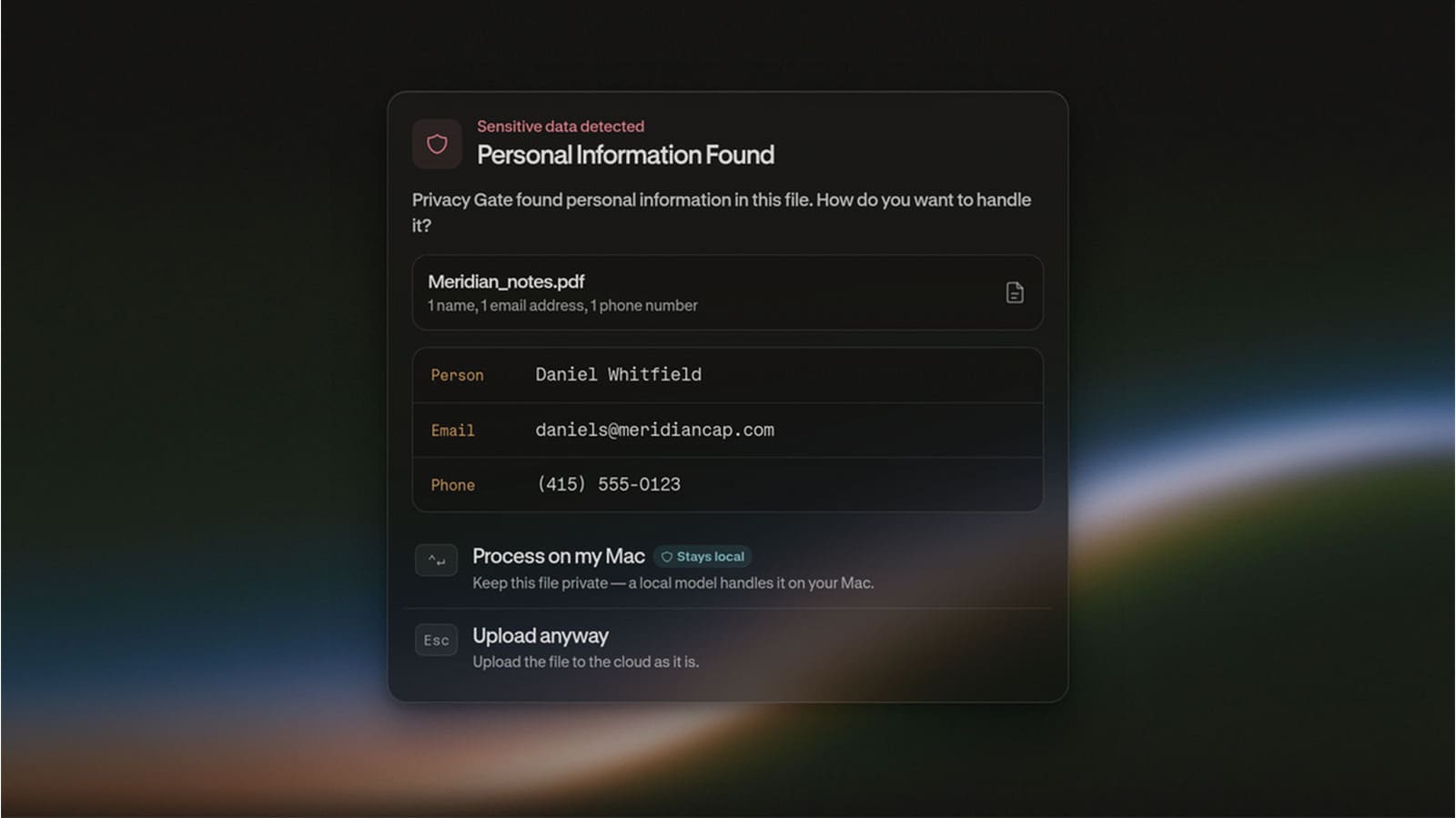
Jon Staff, who leads the company's Mac product suite, explained that the system uses a newly trained privacy classifier to flag files and data that should remain local. Before execution, users review the classifier's recommendations and select which models will handle each portion of the task. On the device side, options include Gemma E4B and two variants of Qwen's 35-billion-parameter 3.6 model, one of which Perplexity post-trained in-house.
Who Needs a Split Stack
Perplexity suggests the feature will appeal to professionals handling confidential material. A lawyer drafting a brief, for instance, could compare client facts against public case law without uploading privileged information to a remote server. The local model processes the sensitive input; the cloud model retrieves and synthesizes the legal precedents.
Beyond privacy, the company is pitching Hybrid Compute as a cost lever. Inference pricing for frontier models remains high, and offloading routine subtasks to a free, on-device LLM can trim token spend. Staff acknowledged that a fully cloud-based workflow will usually produce a higher-quality artifact, but argued that not every task requires maximum capability. For users who prioritize data sovereignty or budget constraints over marginal quality gains, the hybrid path offers a viable trade-off.
The feature includes a real-time dashboard showing CPU, GPU, and memory utilization on the local machine, alongside a token counter that tallies only the cloud portion of the workload. Tokens generated locally carry no charge.
The Capability Trade-Off
At DailyTechWire, we've followed the enterprise on-prem versus cloud debate since the first wave of LLM API lockdowns in regulated industries. Hybrid Compute sits in the middle: it assumes users will accept slightly weaker outputs in exchange for keeping certain data inside their perimeter.
Staff was candid about the performance gap. A fully frontier stack will almost always outperform a hybrid one in raw artifact quality, he said. The value proposition hinges on whether the user's workflow has a clear privacy or cost boundary. If it does, the architecture makes sense. If the entire task can be handled in the cloud without regulatory or budget friction, the simpler path is probably better.
Perplexity's privacy classifier attempts to automate the triage, but the final call rests with the user. That hand-off is deliberate: the company wants to avoid the liability of making incorrect sensitivity judgments on behalf of customers, especially in legal or healthcare contexts where misclassification can carry real penalties.
Hardware and Rollout Constraints
Hybrid Compute is available only on Apple Silicon Macs running macOS 15, and Perplexity recommends machines with at least 32 gigabytes of unified memory. The feature is bundled into the company's Pro and Max subscription tiers, as well as enterprise plans.
Installation of local models happens inside Perplexity's Mac app, with no need to open a terminal or manage dependencies manually. The streamlined onboarding is a nod to non-technical users, though the memory floor effectively limits the audience to professionals with recent, high-spec hardware.
The company plans to expand the roster of local models over time, though it has not disclosed a timeline or specific candidates. The current lineup skews toward smaller, faster architectures that fit comfortably in device memory while still delivering reasonable instruction-following performance.
Why This Matters for Agentic Products
Hybrid Compute represents a broader design question facing every agentic AI product: how much autonomy should the system have over where computation happens? The naive answer is to route everything to the most capable model available. But as agentic tools move into regulated verticals and cost-sensitive use cases, that heuristic breaks down.
Perplexity's approach is to make the routing decision transparent and user-configurable, with guardrails provided by the privacy classifier. It's a pragmatic middle ground, though it introduces friction. Every time the system flags a file, the user must review and approve the split. For high-throughput workflows, that review step could become a bottleneck.
The feature also exposes a longer-term architectural challenge. As local models improve, the gap between on-device and cloud performance will narrow. At some threshold, the privacy and cost benefits of hybrid inference will outweigh the capability penalty for a much larger share of tasks. Perplexity is betting that threshold is already here for a meaningful segment of professional users. Whether that bet pays off will depend on how quickly competitors adopt similar split-stack designs and whether enterprises see the feature as a compliance unlock or an operational headache.
For now, Hybrid Compute is a signal that the agentic AI market is maturing past the "bigger model, better output" phase and into a more nuanced conversation about where inference should happen, who controls the boundary, and what trade-offs users are willing to accept.