Huawei Pushes R&D Spend to 25% of Revenue as Profit Falls
The Shenzhen giant is trading near-term earnings for long-term tech autonomy, a bet that mirrors the broader strategic shift across China's semiconductor and AI ecosystems.
The Numbers Behind the Bet
Huawei Technologies allocated 121.4 billion yuan (US$18 billion) to research and development in the first half of 2024, a 25 percent increase year-on-year that consumed more than a quarter of total revenue. Net profit fell 36 percent during the same period. The trade-off is deliberate: the company is prioritizing technological self-reliance over short-term financial performance, a posture that increasingly defines China's approach to critical infrastructure and frontier compute.
At DailyTechWire, we've tracked how export restrictions and supply-chain fractures have reshaped capital allocation across the region's semiconductor and AI players. Huawei's R&D intensity is among the highest globally for an integrated hardware-software firm, exceeding the ratios at Samsung Electronics (around 9 percent) and Apple (roughly 8 percent). The gap reflects not only ambition but necessity: when you cannot reliably source advanced process nodes or EDA tools from traditional suppliers, you build the stack yourself or accept strategic obsolescence.
What the Spend Is Buying
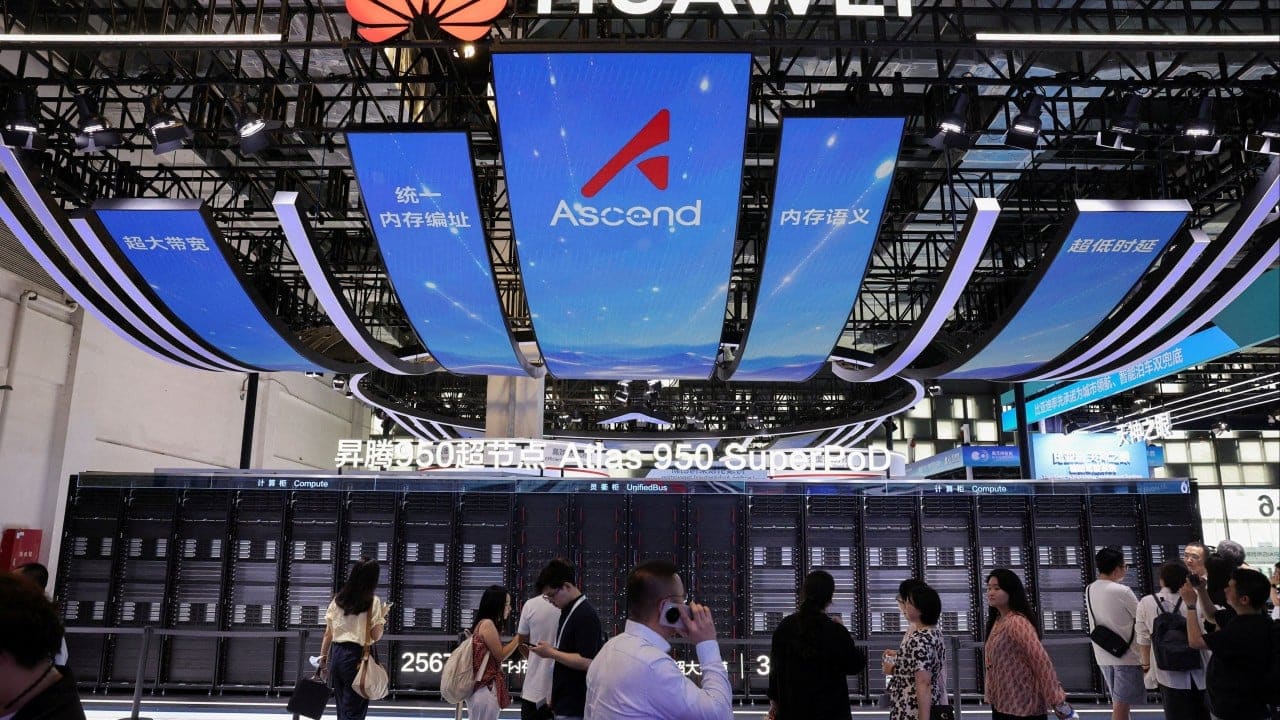
The 121.4 billion yuan is flowing into three overlapping domains. First, chip design and fabrication workarounds: Huawei's HiSilicon unit continues iterating on Kirin and Ascend architectures, exploring mature-node optimizations and chiplet packaging to claw back performance lost to cutting-edge lithography constraints. Second, network infrastructure, where the company remains a global leader in 5G radio and optical transport despite Western market exits. Third, operating-system and software layers: HarmonyOS, Euler, and the MindSpore AI framework are all vehicles for decoupling from Android, Linux distributions, and TensorFlow dependencies.
The company has also accelerated hiring in applied mathematics, materials science, and photonics, disciplines adjacent to traditional silicon engineering. These bets hedge against the possibility that Moore's Law economics stall or that geopolitical barriers harden further. If conventional roadmaps falter, alternative compute substrates and architectures become the next battleground.
The Profitability Trade-Off
A 36 percent profit decline would typically alarm investors, but Huawei is not publicly traded and operates under a governance model that affords management unusual insulation from quarterly earnings pressure. The company's employee shareholding structure means capital allocation decisions can extend across multi-year horizons without activist intervention. That freedom is both a competitive advantage and a structural risk: without market discipline, misallocated R&D can compound for years before course correction.
Revenue growth in the first half remained positive but modest, driven primarily by enterprise networking and cloud services. Consumer hardware, once Huawei's flagship, has stabilized but not returned to pre-sanction volumes. The smartphone business, constrained by chip availability and app-ecosystem gaps, now competes mainly in the domestic market. Profit compression is therefore a function of revenue mix shifting toward lower-margin infrastructure sales while R&D spend scales faster than top-line growth.
Strategic Context Across the Region
Huawei's capital-allocation pattern mirrors broader trends we observe in Seoul, Taipei, and Shenzhen. When geopolitical risk becomes a first-order variable, companies that can afford it overspend on redundancy and vertical integration. TSMC is building fabs in Arizona and Japan not because the economics are optimal but because customer concentration and supply-chain security demand geographic dispersion. Samsung has similarly expanded foundry and packaging capacity in South Korea and Texas, accepting lower near-term returns for strategic optionality.
The difference is that Huawei faces a more acute constraint set. TSMC and Samsung retain access to ASML's EUV lithography and can participate in cutting-edge nodes. Huawei must innovate around those barriers, which raises the cost and uncertainty of each R&D dollar. The 25 percent revenue share devoted to R&D is less a signal of strength than an indicator of the premium required to maintain parity under asymmetric conditions.
Risks and Diminishing Returns
Sustained R&D intensity at this level carries execution risk. Throwing capital at hard problems does not guarantee breakthroughs, especially in domains like advanced lithography and EDA where decades of cumulative knowledge and supplier ecosystems matter. Huawei has made credible progress in areas like optical networking and base-station silicon, but replicating an entire semiconductor supply chain domestically remains an open question.
There is also the risk of strategic drift. High R&D budgets can foster internal empire-building, where engineering teams pursue technically interesting projects disconnected from commercial viability. Without the feedback loop that competitive markets provide, resource allocation becomes a function of internal politics rather than customer demand. Huawei's leadership has historically maintained tight strategic coherence, but the scale and scope of current initiatives test that discipline.
What Comes Next
If the bet pays off, Huawei emerges in three to five years with a vertically integrated stack less vulnerable to external shocks, a position that would reshape competitive dynamics in telecom infrastructure and enterprise AI. If it does not, the company will have burned through tens of billions in shareholder equity with limited strategic gain, potentially ceding market share to rivals who optimized for profitability and incremental innovation.
For now, the 25 percent R&D ratio is a clear statement of intent: Huawei is willing to sacrifice margin and profit growth to secure technological autonomy. Whether that autonomy is achievable at acceptable cost remains the central question, one that will be answered not in earnings calls but in tape-outs, system benchmarks, and customer deployments over the next several product cycles. The firm is playing a long game in an environment where the rules are still being written, and the scoreboard may not be readable for years.