The Twenty-Dollar Gamble: OpenAI's Push to Turn Office Workers Into AI Power Users
ChatGPT Work aims to replicate the coding revolution across finance, operations, and communications, but adoption outside OpenAI's walls remains under two percent.
The Access Dilemma
Andrew Ambrosino has given an AI system control over his email, Slack messages, phone, Notion documents, and Figma files. As the lead engineer for OpenAI's desktop app, he considers this level of access non-negotiable if he wants to test what the company believes is the future of knowledge work. The risk is real: the model could pull sensitive information from a private message and inadvertently share it elsewhere. But for Ambrosino, the trade-off is worth it.
This tension between utility and control sits at the center of OpenAI's newest commercial bet. ChatGPT Work, released last month at the company's twenty-dollar monthly tier, extends the agent capabilities that software developers have enjoyed through tools like Codex to accountants, operations teams, investors, and anyone else whose job involves juggling multiple digital tools. The pitch is straightforward: move beyond answering questions to completing multi-step projects autonomously.
For OpenAI, the stakes are existential. Agents that run longer tasks consume more tokens, making them more lucrative per user. But more importantly, the company needs to prove that large language models can deliver value beyond the narrow confines of software engineering. If AI labs cannot expand into new professions quickly, industry observers warn, value will flow to vertical-specific competitors already embedding themselves in legal work, sales, and other domains with model-agnostic strategies.
The Ninety-Eight Percent Problem
Internal adoption numbers tell a revealing story. By June, ninety-eight percent of OpenAI employees were using Codex, the agentic coding tool that became the foundation for ChatGPT Work. Among organizational subscribers outside the company, that figure dropped to seventeen percent. For individual subscribers, usage fell below one percent.
That chasm between near-universal internal adoption and negligible external uptake defines both the challenge and the opportunity OpenAI faces. The company's communications and finance teams started using Codex when it was, in Ambrosino's words, "actively hostile" to non-engineers, displaying technical readouts about code diffs that meant nothing to them. Between February and the Work launch, the team worked to strip away that friction.
The effort reflects a broader design question: how do you make tools built for power users accessible to everyone else? Every large language model requires a harness, the software layer that determines what information the model sees, which tools it can access, and how it presents results. For developers, a command-line interface was enough to transform how software gets built. But most people do not use command-line interfaces, and OpenAI's engineers understand that mainstream adoption requires different affordances.
Building for the Messy World
The challenge is not just technical but philosophical. Inside OpenAI, debates play out over whether users need buttons at all when they could simply ask the model for what they want. Ambrosino and his team argue that discoverability matters in these early stages, even if those visual cues eventually disappear. He compares the approach to skeuomorphism, the once-common practice of making digital tools resemble their physical predecessors. A calculator app designed to look like a pocket calculator might seem dated now, but it helped people make the transition to digital interfaces.
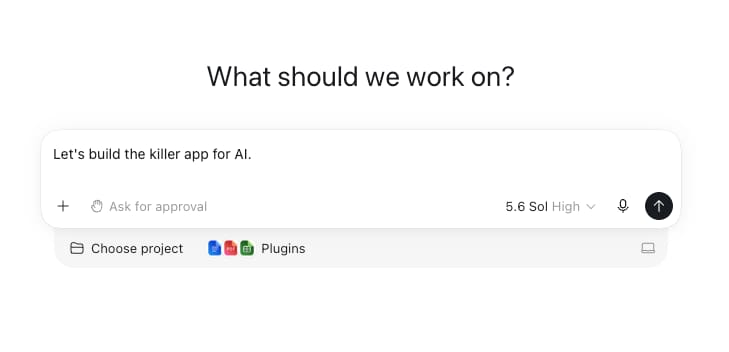
ChatGPT Work includes a few more buttons than standard ChatGPT for selecting projects and plugins, but it maintains the same conversational interface. The goal is to abstract away complexity the way coding agents enabled "vibe coding," where users describe what they want in natural language rather than writing syntax. OpenAI wants to bring that same ease to tools that interact with what Ambrosino calls "the messy world of your life and your tools and websites that were built in 1995 and never updated."
The company frames the product as best suited for routine, data-intensive coordination tasks. Employees are using it to generate weekly metrics reports and transform spreadsheets into planning tools. Venture capitalists are assembling investment memos by having agents pull together relevant communications and analysis. Operations teams are spinning up custom dashboards. One engineer described asking the system to review a Slack conversation about an engineering problem and produce charts, receiving back a series of useful visualizations without further guidance.
The Permission Paradox
In practice, the experience reveals friction points that highlight how early this technology remains. Setting up permissions for agents to access cloud storage can be confusing and circular. Users attempting to grant read-only access may encounter error messages, only to discover through a mobile dialog box that complete access is required. Many critical settings are only available through the web interface, forcing users to toggle between platforms.
The model's own limitations can be perplexing. Link it to Google Calendar and it can create events but not new calendars. The system struggles with low-effort tasks, leading early adopters to warn that frustrated newcomers might give up entirely. OpenAI's engineers acknowledge that effort settings are not yet intuitive, with the harness engineering lead admitting there is room for improvement in helping users select the right level of reasoning.
One journalist testing the system asked it to extract a preschool calendar from email and populate Google Calendar, a task that would have required tedious manual data entry. The agent succeeded. The same user tasked it with building an auto-updating dashboard of financial metrics for publicly traded companies and creating a queryable database of space launches, work that previously required writing Python scripts. But the journalist declined to grant access to their inbox, source interviews, or story drafts, limiting the tool's potential utility.
The Evaluation Gap
OpenAI faces a structural challenge as it moves beyond software engineering: most white-collar workflows are harder to measure. Code either compiles and runs or it does not, a binary outcome that simplifies evaluation even if it flattens the nuance of what makes code good. A compelling presentation, sound business strategy, or effective sales pitch defies easy measurement or tracing.
When asked which specific problems the team designs around and which workflows it targets, the engineers building ChatGPT Work deferred to the research team. OpenAI later stated it uses GDPval, a benchmark drawn from forty-four occupations and hundreds of knowledge work tests, supplemented by user feedback. A less formal answer is that the workflows come from OpenAI employees themselves, though Ambrosino acknowledges the team must constantly ask whether they are building for patterns everyone will follow or for behaviors unique to their own organization.
The early adopters of ChatGPT Work will generate valuable usage traces, much as coding tools benefited from similar data collection, assuming users do not opt out of making their activity available for training. That data may prove crucial as OpenAI refines the product, but it also underscores the trust barrier the company must overcome. Giving an AI system access to email, internal communications, and proprietary documents requires confidence that sensitive information will not leak or be misused.
The Broader Competitive Landscape
While OpenAI has been focused on expanding from its developer base, vertical-specific competitors have been pursuing professionals in law, sales, and other domains with tools that plug in whichever AI model performs best at any given moment. This model-agnostic approach allows them to optimize for results rather than loyalty to a particular lab's technology.
Industry analysts view this dynamic as one of the central challenges facing OpenAI and its peers. If the labs cannot rapidly secure the complementary assets needed to scale AI across different markets, value will accumulate elsewhere. The window for establishing dominance in knowledge work may be narrower than the labs assume, particularly as enterprises grow comfortable with the idea of swapping models based on performance and cost.
OpenAI's response is to make agent functionality as intuitive as prompting, lowering the barrier for mainstream users who would not otherwise know how to harness long-running AI tasks. Without these products wrapping the models, the company argues, only experts would achieve results. But reaching a billion users requires different design choices than serving power users, a tension that plays out in every product decision.
What Adoption Requires
The company insists the value proposition is clear: users should be willing to pay twenty dollars monthly because the utility they receive far exceeds that cost. But the gap between internal and external adoption suggests that value is not yet obvious to most subscribers. The joint app combining Codex and Work is used by just twenty million people, compared to over a billion prompting ChatGPT online.
Part of the problem is that giving an AI agent license to act on your behalf requires a leap of faith many users are not ready to make. The more access you grant, the more useful the tool becomes, but the stakes of something going wrong also escalate. Ambrosino's willingness to expose his private messages to the model is not representative of how most professionals think about risk.
At DailyTechWire, we have tracked similar adoption curves across the region, where enterprises experiment with AI tools in sandboxed environments before granting broader access. The pattern suggests that trust accumulates slowly, shaped by both positive experiences and the absence of negative ones. OpenAI's challenge is not just technical but cultural: convincing users that the benefits of delegation outweigh the discomfort of ceding control.
The company is betting that as the product matures and the interface becomes more intuitive, adoption will follow the same trajectory it saw with software developers. But coding had a clear benchmark for success and a community of early adopters willing to tolerate rough edges in exchange for productivity gains. Whether finance teams, operations managers, and other knowledge workers will make the same calculation remains an open question, one that will determine whether OpenAI's twenty-dollar gamble pays off.