China's Data Center Belt Rises in the Grasslands of Inner Mongolia
Ulanqab, a city once defined by livestock and potatoes, has become a critical node in the country's AI infrastructure push, powered by wind and cold air.
From Pasture to Processors
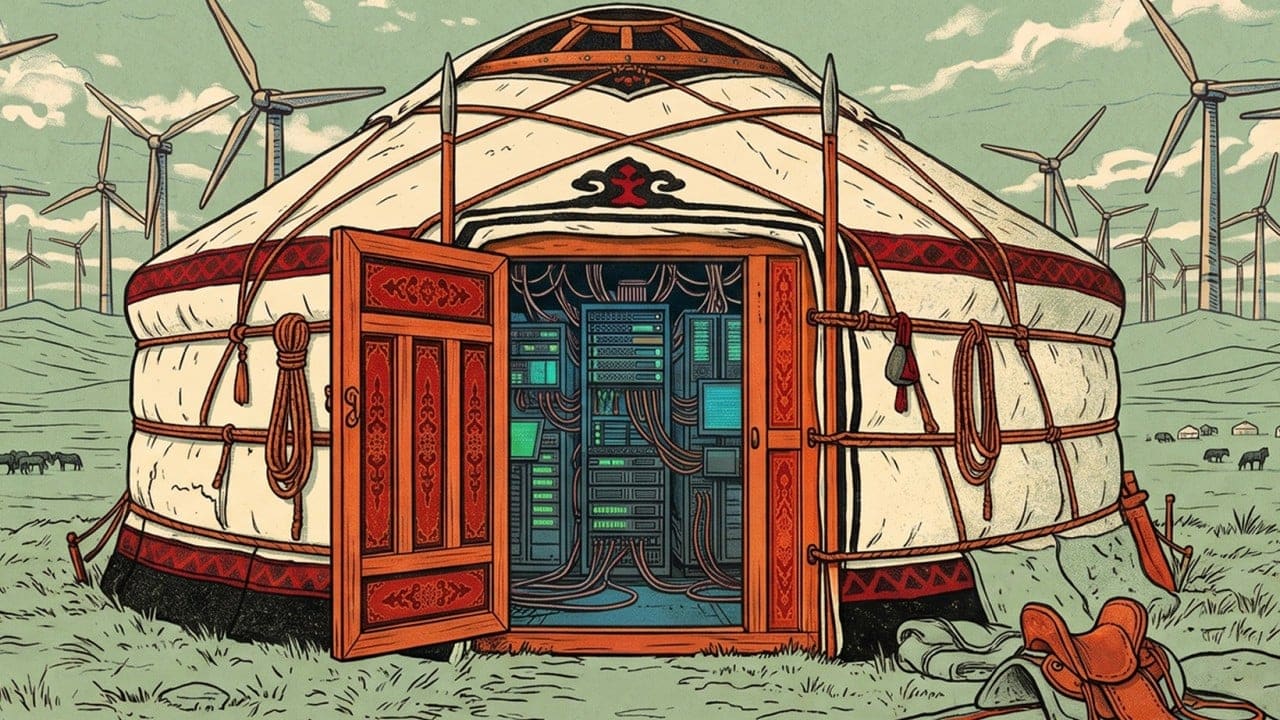
Wind turbines now share the horizon with cattle in Ulanqab, a city several hundred kilometers northwest of Beijing that spent generations as a pastoral outpost in Inner Mongolia. The transformation is not aesthetic. What was once an economy built on livestock, potatoes, and the rhythms of grazing seasons has quietly repositioned itself as a supplier of something the AI era demands in volume: low-cost, energy-efficient computing capacity.
The shift reflects a broader pattern across China's interior provinces. As coastal hubs face power constraints and rising land costs, the infrastructure needed to train large language models and run inference at scale is moving inland. Ulanqab sits at the intersection of two advantages that matter acutely to hyperscalers and cloud operators: abundant renewable energy from the Yinshan mountain range and a climate cold enough to reduce cooling expenses year-round.
At DailyTechWire, we've tracked similar buildouts across northern China, Kazakhstan, and parts of Siberia, where geography is being revalued through the lens of thermal efficiency and grid proximity. Ulanqab is a particularly clear case study. The same wind that once dictated planting schedules now powers rows of servers; the same cold that shortened growing seasons now lowers the cost per FLOP.
The Economics of Cold Air
Data centers are heat engines in reverse. Every watt of compute generates thermal load that must be dissipated. In tropical or temperate climates, this means mechanical cooling, which can account for thirty to forty percent of a facility's total power draw. In Ulanqab, winter temperatures regularly fall below freezing, and even summer nights offer natural convection cooling.
This is not a marginal advantage. For a mid-sized facility running GPU clusters at high utilization, the difference in power usage effectiveness can translate to millions of dollars annually. Chinese cloud providers have been explicit about the calculus: build near renewable generation, minimize cooling overhead, and locate far enough from tier-one cities to avoid land premiums but close enough to fiber backbone for acceptable latency to eastern demand centers.
Ulanqab checks each box. The region's wind farms generate surplus electricity during off-peak hours, and local governments have offered favorable grid rates and land leases to attract digital infrastructure. The result is a cluster of facilities that can offer compute at price points difficult to match in Shenzhen or Shanghai.
Policy and the Push Westward
China's data center migration is not purely market-driven. National policy has explicitly encouraged the construction of computing infrastructure in western and northern regions under frameworks that prioritize energy efficiency and renewable integration. The goal is twofold: relieve pressure on coastal grids and stimulate economic activity in less-developed provinces.
Ulanqab has benefited directly. Provincial authorities have streamlined permitting for data center projects, and state-owned enterprises have co-invested in fiber links and power substations. The city now hosts facilities operated by major domestic cloud platforms, serving workloads that range from model training to video rendering to financial risk simulation.
The policy tilt also reflects a longer-term concern about energy security. As AI compute scales, so does its appetite for electricity. Locating capacity near renewable sources reduces reliance on coal-fired baseload and aligns with decarbonization commitments. Wind and solar in Inner Mongolia are abundant but intermittent; pairing them with flexible, high-load data centers offers a form of demand-side grid balancing that would be harder to achieve with traditional industrial users.
Latency, Connectivity, and the Limits of Geography
Geography solves some problems and creates others. Ulanqab is roughly 450 kilometers from Beijing, which translates to single-digit millisecond latency over fiber. That is acceptable for batch training jobs, video transcoding, and backend inference. It is less acceptable for real-time applications, interactive AI, or services where user experience depends on sub-20ms response times.
The infrastructure buildout has therefore been selective. Workloads that can tolerate distance have moved north; latency-sensitive tasks remain closer to end users. This bifurcation is increasingly common across Asia. We see similar patterns in India, where hyperscale facilities cluster in Maharashtra and Telangana but edge nodes proliferate in tier-two cities; and in Southeast Asia, where Singapore remains the control plane but compute increasingly runs in Johor or Batam.
Ulanqab's role is not to replace Beijing or Shenzhen but to complement them. It provides the heavy-lifting capacity needed for training runs and large-scale inference, freeing up coastal resources for interactive and edge workloads. The model depends on fast, reliable interconnects and on workload orchestration that can intelligently route tasks based on latency tolerance and cost.
The Human and Environmental Ledger
The transformation has brought employment, but not always of the kind local residents expected. Data centers are capital-intensive and labor-light. A facility that occupies tens of thousands of square meters might employ a few dozen technicians and security personnel. The economic multiplier comes less from direct jobs than from construction, logistics, and ancillary services.
Environmental impact is more complex. Renewable energy is a clear positive, but water use for cooling, land conversion, and electronic waste from hardware refresh cycles all carry costs. Northern China is water-scarce, and even air-cooled systems require some water for humidification and backup cooling. Local authorities have imposed usage caps, but enforcement varies, and transparency around consumption data is limited.
There is also the question of what happens when hardware reaches end-of-life. GPU clusters refresh every three to five years; older generations are decommissioned or sold into secondary markets. The scale of e-waste generated by AI infrastructure is not yet well understood, but it is growing. Ulanqab, like other data center hubs, will need to develop recycling and disposal pathways that prevent toxic materials from entering soil and groundwater.
What This Means for Asia's AI Geography
Ulanqab is not an outlier. It is part of a broader reconfiguration of where compute happens, driven by energy costs, climate, policy, and the physics of heat dissipation. Similar dynamics are playing out in Mongolia proper, in Russia's Far East, in northern Japan, and in the high-altitude plateaus of Yunnan and Qinghai.
The implications extend beyond China. As training runs grow larger and inference demand multiplies, every region will face the same pressure to locate capacity where power is cheap, cooling is efficient, and land is available. The winners will be places that can offer all three, along with connectivity and political stability.
For now, Ulanqab offers a preview of what that future looks like: wind farms and server farms side by side, a rural economy reoriented around the invisible work of matrix multiplication, and a city whose name once evoked red cliffs and open sky now associated with the infrastructure that powers generative models half a continent away.