OpenAI Bets Long-Running Agents Can Finally Deliver on Automation Promises
ChatGPT Work attempts to solve the persistence problem that has plagued task automation, with workflow chains that span hours and scheduled execution built in.
The Persistence Problem
The automation tools that shipped over the past eighteen months shared a common flaw: they timed out. Whether browser-based agents or task executors, most systems would stop after a handful of steps, forcing users to babysit processes that promised autonomy. OpenAI encountered this ceiling with its Atlas browser's Agent Mode, where complex workflows would simply halt mid-execution.
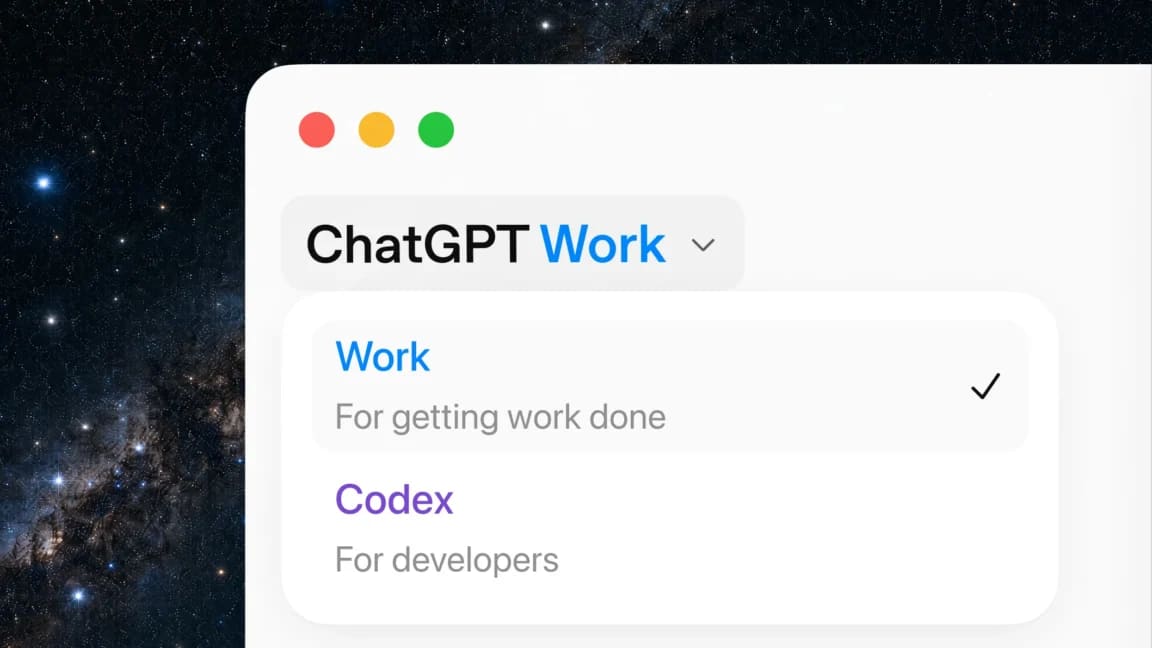
ChatGPT Work, launched this week, targets that specific limitation. The system is engineered to maintain focus on a single objective for hours rather than minutes, completing multi-step processes without human intervention at each checkpoint. The company frames it as a shift from assisted work to delegated work.
Approval Gates and Workflow Chains
The architecture balances persistence with control through approval checkpoints. ChatGPT Work will execute routine sub-tasks autonomously but pauses before committing to actions the system classifies as consequential: sending emails to clients, authorizing expenditures, or publishing content externally.
OpenAI illustrates the capability with a marketing workflow example: the agent conducts customer research, synthesizes findings into a campaign brief, then generates region-specific creative assets. Each phase feeds into the next without re-prompting, a design intended to mirror how a junior team member would handle a delegated project.
The company is encouraging early adopters to test the system on familiar tasks - budget analysis, meeting preparation, report compilation - where users can benchmark output quality against their own work. This "known task" validation approach suggests OpenAI is still calibrating reliability thresholds for broader deployment.
Scheduled Execution and Background Operation
Integrated into ChatGPT Work is a scheduling layer that functions as an enterprise-grade job scheduler. Users can configure recurring tasks - weekly sales pipeline summaries, daily inventory checks, monthly compliance reports - or set event-driven triggers that launch workflows when specific conditions materialize.
The scheduling component operates independently of active user sessions. Tasks continue executing when devices are locked or offline, with mobile notifications surfacing status updates and intervention requests. This background persistence is critical for workflows that span time zones or require off-hours processing, such as nightly data reconciliation or early-morning market briefings.
At DailyTechWire, we've tracked the evolution of agentic systems across the region, and the pattern is consistent: adoption hinges not on capability breadth but on reliability over time. A tool that completes eighty percent of a four-hour workflow is less useful than one that reliably handles a thirty-minute sequence end-to-end.
The Economics of Delegation
The underlying bet is that knowledge workers will pay for time arbitrage. If ChatGPT Work can compress a three-hour research-and-synthesis task into forty minutes of agent runtime plus twenty minutes of human review, the value proposition is straightforward. But the calculus shifts if approval friction is high - if users must intervene every ten minutes, the tool becomes a different product.
Pricing and access tiers have not been detailed, though the feature set implies positioning above consumer ChatGPT subscriptions. Enterprise buyers evaluating agent platforms will weigh ChatGPT Work against competing offerings from Anthropic, Google, and vertical-specific automation vendors. The differentiation will likely come down to integration depth - how smoothly the agent interfaces with internal systems, databases, and collaboration tools - and error recovery behavior when workflows encounter unexpected states.
Guardrails and Scope Limits
OpenAI has not disclosed the technical mechanisms that determine when an action requires approval, though the system likely employs a combination of action-type classification and confidence scoring. High-stakes decisions - financial transactions, external communications, irreversible changes - would trigger review prompts, while low-risk operations proceed automatically.
The hours-long persistence claim also raises questions about resource consumption and cost control. Extended agent sessions that invoke multiple API calls, conduct web searches, and process large documents could accumulate usage charges quickly. Whether OpenAI imposes runtime caps or metered billing will shape how users scope tasks.
There is also the question of failure modes. When a multi-hour workflow encounters an error at step twelve of fifteen, does the agent retry, escalate, or abandon? Robust error handling and state preservation - allowing users to resume from the point of failure rather than restarting - will determine whether ChatGPT Work becomes a reliable delegation target or a high-maintenance experiment.
Workflow Standardization and Institutional Memory
If agents can reliably execute complex, multi-step processes, organizations may begin codifying workflows as prompt templates and approval policies rather than process documentation. A sales team might maintain a library of agent-executable playbooks: prospect research sequences, proposal generation pipelines, post-sale onboarding checklists. This shifts workflow knowledge from tacit expertise held by individuals to explicit, executable artifacts managed centrally.
The flip side is dependency risk. Teams that delegate extensively to agents may lose fluency in the underlying tasks, making it harder to audit outputs, troubleshoot errors, or adapt workflows when business context changes. The tool works best when users remain capable of performing the work themselves but choose not to - a higher bar than simple adoption.
What Comes Next
OpenAI's move into persistent, scheduled automation puts it in more direct competition with robotic process automation platforms and enterprise workflow tools, not just conversational AI products. The company is signaling that large language models are ready to graduate from answering questions to owning outcomes.
Whether that confidence is justified will depend on real-world reliability data that only large-scale deployments can surface. Early enterprise pilots will reveal whether ChatGPT Work's approval gates are calibrated correctly, whether its scheduling layer handles edge cases gracefully, and whether hours-long persistence translates to useful output or accumulated drift.
For now, the product represents a testable hypothesis: that the agent reliability threshold has been crossed, and the bottleneck has shifted from capability to user trust. If OpenAI is right, the next twelve months will see a wave of workflow delegation experiments across sectors. If the approval friction remains high or output quality proves inconsistent, ChatGPT Work will join the long list of automation tools that promised autonomy but delivered assisted mode with extra steps.