OpenAI Bets Voice Will Replace Screens for Complex Work
New full-duplex models promise uninterrupted conversations and hands-free computing, but localization gaps show the challenge of building truly global voice interfaces.
The Full-Duplex Gambit
OpenAI introduced GPT-Live-1 and a smaller GPT-Live-1 mini this week, marking its most aggressive push yet to position voice as the default way people interact with artificial intelligence. The models operate in full-duplex mode, processing speech input and generating audio output simultaneously. That architectural choice eliminates the awkward pauses that plague earlier systems, where users had to wait for the assistant to finish before speaking again.
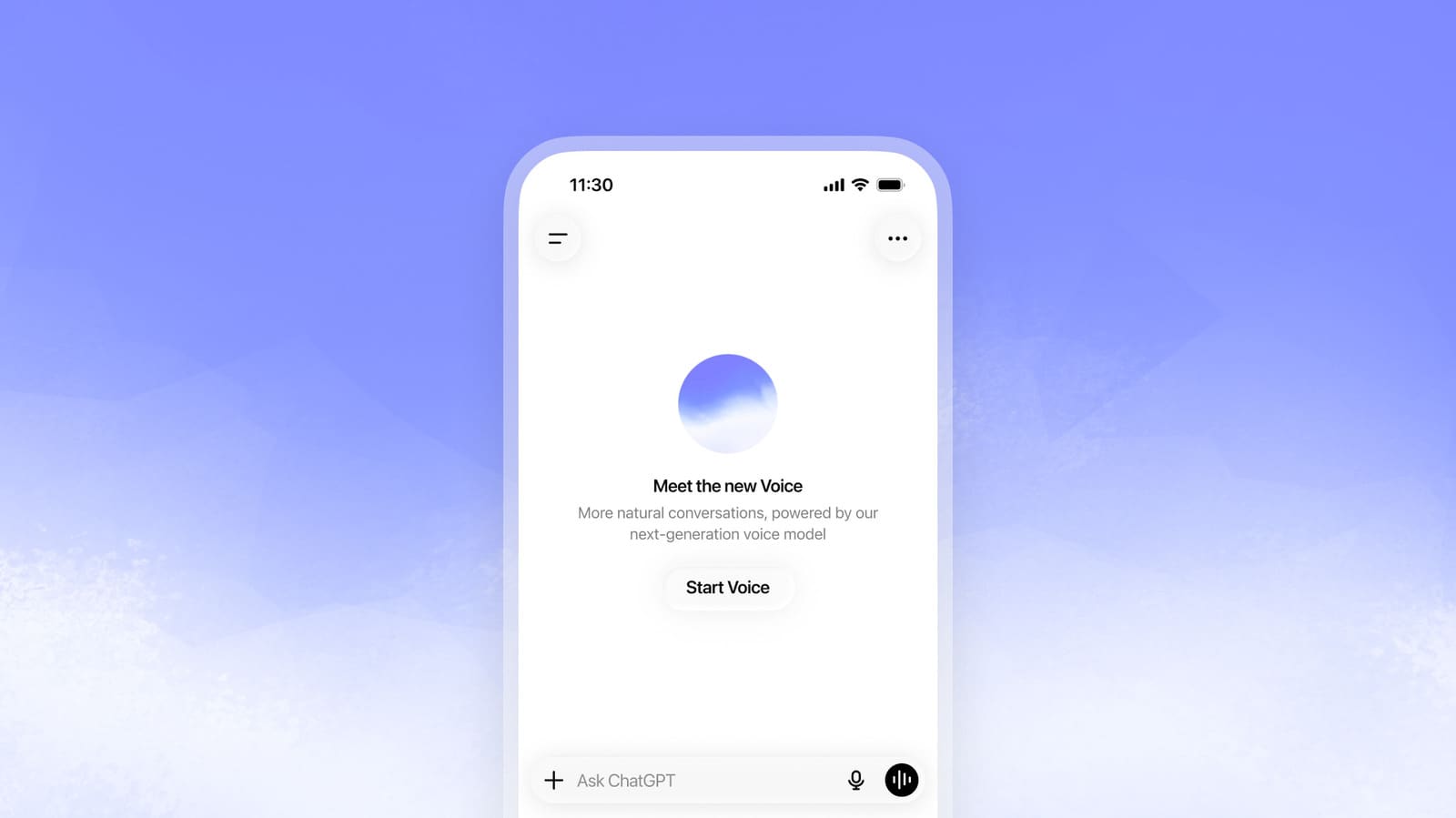
The company is replacing Advanced Voice Mode across ChatGPT with GPT-Live-1 mini for all users; paid subscribers gain access to the larger variant. Unlike the previous pipeline that chained speech-to-text transcription, a language model, and text-to-speech synthesis, the new architecture routes queries to OpenAI's latest reasoning and search models while maintaining conversational flow. During a press briefing, the company demonstrated the system staying silent for extended stretches, absorbing context until explicitly prompted to respond.
At DailyTechWire, we've tracked the convergence of multimodal capabilities and conversational interfaces across Asia and North America. OpenAI's decision to fold visual responses into voice interactions mirrors moves by startups like Monogram, which recently secured forty million dollars in seed capital to build assistants that blend audio and on-screen information. The question is whether users actually want to talk to their devices for thirty-minute stretches, or whether this remains a solution hunting for a problem.
Interface Ambitions and Hardware Whispers
Atty Eleti, who leads voice product development at OpenAI, described personal sessions lasting thirty to forty minutes during walks. His team envisions voice handling "increasingly complex long-running agentic work," a phrase that suggests OpenAI sees conversational AI managing background tasks while users go about their day. That vision aligns with persistent rumors that the company plans to launch AI-enabled earbuds before year-end, though no hardware announcements accompanied this release.
The strategic calculus is clear: if voice becomes the primary computing interface, OpenAI positions itself at the center of a post-screen paradigm. The company claims more than one hundred fifty million people already use voice or dictation features in ChatGPT, a figure that suggests latent demand for hands-free interaction. Whether that demand extends to complex workflows, code generation, or research tasks remains unproven.
Competitors are moving in parallel. Apple and Amazon have both refreshed their assistants with improved context retention and more natural phrasing. Sesame, co-founded by Oculus veteran Brendan Iribe and Ankit Kumar, launched an assistant designed for extended conversations while executing tasks in the background. The race is no longer about whether voice will matter, but who can make it reliable enough to displace keyboards and touchscreens for knowledge work.
Localization Gaps and Safety Rails
OpenAI emphasized that the new models include safeguards to deliver age-appropriate content and connect users discussing self-harm to resources. The company is explicit that it does not intend to build an AI companion, a distinction that reflects both regulatory scrutiny and user expectations around emotional dependency on conversational agents.
Yet the live translation demo exposed friction. When the system translated speech into Hindi, it produced output with a heavy American accent and phrasing that sounded stiff and overly formal. OpenAI stated the models are optimized for "most spoken languages" but declined to specify which languages meet that threshold. For a company with Asia-forward ambitions, that gap is significant. Markets from Jakarta to Seoul to Bengaluru expect localized experiences, not English phonetics draped over regional vocabulary.
The technical challenge is nontrivial. Full-duplex models must handle interruptions, manage turn-taking across cultures with different conversational norms, and render prosody that feels natural in dozens of languages. OpenAI's decision to ship now, despite visible rough edges in non-English contexts, suggests pressure to establish a beachhead before rivals close the gap.
What This Means for Developers and Enterprises
For developers building atop OpenAI's platform, the shift to full-duplex voice opens new interaction patterns. Applications that previously required users to tap a button, wait for transcription, and parse text responses can now sustain fluid, interruptible dialogue. That unlocks use cases in customer support, field operations, and accessibility tools where hands-free operation is not a luxury but a requirement.
Enterprises evaluating voice interfaces will weigh latency, accuracy, and cost. The smaller GPT-Live-1 mini model likely trades some reasoning depth for faster response times and lower inference expense, while the full model targets scenarios where nuanced understanding justifies higher compute budgets. OpenAI's integration with its latest reasoning and search models means voice queries can trigger complex, multi-step workflows without forcing users back to a screen.
The risk is fragmentation. If every major AI lab ships its own voice architecture with proprietary APIs and inconsistent language support, developers face the same integration headaches that plagued chatbot platforms in the late 2010s. Standards matter, and none have emerged yet for full-duplex conversational AI.
The Screen Is Not Dead Yet
OpenAI's bet on voice assumes that people prefer talking over typing for a growing share of tasks. That assumption holds in scenarios where hands or eyes are occupied: driving, cooking, exercising, or navigating unfamiliar environments. It is less obvious when users are seated at desks, where keyboards remain faster and more precise for structured input like code, spreadsheets, or detailed instructions.
The company's addition of visual responses, where the voice assistant can display charts or diagrams mid-conversation, acknowledges this tension. Truly replacing screens would mean eliminating visual output entirely; instead, OpenAI is hedging by blending modalities. That pragmatism makes sense, but it also narrows the transformational claim. If voice becomes one input method among many, rather than the primary interface, the strategic payoff diminishes.
Asia's mobile-first markets may prove the stronger testing ground. In cities where commuters spend hours on trains and buses, where voice messaging dominates social apps, and where typing on small screens frustrates users, a capable voice interface could see faster adoption than in North American office environments. OpenAI's challenge is ensuring those markets get the localization quality they expect, not the accented, awkward translations demonstrated this week.
Forward Pressure
OpenAI has moved quickly from text-only models to multimodal systems that integrate vision, voice, and reasoning. The release of GPT-Live-1 and its smaller sibling continues that trajectory, betting that conversational interfaces will unlock workflows keyboards cannot. The technical foundation is promising: full-duplex operation, integration with advanced reasoning models, and the ability to sustain long interactions without breaking context.
The gaps are execution details that matter enormously in practice. Localization quality, latency under load, cost at scale, and the willingness of users to adopt voice for tasks they currently handle with text and touch all remain open questions. OpenAI is shipping fast, iterating in public, and hoping network effects around its platform create enough lock-in that imperfect launches become footnotes. Whether that strategy works depends less on the technology itself and more on whether people actually want to talk to their computers for thirty minutes at a time.