The Motorola Moto Watch Asks You to Settle for Less
A $150 wearable with premium looks but budget silicon exposes the gap between branding and actual capability in today's smartwatch market.
When Hardware Promises More Than Software Can Deliver
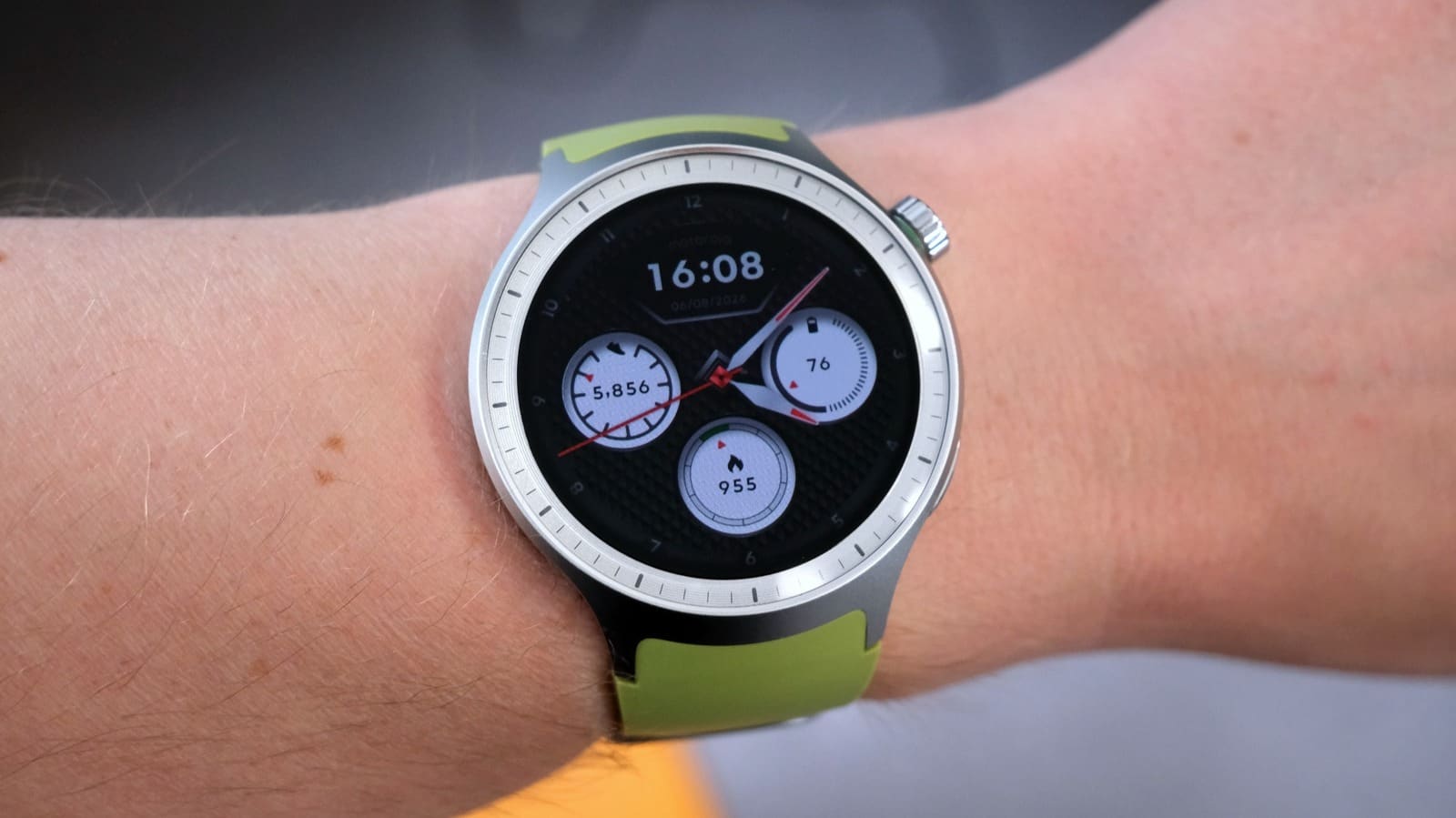
Pull the Moto Watch from its retail packaging and the first impression is disorienting: a 47mm aluminum case with enough heft to suggest a device twice its $150 price, a machined crown bearing Motorola's iconic batwing logo, and a 1.43-inch OLED display framed in Gorilla Glass 3. In a segment dominated by slim fitness bands like the Fitbit Charge 6, here sits something that actually resembles a watch.
That initial confidence evaporates the moment you swap bands. The steel link bracelet's retaining pins slide out onto the floor without warning, a minor failure that foreshadows deeper compromises. At DailyTechWire, we've tracked enough product launches to recognize when industrial design outpaces the platform beneath it, and the Moto Watch is a textbook case.
The Licensing Question Nobody Wants to Answer
Understanding what this device actually is requires parsing Motorola's tangled brand strategy. The retail box lists Motorola Mobility as manufacturer and importer. The underside carries a "Designed by Motorola" engraving. Yet the product website credits CE Brands, a Canadian white-label manufacturer that licensed the Moto name in 2023, as the official licensee and primary contact.
When pressed for clarity on provenance, Motorola's representatives declined to provide manufacturing details. This opacity matters because it explains the product's contradictions: a Wear OS aesthetic layered over Real Time OS, an embedded-systems platform designed for low-power microcontrollers, not consumer wearables. The silicon inside remains unspecified, likely because acknowledging its limitations would undermine the premium positioning.
Motorola has precedent here. The 2019 Moto 360 revival, widely praised for reviving the circular smartwatch form factor, was also a licensee product. But that device ran proper Wear OS. The current Moto Watch does not, and that single architectural decision cascades into nearly every user-facing limitation.
Software That Looks the Part But Isn't
The UI mimics Wear OS closely enough to mislead. Icons, transitions, and menu structures all suggest Google's wearable platform, raising expectations the underlying RTOS cannot meet. Setup requires downloading a dedicated Moto Watch app, which froze twice during initial pairing and demanded account creation despite interface cues suggesting it was optional.
Notification handling inverts the expected default: instead of mirroring your phone and letting you curate exceptions, the Moto Watch requires manually enabling each app you want represented on your wrist. Miss Google Calendar in that initial scroll and you will miss meetings. The friction is high enough that many users will simply leave notifications off.
Core functions exist but feel incomplete. You can track heart rate, steps, and calories. Timers, stopwatches, and a compass are present. There is a dialer for Bluetooth-tethered calls. Sleep tracking data flows into cleanly designed dashboards co-branded with Polar, the Finnish sports tech firm whose logo appears on packaging and in-app health panes.
But third-party apps do not exist here. Google Pay is absent. Music playback is limited to files manually loaded onto the watch's 4GB eMMC storage; streaming services are out of reach. The walled garden is total, and the walls are low.
Fitness Tracking Without the Fitness Part
Polar's involvement suggested the Moto Watch might salvage credibility through health metrics. The collaboration yields polished UI: three activity rings for steps, calories, and active minutes, plus dedicated sections for recovery, stress, and workout logs. The exercise library is exhaustive, spanning standard cardio and niche pursuits like kabaddi, jazz dance, and hula-hooping. Darts and kite flying make the list.
None of that matters if the watch cannot detect when you are actually moving. Automatic activity recognition, standard on wearables for over a decade, is missing. Start a run without manually launching the workout app and the Moto Watch records nothing. No retroactive logging, no gentle prompt asking if you forgot to press start. The device assumes you will remember every time, a assumption that breaks down in real use.
Dual-band GPS is spec'd but inconsistent. Signal acquisition failed outdoors in open areas where other devices connected instantly, and temporary dropouts triggered pre-recorded voice warnings mid-workout. For a product positioning itself alongside fitness-first wearables, the gaps are disqualifying.
Battery Life as the Lone Bright Spot
The unspecified battery lasted eight days with always-on display enabled, exceeding Motorola's seven-day claim and outpacing most Wear OS devices by a wide margin. Real Time OS delivers on its low-power mandate here. Whether that longevity compensates for everything else depends on how much you value not charging versus actually using the device.
The charging puck is standard Qi-style magnetic attachment. Bluetooth 5.3+ LE handles phone pairing. IP68 ingress protection covers dust and water resistance to 1.5 meters for 30 minutes. The hardware checklist reads competently; execution is where confidence falters.
What the Market Actually Needs at $150
The Moto Watch occupies an awkward position. It costs less than entry Wear OS devices like the TicWatch E3 but more than dedicated fitness bands from Xiaomi or Huawei. It looks premium but performs like a first-generation product from a startup still learning wearable UX. The Polar partnership adds credibility on paper but cannot overcome missing auto-tracking or spotty GPS.
For budget-conscious buyers, better options exist. The Fitbit Charge 6 sacrifices watch aesthetics but delivers reliable tracking and Fitbit's mature ecosystem for similar money. Amazfit and Zepp offer full-featured watches with longer app histories at comparable price points. Even older Wear OS devices, discounted as newer models arrive, provide access to Google services and third-party apps the Moto Watch cannot.
The device might appeal to users who want a watch-shaped object on their wrist, manually log every workout, and never open an app beyond stock timers and alarms. That user exists but represents a shrinking segment as expectations rise and competitors improve.
The Cost of Looking Expensive
Standing back, the Moto Watch reads as a study in misaligned priorities. Industrial design and materials budget suggest a $300 device. The platform and software reveal a $75 one. Splitting the difference at $150 satisfies neither camp: enthusiasts wanting full OS capability will pay more for Wear OS, while cost-focused buyers will accept simpler hardware if the tracking works reliably.
Motorola's brand carries weight in mobile, but wearables demand different competencies. Licensing the name to third parties generates revenue with minimal risk, yet it also seeds the market with products that dilute brand equity when they underdeliver. The Moto Watch will sell on name recognition and shelf appeal. Some percentage of those buyers will be satisfied. Others will learn the hard way that heft and finish do not equal capability, and the gap between what a device looks like and what it can do remains as wide as ever.