Spotify Rolls Out AI Persona Badge to Separate Human Artists from Synthetic Creators
The streaming platform introduces new labeling system as generative music floods its catalog, raising questions about authenticity and algorithmic curation
The Labeling Mechanism
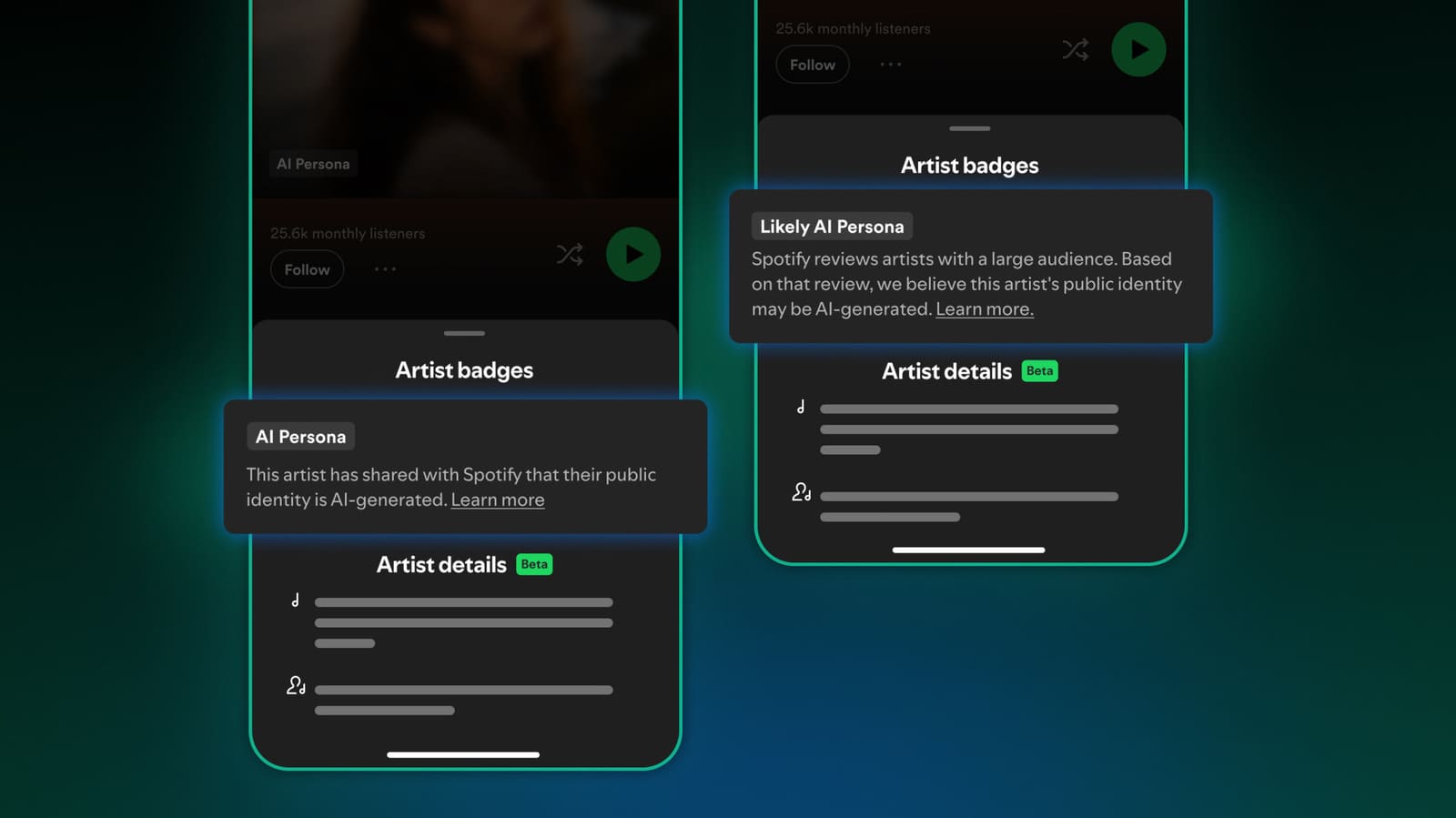
Spotify has opened a new front in the platform authenticity debate. Starting this month, the streaming service introduced a two-tier badge system designed to identify artist profiles that represent generative AI systems rather than human musicians. The move addresses a mounting concern among listeners and industry stakeholders: the rising volume of synthetic music flooding streaming catalogs, often presented without clear disclosure.
The first tier allows accounts to self-declare through the Spotify for Artists portal. Creators operating AI-driven music projects can voluntarily apply an "AI Persona" badge to their profiles. The second tier is enforcement-driven. Spotify will deploy a combination of human reviewers and automated checks to flag accounts it suspects are synthetic, applying a "Likely AI Persona" label. Accounts tagged by the system will be notified and granted an appeals process if they believe the classification is incorrect.
At DailyTechWire, we've tracked similar disclosure experiments across creative platforms, from Midjourney watermarks to YouTube's synthetic content flags. Spotify's approach stands out for embedding the label directly into the artist identity layer, not just individual tracks. That architectural choice reflects how deeply generative music has integrated into streaming economics: entire "artist" entities can now exist as algorithmic shells, complete with release schedules, playlist placements, and follower counts.
Visibility and Algorithmic Consequences
The badges will begin appearing in mid-September across mobile interfaces, including artist profile pages, search results, and playlist track rows. Spotify has not disclosed whether desktop or web players will receive the same treatment simultaneously, a gap that suggests a phased rollout tied to mobile-first user behavior.
More significant than the visual label is the algorithmic penalty. Spotify confirmed that content from AI Personas will be excluded from its personalized recommendation systems by default. That exclusion carries real commercial weight. Recommendation engines drive a substantial share of streaming consumption; being removed from Discover Weekly, Release Radar, and Daily Mix playlists can cripple an account's ability to accumulate plays and revenue.
The policy creates a de facto two-tier catalog: human-made music eligible for full algorithmic promotion, and synthetic music confined to direct search and manual discovery. Whether this split will hold as generative models improve and as licensing frameworks evolve remains an open question. Spotify has not indicated whether users will gain the ability to opt into AI Persona recommendations, nor whether premium subscribers might receive different defaults.
The Platform's Dual Position
Spotify's stance on generative audio is not straightforward opposition. The company has been actively integrating AI tools into its product suite. Recent quarters have seen the rollout of AI-powered playlist generation, voice translation for podcasts, and experimentation with agentic recommendation interfaces that go beyond passive algorithmic suggestion.
This duality reflects broader platform economics. Generative content is cheap to produce and can fill catalog gaps in niche genres or emerging markets. But unchecked synthetic music also threatens the perceived value of the service. If listeners believe a significant portion of their streams reward algorithmic output rather than human creativity, subscription willingness may erode. Label and artist pressure has intensified as well; rights holders have pushed streaming platforms to differentiate their catalogs from what they view as commoditized AI filler.
Spotify's approach mirrors strategies in social media moderation: light-touch disclosure combined with algorithmic demotion. The system avoids outright bans, which would invite accusations of stifling innovation, while still creating friction for synthetic accounts seeking to masquerade as human artists.
Enforcement Challenges Ahead
The viability of the badge system hinges on detection accuracy. Spotify has not detailed the signals its review process will use to identify AI Personas. Likely candidates include metadata anomalies, upload velocity, absence of verifiable identity markers, and audio fingerprinting that flags common generative model artifacts. But as synthesis quality improves and as hybrid workflows blend human composition with AI arrangement, the boundary between "real" and "synthetic" will blur.
The appeals process will be critical. False positives could harm emerging artists who use digital production tools heavily or who operate under pseudonyms without public-facing identities. The burden of proof in appeals, response times, and the criteria for reversal will determine whether the system functions as a transparency tool or an exclusionary gate.
There is also the question of incentive alignment. Artists operating AI Personas have little reason to self-declare if doing so guarantees algorithmic exclusion. Voluntary adoption will likely remain minimal unless Spotify ties the badge to benefits, such as access to designated AI music playlists or eligibility for experimental monetization models. Without carrots to accompany the stick, the self-declaration path may see negligible uptake.
Regional and Rights Implications
Spotify's announcement did not specify geographic rollout details, but the policy will intersect unevenly with regional music markets. In markets with lower barriers to digital distribution and less established artist verification infrastructure, synthetic accounts have proliferated more rapidly. Southeast Asia, Latin America, and parts of Africa have seen waves of AI-generated tracks uploaded under ambiguous artist names, often targeting playlist slots in ambient, lo-fi, and instrumental genres.
The badge system may also influence ongoing rights negotiations. Music publishers and collecting societies have argued that AI-generated music should be subject to different royalty structures or excluded from certain licensing pools. Spotify's labeling creates a technical infrastructure that could support differentiated payment tiers, though the company has not announced any such plans.
Finally, the move sets a precedent for competitor platforms. Apple Music, Amazon Music, and YouTube Music have not implemented comparable labeling systems at scale. If Spotify's approach gains traction with users and rights holders, industry-wide adoption could follow, reshaping how streaming catalogs are organized and monetized across the board.