Meta Ships Real-Time Transcription Model That Handles Code-Switching and 20-Speaker Sessions
Muse Voice Transcribe uses adaptive delay to decide when to commit tokens, marking Meta Superintelligence Lab's first production audio perception model.
Adaptive Latency Meets Multi-Speaker Recognition
Meta has shipped Muse Voice Transcribe, a real-time audio perception model that handles speaker identification, language switching, and punctuation natively within a single architecture. The model can process sessions with more than 20 speakers and toggle between languages mid-sentence without requiring separate diarization or language-detection pipelines.
At DailyTechWire, we've tracked the shift from offline batch transcription to streaming inference as latency tolerance in voice interfaces has tightened. Muse Voice Transcribe takes that evolution a step further by embedding what the industry calls "endpointing" directly into the model: it decides when to commit a token based on phonetic confidence, holding back on ambiguous words and accelerating through clear ones. That adaptive delay mechanism is designed to improve accuracy without sacrificing the responsiveness users expect in dictation and live captioning.
The model was trained across more than 70 languages, with 25 validated for production at launch. Code-switching, where speakers alternate between languages within a single utterance, is handled natively. In a demonstration, Meta showed the model transcribing a conversation that moved fluidly between English and Spanish, correctly attributing each segment to the right speaker and maintaining punctuation across the switch.
Positioning Against Google's Gemini 3.5 Transcribe
The release arrives days after Google introduced Gemini 3.5 Transcribe, its own streaming audio model with comparable multi-language and speaker-separation capabilities. Google is embedding its model into Android and Chrome, giving it distribution across billions of devices. Meta has not announced comparable integration plans for WhatsApp, Instagram, or Facebook.
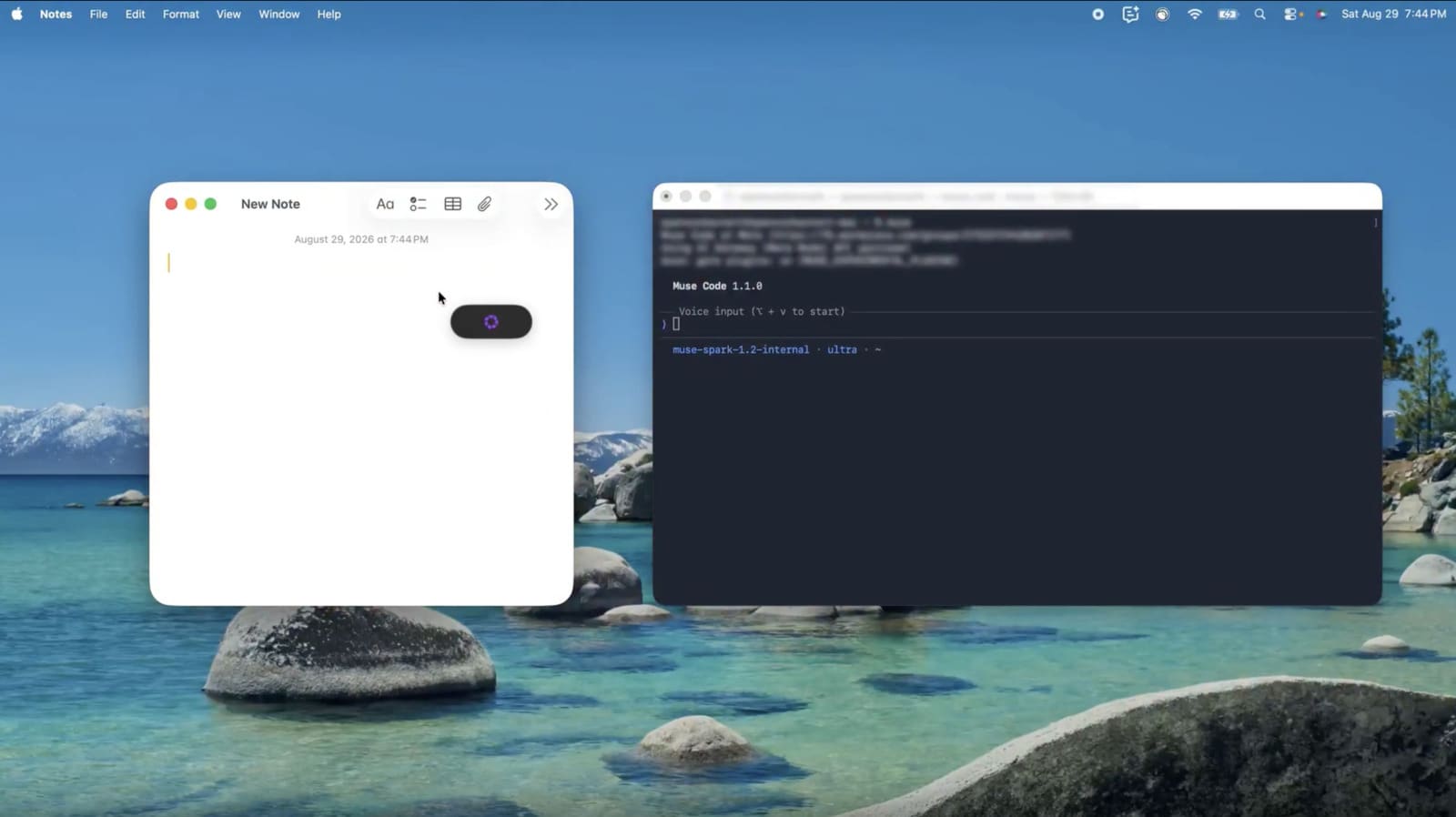
Instead, Muse Voice Transcribe is available through three channels: the recently launched Meta AI Mac app, where it powers system-wide dictation; Muse Code, Meta's coding environment; and the company's Model API, priced at three dollars per 1,000 audio minutes. A demo version is live on Meta's research blog.
The Mac app architecture allows Muse Voice Transcribe to function as a dictation engine for other applications, positioning it as infrastructure rather than a feature locked to Meta's consumer products. That approach mirrors OpenAI's strategy with Whisper, which became widely adopted as a transcription backend despite not being tightly integrated into OpenAI's own interfaces.
Real-World Audio and Hour-Long Sessions
Meta emphasizes that the model was trained on "messy, real audio" rather than studio-quality recordings. That includes background noise, overlapping speech, and the acoustic variability of phone calls, video conferences, and open-plan offices. The ability to handle hour-long sessions with more than 20 speakers suggests the model maintains speaker embeddings in memory without degradation, a challenge for earlier transformer-based architectures that struggled with long-context audio.
Speaker diarization, the task of determining "who spoke when," has traditionally required separate models or post-processing steps. By integrating it natively, Muse Voice Transcribe reduces latency and eliminates the cascading errors that occur when diarization output feeds into a downstream transcription model. The architecture likely uses multi-task learning, where speaker identification and token prediction share lower-layer representations.
The adaptive delay mechanism is particularly relevant for languages with complex morphology or tonal distinctions, where committing too early can lock in errors. Vietnamese, Mandarin, and Thai all present cases where a phoneme's meaning depends on pitch contour or surrounding context. By allowing the model to wait when confidence is low, Meta is trading a few hundred milliseconds of latency for higher word-error-rate scores.
Meta Superintelligence Lab's Expanding Footprint
Muse Voice Transcribe is the latest output from Meta Superintelligence Lab, the division formed to consolidate the company's AI research and productization efforts. In recent weeks, MSI has released a dedicated coding agent, an open-weight foundation model, and the Meta AI Mac app that serves as the distribution layer for several of these tools.
The pace suggests Meta is operating under a ship-fast cadence, pushing models to production as soon as validation thresholds are met rather than waiting for perfect performance. That mirrors the approach we've seen from Anthropic and OpenAI, where iterative releases and developer feedback loops have replaced the traditional research-then-product waterfall.
The three-dollar-per-1,000-minutes API pricing puts Muse Voice Transcribe below some enterprise transcription services but above commodity options like AssemblyAI's base tier. The economics will depend on whether Meta's diarization and code-switching capabilities justify the premium for developers building multilingual customer-support tools, meeting summarizers, or podcast production workflows.
Asia-Forward Implications
For developers across Seoul, Singapore, and Jakarta, the 25 validated languages at launch will determine adoption. Meta has not published the full language list, but if it includes Korean, Bahasa Indonesia, Tagalog, and the major Indian languages, the model becomes immediately relevant for regional call-center automation, live event captioning, and content moderation pipelines.
Code-switching is particularly prevalent in Southeast Asia and India, where English mixes with local languages in business and casual conversation. A model that handles this natively eliminates the need for language-detection preprocessing or separate monolingual pipelines, reducing infrastructure complexity and cost.
The lack of integration into WhatsApp is a missed opportunity in markets where the app is the dominant communication platform. If Meta eventually routes Muse Voice Transcribe into voice messages or live calls, it would unlock accessibility features and searchable voice archives for hundreds of millions of users. For now, though, the focus appears to be developer adoption and Mac-based productivity use cases, which skew toward North American and European markets.
What Comes Next
Meta has not disclosed whether Muse Voice Transcribe will remain Mac-exclusive or expand to Windows and Linux. The company also has not addressed whether the model will power real-time translation, the logical next step once transcription and language identification are solved. OpenAI's recently announced real-time translation feature in ChatGPT suggests the race is on.
The adaptive delay mechanism and native diarization represent incremental but meaningful progress in streaming audio inference. The real test will be whether Meta can leverage its distribution, either through the Model API or eventual integration into its consumer apps, to turn Muse Voice Transcribe into infrastructure that developers and users adopt by default. Google's head start with Android and Chrome integration gives it a structural advantage, but Meta's open-weight philosophy and developer-first rollout may carve out a different path to scale.