Meta Launches Mac Desktop App for Business-Focused AI Assistant
The company's latest move combines screen-sharing capabilities with analytics integration to court small business owners and creators on Facebook and Instagram.
Screen Sharing Meets Campaign Analytics
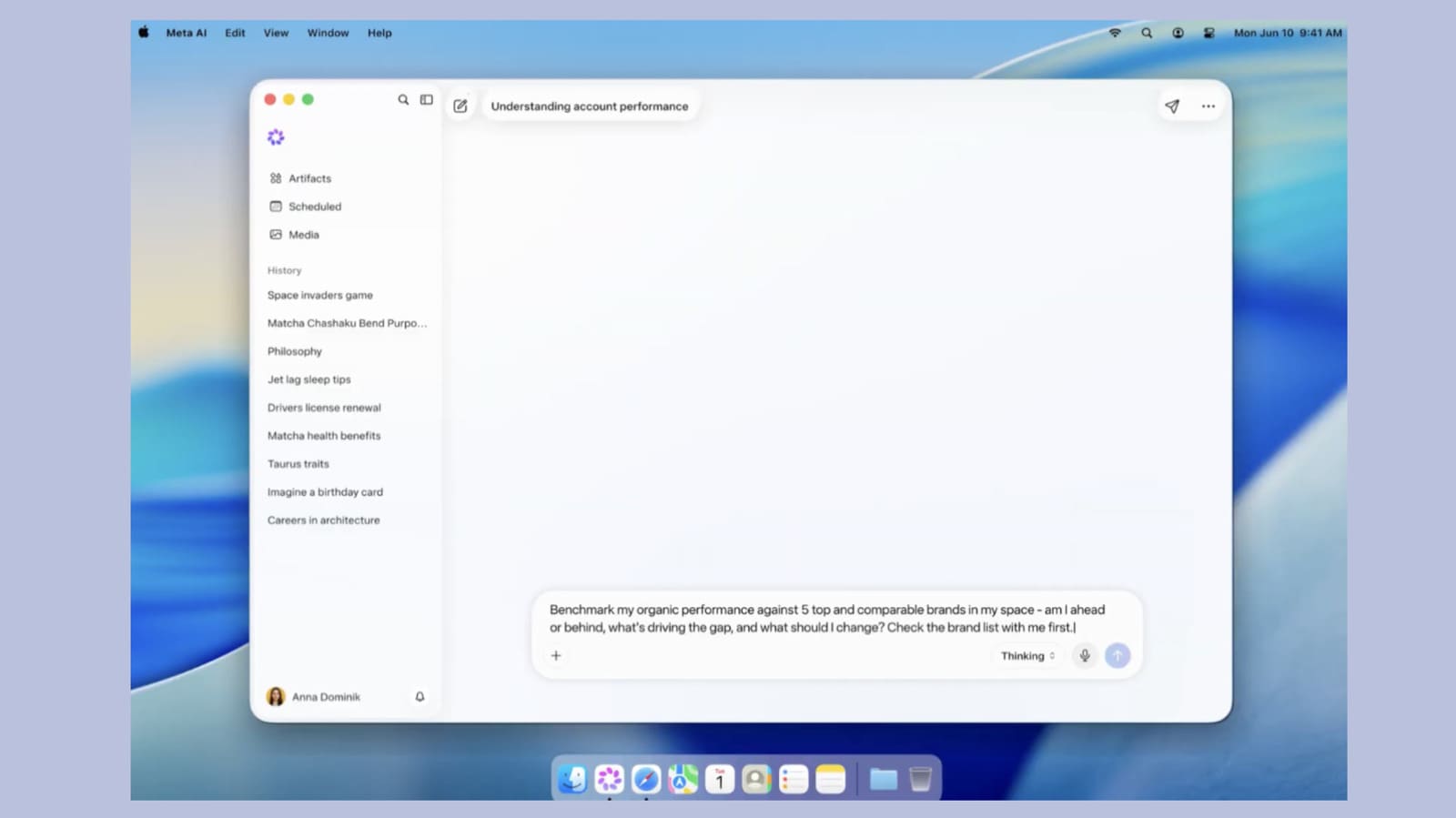
Meta has shipped a native Mac application for its AI assistant, marking the first time the tool has moved beyond web and mobile interfaces. The desktop release centers on a single technical capability that distinguishes it from browser-based competitors: users can share portions of their screen directly with the assistant, allowing it to parse visual context from documents, design mockups, or campaign dashboards.
The feature targets a specific user segment that Meta has spent the past eighteen months courting with increasing intensity: the estimated 200 million businesses that maintain active presences on Facebook and Instagram. For solo operators managing ad spend across multiple campaigns or creators juggling sponsorship contracts, the ability to point an AI at a spreadsheet and ask "which audience segment drove the highest conversion rate last quarter?" represents a meaningful reduction in context-switching overhead.
At DailyTechWire, we've tracked Meta's enterprise AI strategy closely over the past year, and this release fits a clear pattern. The company is methodically building connective tissue between its consumer-facing assistant and the backend infrastructure that powers its advertising engine, the $131 billion revenue stream that funds everything else Menlo Park builds.
Google Workspace Integration and the Data Moat Question
The Mac app introduces a second integration layer that extends beyond Meta's own properties. Users with professional Facebook or Instagram accounts can now authorize the assistant to pull data from Google Workspace, including Docs, Sheets, and Drive files. In practice, this means a small business owner can ask the assistant to cross-reference sales projections stored in a Google Sheet with engagement metrics from their Instagram account and receive synthesized recommendations on ad budget allocation.
This move is tactically shrewd. By positioning itself as a hub that aggregates data from both Meta's platforms and Google's productivity suite, the company is attempting to create switching costs that go beyond simple feature parity. Once a business has connected multiple data sources and built workflows around those integrations, migrating to a competing assistant requires not just learning a new interface but reconstructing an entire data topology.
The approach also highlights a structural advantage Meta holds over pure-play AI startups. While companies like Anthropic and OpenAI offer technically sophisticated models, they lack direct access to the behavioral and transactional data flowing through billions of daily social media interactions. Meta's assistant can answer questions about "comparable brands" and their growth trajectories because it sits atop a graph of user behavior that no external API can replicate.
The Subscription Squeeze and Rate Limit Strategy
The Mac app itself carries no upfront cost, but Meta has begun implementing usage caps on what it terms "advanced AI features." Users who hit those thresholds encounter prompts to subscribe to Meta One, the company's $11.99 monthly plan that bundles higher rate limits with verification badges and customer support access.
This freemium architecture mirrors strategies deployed by GitHub Copilot, Notion AI, and other productivity-focused assistants. The calculus is straightforward: offer enough utility in the free tier to drive adoption and integration into daily workflows, then convert the subset of power users whose usage patterns justify recurring spend. For Meta, which has historically derived negligible revenue from subscription products, even modest conversion rates among its business user base would represent a material diversification of its income streams.
The timing of the rate limit rollout is worth noting. Meta introduced these caps after the assistant had been available for several months without usage restrictions. This sequencing is deliberate; it allows users to develop dependencies before encountering friction, a tactic that tends to yield higher conversion rates than gating features from the outset.
The Zuckerberg Vision and Competitive Pressure
Mark Zuckerberg has articulated an expansive vision for Meta's AI products, stating publicly that he expects agents to eventually "run your whole business." That ambition extends well beyond the capabilities shipped in this Mac app, suggesting the current release is an incremental step toward a more autonomous system that could handle tasks like campaign optimization, content scheduling, and customer response without human oversight.
Whether that vision materializes depends on factors Meta cannot entirely control. Regulatory scrutiny of AI systems that make consequential business decisions is intensifying across multiple jurisdictions. The European Union's AI Act, for instance, classifies certain automated decision-making systems as high-risk, subjecting them to transparency and audit requirements that could complicate deployment of fully autonomous business agents.
Meta also faces competition from established enterprise software vendors. Salesforce, HubSpot, and Adobe have all introduced AI assistants tailored to marketing and sales workflows, and those products benefit from existing customer relationships and data integrations that took years to build. Meta's advantage lies in its unique dataset and the billions of users already active on its platforms; its challenge is persuading businesses that an assistant built by a social media company can be trusted with mission-critical operations.
What This Means for the Asia-Pacific SMB Landscape
The business-focused positioning of this release has particular resonance across Asia-Pacific markets, where small and medium enterprises represent a disproportionate share of Meta's active advertiser base. In Southeast Asia alone, over 40 million SMBs use Facebook or Instagram for customer acquisition, according to data Meta disclosed in its 2025 economic impact report.
For these businesses, many of which lack dedicated marketing teams or analytics resources, an assistant that can interpret campaign performance and suggest tactical adjustments lowers the expertise threshold required to run effective digital advertising. That democratization dynamic could accelerate ad spend among smaller accounts, a segment Meta has historically struggled to monetize as efficiently as large brand advertisers.
The Google Workspace integration also aligns with usage patterns common among Asian SMBs, where Google's productivity tools have achieved near-ubiquitous adoption in markets like India, Indonesia, and the Philippines. By meeting businesses where their data already lives, Meta reduces the implementation friction that often stalls enterprise software adoption in resource-constrained environments.
The Mac-first release strategy, however, introduces a geographic wrinkle. While Apple's desktop platform dominates in North American and Western European creative and business segments, Windows and web-based workflows remain far more prevalent across much of Asia. Meta has not yet announced a Windows version of the app, which may limit near-term uptake in markets like Vietnam, Thailand, and India, where Mac penetration among SMBs remains in the single digits.
The Coding Agent Context
This Mac app arrives less than two months after Meta released an AI coding agent priced below competing offerings from GitHub and Replit. That product, aimed at developers building applications on Meta's platforms, shares the same strategic intent: deepen platform lock-in by embedding AI tools directly into the workflows of users who generate value on Meta's infrastructure.
Taken together, these releases signal a broader shift in Meta's product philosophy. Rather than positioning AI as a standalone consumer novelty, the company is systematically weaving it into the operational layers of its platform, making it progressively harder for businesses and developers to extract equivalent value from competing ecosystems. It is platform strategy executed through the language of AI assistance.