Idaho Lab Tests Chinese Lidar Sensors as Washington Weighs Ban
Industry-funded research at a Department of Energy facility explores cybersecurity risks while automakers face a supply-chain crossroads
A Quiet Investigation in Idaho
The Idaho National Laboratory, a Department of Energy research facility known for its work on nuclear reactors and critical infrastructure, has taken on an unusual assignment: testing whether lidar sensors manufactured in China could compromise vehicles operating on American roads. The research, funded by one or more companies in the electric and autonomous vehicle sectors, represents a rare intersection of industrial competition, national security policy, and the technical realities facing automakers as they build out advanced driver-assistance and autonomy systems.
The laboratory has declined to discuss the project publicly. When pressed, a spokesperson said only that "this isn't a project that we're at liberty to discuss with reporters." Sources familiar with the effort, who spoke on condition of anonymity, confirmed that the review is underway and that industry money is backing it. The identity of the sponsor remains unclear. Rivian, General Motors, Ford, Kodiak, Lucid Motors, Nuro, and Uber all told inquirers they were unaware of the research. Nvidia, Zoox, and Aurora did not respond to questions.
At DailyTechWire, we've tracked the steady erosion of American lidar competitiveness over the past five years. What began as a technology pioneered by U.S. startups has become a market increasingly dominated by Chinese manufacturers who can produce sensors at a fraction of historical costs. The Idaho review arrives at a moment when that shift has moved from a business story to a policy flashpoint.
The Economics Behind the Alarm
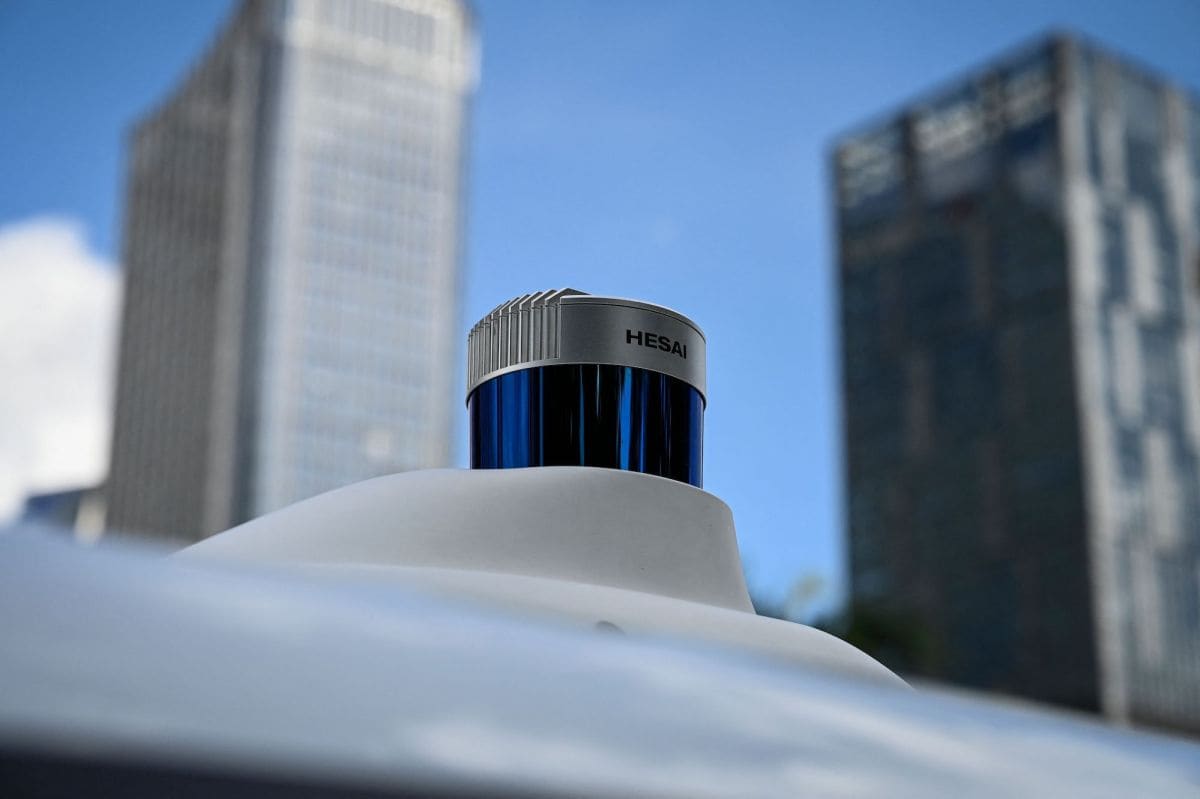
Lidar technology measures distance by bouncing laser pulses off objects and calculating how long the light takes to return. A decade ago, a single unit could cost seventy-five thousand dollars. Today, Chinese suppliers Hesai and RoboSense offer sensors priced in the hundreds of dollars. That compression has made lidar economically viable for mass-market vehicles, not just experimental robotaxis or military applications.
American lidar companies have struggled to match that pricing. Luminar, once a high-flying public company, filed for bankruptcy. Others have consolidated or exited the market entirely. The result is a supply-chain dilemma for U.S. automakers: build autonomy stacks around sensors from a geopolitical rival, or pay significantly more for domestic alternatives that may not exist at scale.
Omer Keilaf, CEO of Israeli lidar firm Innoviz, frames the risk in two layers. The first is straightforward supply-chain exposure. Beijing has designated lidar as strategically important technology, which means any automaker building an entire autonomy platform around Chinese components faces the possibility of sudden policy shifts or export restrictions. "If an OEM now builds its entire autonomous driving stack based on a Chinese supply chain, that's a huge risk down the road," Keilaf said in a recent interview.
The second layer involves cybersecurity. Keilaf, who spent seven years in Israeli intelligence, outlined two primary threat vectors. One is mass disabling. Researchers have demonstrated that individual lidar units can be blinded or disrupted using precisely aimed lasers. Scaling that to an entire fleet would require coordination, but the theoretical risk remains. The more plausible concern, Keilaf argues, is data exfiltration. Lidar generates high-resolution spatial data about roads, buildings, and infrastructure. That data can be compressed and transmitted via cellular chips embedded in vehicle systems. "It's not very difficult to extract that information," he said.
Legislative Pressure Builds
Senator Tammy Baldwin of Wisconsin and Senator Ted Budd of North Carolina are co-sponsoring the Securing Infrastructure from Adversaries Act, legislation designed to restrict Chinese lidar use in federally funded projects. Baldwin told inquirers she is primarily concerned about military and industrial espionage. "As infrastructure becomes more sophisticated, the threat Chinese LiDAR technology poses to American communities and our national security cannot be allowed to go unchecked," she said in a statement. "We need to be doing more to protect Americans and that starts with ensuring taxpayer dollars aren't being used to purchase technologies that could be used to spy on us."
Congressman John Moolenaar of Michigan is co-sponsoring a separate bill with Congressman Raja Krishnamoorthi of Illinois. Moolenaar has raised concerns about "back doors" that could "transmit information back to these Chinese Communist interests." Krishnamoorthi has spent years warning that widespread adoption could enable China to "gather sensitive data or disrupt our systems."
The legislative push reflects broader anxiety in Washington about Chinese technology in critical infrastructure. The Department of Commerce in 2025 implemented rules prohibiting Chinese-made connectivity hardware in U.S. passenger cars, but that regulation does not extend to lidar or other autonomy sensors. The Department of Defense has placed both Hesai and RoboSense on its 1260H list, a designation that restricts their ability to work with the U.S. military but does not bar commercial use.
What the Lab Might Find
The Idaho review appears focused on cybersecurity risks rather than supply-chain resilience. Sources familiar with the effort suggest the research could potentially clear Chinese lidar of certain security concerns, though the scope and methodology remain opaque. That outcome would be politically delicate. A clean bill of health from a DOE laboratory might ease automakers' procurement decisions but complicate legislative efforts to ban the technology outright.
The technical questions are not trivial. Unlike connectivity modules or infotainment systems, lidar sensors do not inherently require network access. They are passive instruments that emit light and measure reflections. Any data transmission would require integration with other vehicle systems, typically through a central compute unit or telematics module. The risk profile depends on how those integrations are architected and whether manufacturers implement air-gapped designs that isolate sensor data from external networks.
One real-world incident offers a cautionary note. In early 2024, customers using Hesai lidar experienced a full-day outage when the company's software failed to account for the leap year. Autonomous vehicles equipped with the sensors stopped functioning. The incident was not a cyberattack, but it demonstrated how software flaws or deliberate interference could disable fleets at scale.
Rivian and the Onshoring Dilemma
Rivian, the electric truck and SUV maker, has publicly grappled with the lidar question. The company plans to offer a version of its R2 SUV with an integrated roof-mounted lidar sensor. In March, CEO RJ Scaringe told reporters the company was exploring the possibility of manufacturing lidar domestically by leveraging Chinese technology, possibly through a joint venture. "A number of different car manufacturers are thinking about how they could do that either together, or at least through a shared alignment to say, hey, let's develop production capacity in the United States for this, or at least outside China," Scaringe said at the time. He noted that Rivian was in "active discussions" with lidar firms and that the effort might include other automakers.
Rivian's chief financial officer later walked back those comments, stating the company has no plans to bring lidar development in-house. The episode illustrates the tension automakers face: acknowledging the geopolitical risk while recognizing the economic and technical barriers to alternatives.
Asia's Lidar Advantage
The cost advantage enjoyed by Hesai and RoboSense is not purely a function of subsidies or state support. Chinese manufacturers benefit from deep domestic supply chains for optoelectronics, large-scale production facilities, and lower labor costs. They also operate in a market where demand for autonomy features is growing rapidly, particularly in urban robotaxi deployments in cities like Shenzhen, Beijing, and Shanghai. That scale allows for faster iteration and cost reduction.
American and European lidar makers, by contrast, face fragmented demand, higher capital costs, and limited access to the kind of vertically integrated supply chains that Chinese firms enjoy. Israeli companies like Innoviz occupy a middle ground, leveraging technical expertise and relationships with Western automakers but lacking the production scale of their Chinese competitors.
The Idaho review, whatever its conclusions, is unlikely to resolve the underlying economic asymmetry. If Chinese lidar is found to pose genuine security risks, U.S. automakers will face a costly scramble to rebuild domestic supply. If the sensors pass muster, the political appetite for restrictions may persist regardless, driven by broader concerns about technological dependence on Beijing.
Forward View
The lidar debate is a microcosm of a larger recalibration underway in U.S.-China tech relations. For years, American companies treated China as both a manufacturing base and a market. That era is closing. Export controls, investment restrictions, and security reviews are reshaping which technologies can cross borders and under what conditions.
Lidar sits at an uncomfortable intersection. It is not a semiconductor or a cutting-edge AI chip, the kinds of technologies that have drawn the most attention in Washington. But it is a sensor with potential intelligence applications, capable of generating detailed spatial data and integrated into vehicles that move through sensitive locations: military bases, government facilities, critical infrastructure.
The Idaho National Laboratory's work will produce data. Whether that data shifts the policy debate, reassures automakers, or simply adds another layer of complexity to an already tangled issue remains to be seen. What is clear is that the question of whose sensors power the next generation of American vehicles will not be answered by engineering alone.