HyperTexting Wants You to Follow Websites, Not Algorithms
A 20-year tech veteran built an iOS app that repackages RSS feeds as a scrollable feed, betting users will prefer the open web over centralized platforms
The Old Internet, New Skin
Caleb Hailey remembers when everyone was supposed to have their own corner of the internet. A domain name, a homepage, maybe a blog. That vision faded as Facebook and Twitter made it easier to post updates than to maintain a website. Now, after two decades in tech, Hailey has released HyperTexting, an iOS app that tries to reverse that shift by making the open web scroll like a social feed.
The app launched in July 2026 with a straightforward premise: follow websites, blogs, newsletters, and podcasts the way you follow people on Instagram. Articles and posts appear in a vertical feed, no algorithm deciding what you see. Users can also publish to their own websites directly from the app, treating personal domains as if they were social profiles.
At its core, HyperTexting is an RSS reader that hides the protocol behind a user interface borrowed from social platforms. RSS, the decades-old syndication standard that still powers WordPress and podcast directories, has never gained mass appeal despite repeated attempts. Google shut down Google Reader in 2013, and tools like Feedly remain niche. Hailey's bet is that packaging RSS in a familiar format will finally make it stick.
Why RSS Failed to Scale
The problem with RSS has always been presentation. Subscribing to feeds requires understanding XML, OPML files, and the concept of syndication itself. Even apps that simplified the technical side, like NetNewsWire, still felt like tools for power users: journalists, researchers, people who read dozens of articles daily. The average smartphone user, accustomed to auto-playing videos and algorithmic suggestions, found RSS readers austere.
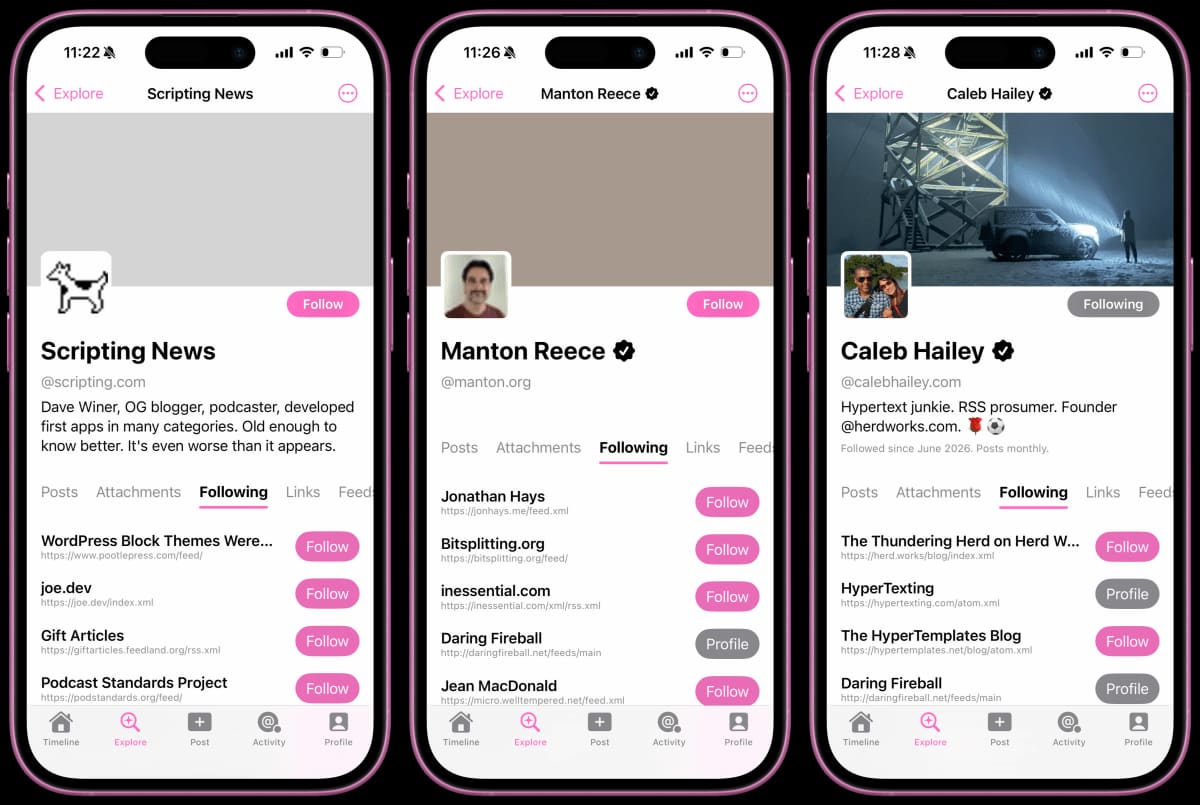
Hailey experienced this friction himself. After uninstalling social apps during the pandemic, tired of what he called "doom scrolling," he returned to NetNewsWire. It worked for him, but he recognized that most people would never adopt a feed reader that looked like an email inbox. HyperTexting reframes RSS as a social experience. You tap "follow" on a website, and its posts appear in your feed. You can comment by publishing a response on your own site, which the app then surfaces to anyone following the original source.
The interface includes profiles for websites, a "following" list, and an Explore tab that highlights trending content across the web. An optional Safari extension lets users add sites to their feed as they browse. The goal is to make discovering and consuming web content feel as effortless as scrolling TikTok, without the engagement-maximizing algorithm.
Publishing Without Platforms
HyperTexting also tries to lower the barrier to publishing. Users can connect a WordPress blog, a Ghost newsletter, or a static site built with generators like Hugo. Hailey's company, Herd Works, also offers HyperTemplates, a static site tool designed for iPhone. Once linked, posting to your website becomes as simple as tapping out a message in the app.
This dual function, reading and writing, distinguishes HyperTexting from pure feed readers. Hailey frames it as a return to the internet's original social layer: hyperlinks. Instead of replies living inside a platform's database, responses exist as standalone posts on personal websites, linked back to the source. The app aggregates those links, creating a distributed conversation layer without a central authority.
The model assumes users care enough about independence to maintain their own domain. That assumption runs counter to two decades of behavior. Social platforms won, in part, because they eliminated friction. You didn't need to pay for hosting or learn HTML. You just signed up and posted. HyperTexting asks users to do slightly more work in exchange for ownership, a trade-off that appeals to a certain type of user but may not scale beyond them.
Algorithms and Attention
Hailey's frustration with Twitter drove much of the design. He pointed to several changes that degraded the platform: the shift from reverse-chronological timelines to algorithmic feeds, the de-prioritization of external links, and the overall chase for engagement metrics. Those changes, common across major platforms, push users toward content that keeps them on-site rather than sending them elsewhere.
HyperTexting rejects that model. There is no algorithm deciding what to show. Feeds are strictly chronological, ordered by publish time. External links are the entire point. The app strips ads from articles when displaying them, though Hailey acknowledges this could create tension with publishers who rely on ad revenue. The revenue model for HyperTexting itself remains uncertain. Hailey has mentioned the possibility of premium subscriptions for additional features or a single sponsored post per day, but nothing is locked in.
The app's philosophy aligns with a broader skepticism of platform power that has grown louder in recent years. Mastodon, Bluesky, and other decentralized social projects have attracted users disillusioned with corporate control. Hailey argues that the web itself is the original decentralized network, and that rebuilding social infrastructure on top of it makes more sense than starting from scratch with new protocols.
The Adoption Problem
HyperTexting faces the same challenge that has doomed every RSS revival: network effects. Social platforms thrive because everyone is already there. Moving to a new app requires convincing not just individuals but entire networks to shift. HyperTexting sidesteps this by not requiring the people you follow to use the app. As long as a website publishes an RSS feed, you can follow it. But the publishing side, the ability to join conversations by posting on your own site, only works if others in your network do the same.
At DailyTechWire, we've tracked multiple attempts to revive interest in the open web. Each wave brings new tools, new rhetoric, and a small but passionate user base. Few break out. The question for HyperTexting is whether repackaging RSS as a social feed is enough to change that pattern, or whether it will remain a tool for the already converted, the people who never stopped believing the web should be decentralized.
Hailey's experience gives him credibility. Twenty years in tech means he has seen platforms rise and fall, watched business models warp products, and lived through the consequences of prioritizing growth over user experience. His diagnosis of what went wrong with social media is widely shared. The harder part is proving that a return to personal websites and RSS feeds can compete with the convenience and reach of centralized platforms.
What Comes Next
HyperTexting is free to download, with no paywalls or premium tiers yet. Hailey has framed the project as an experiment, testing whether simplifying access to the open web can draw people away from algorithmic feeds. The app's success will depend on whether users value independence enough to accept a smaller, quieter internet.
The broader trend, though, is clear. Frustration with platform control is growing. Regulatory pressure is mounting. Alternative models, from federation to static sites, are gaining attention. HyperTexting is one answer among many, distinguished by its refusal to reinvent the wheel. Instead of building a new protocol or network, it wraps the existing web in a more familiar interface.
Whether that's enough remains to be seen. The web Hailey wants to revive never fully disappeared. It just got buried under a layer of platforms that made it easier to post, easier to scroll, and harder to leave. HyperTexting is betting that enough people are ready to dig back down.