HP Bets on Durability and Power in Its Revamped Ultraportable
The OmniBook Ultra 14 marks HP's most serious challenge to premium Windows laptops in years, combining industrial design, vapor chamber cooling, and configurations reaching 64GB of RAM.
A Consolidation Play With Real Engineering
HP spent the past two years collapsing its consumer laptop brands into a single OmniBook family, retiring the Spectre, Envy, and Pavilion lines in the process. The gamble was that simplification would let the company focus resources on fewer, better machines. The OmniBook Ultra 14, which began shipping this summer, is the first product that validates that strategy.
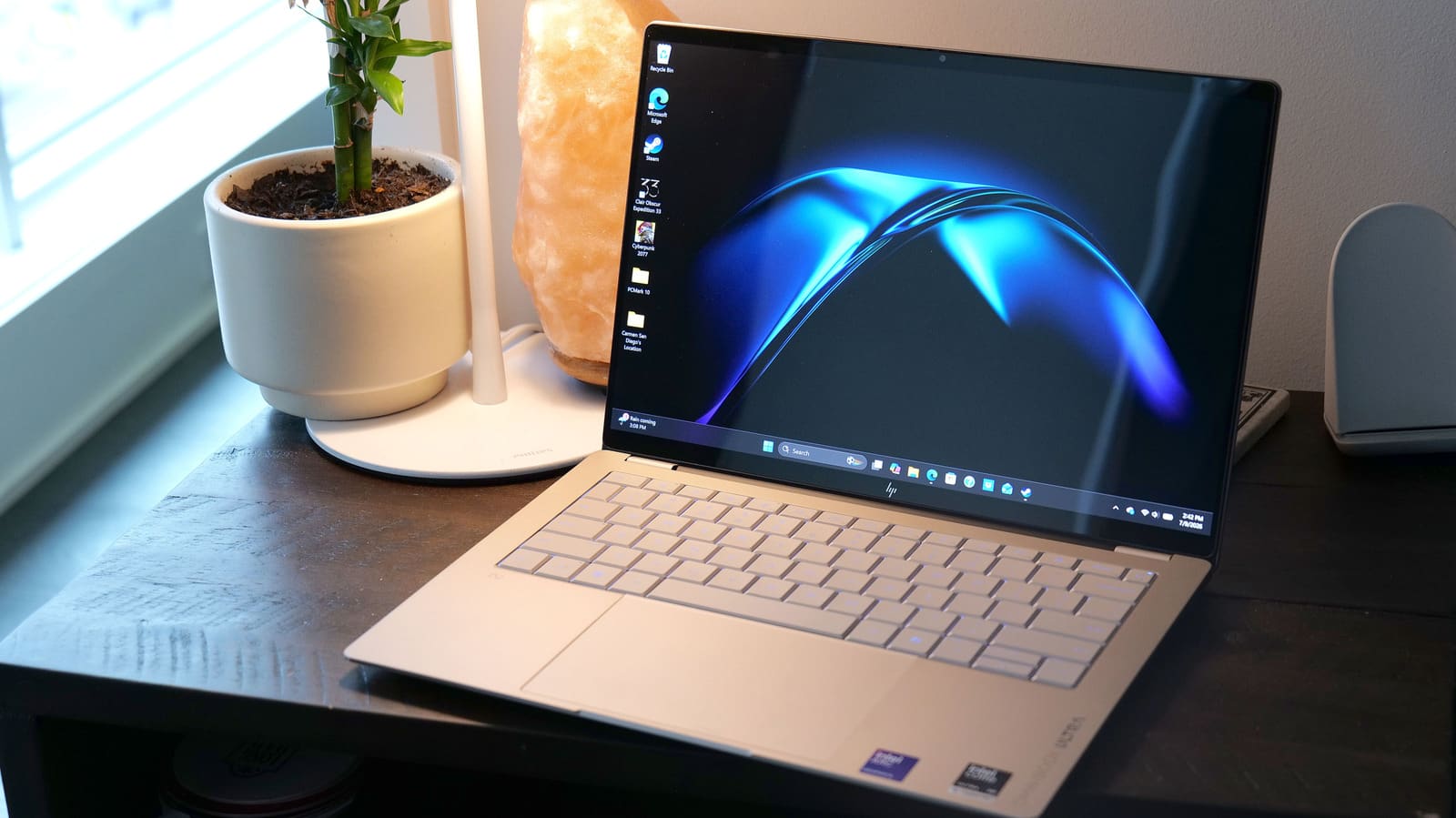
Where previous HP ultraportables often felt like safe, second-tier alternatives to Dell's XPS or Apple's MacBook Pro, the Ultra pushes past feature parity into differentiation. HP claims it is "the world's most durably slim consumer notebook," a phrase that sounds like marketing until you examine the construction method: forged stamped aluminum rather than unibody CNC milling. The process yields a chassis that passes MIL-STD 810H shock, temperature, and humidity tests while keeping the system at 2.8 pounds and 0.42 inches thick. For context, a 14-inch MacBook Pro weighs 3.4 pounds and measures 0.6 inches.
The trade-off is cosmetic. The matte finish scratches more easily than anodized aluminum when jostled against metal objects in a bag. But the structural payoff is clear: four-screw access to internals, a rarity in premium ultraportables, and rigidity that belies the thinness.
Vapor Chamber Cooling and Memory Ceiling
This is the first OmniBook to ship with a vapor chamber, a cooling architecture typically reserved for gaming laptops or workstations. HP pairs it with configurations that reach 64GB of RAM, another first for the line. The combination allows the Ultra to sustain higher CPU turbo frequencies under prolonged load without throttling, a constraint that has historically separated ultraportables from true mobile workstations.
The review unit tested carried an Intel Core Ultra X9 388H processor, 64GB of RAM, and 2TB of storage. That configuration costs around $4,000, which is overkill for most workflows. But HP offers a more sensible $2,600 variant with a Core Ultra X9 388H and 32GB of RAM, which retains the Arc B390 integrated GPU. That GPU matters: lower-tier Intel CPUs ship with generic Intel Graphics silicon that underperforms in GPU-bound tasks.
HP also offers Snapdragon X2 Plus and X2 Elite processor options. Those ARM-based chips deliver longer battery life and faster neural processing units for on-device AI inference, but the x86 Intel models provide broader application compatibility and more balanced CPU-GPU performance. For users running legacy Windows software or GPU-accelerated creative tools, the Intel path remains safer.
Display Quality and Connectivity Compromises
The 14-inch 3K OLED touchscreen covers 100 percent of DCI-P3 and peaks at 500 nits in SDR, rising to 1,100 nits in HDR. The 120Hz refresh rate keeps scrolling and animation fluid. For photo editing or HDR video grading, the panel is more than adequate.
Above the display sits a 5-megapixel webcam with infrared support for Windows Hello facial recognition and a physical privacy shutter. Image quality is serviceable for video calls, though dynamic range suffers in backlit scenarios, a common weakness in laptop webcams.
Port selection is sparse: three USB-C ports with Thunderbolt 4, DisplayPort 2.1, and USB Power Delivery 3.1 support, plus a 3.5mm audio jack. There is no HDMI port, no USB-A, and no SD card reader. For photographers or videographers who work in the field, that omission stings. HP clearly prioritized thinness over legacy I/O, a choice that aligns with Apple's approach but diverges from Dell's XPS lineup, which still includes an SD card slot on some models.
The keyboard uses trapezoidal keycaps, which some users find less comfortable than cylindrical designs, but key travel and tactile feedback are well tuned. The haptic touchpad is large and responsive, tracking accurately across gestures.
Gaming Performance From an Ultraportable
Intel's Arc B390 GPU in the Core Ultra X9 388H configuration delivered 56 frames per second in Cyberpunk 2077 at 1080p with medium settings and XeSS upscaling set to performance mode. That result is within striking distance of the ASUS ROG Ally X, a dedicated PC gaming handheld that achieved 62 fps in the same test. For an ultraportable laptop, that level of GPU performance is unusual.
The vapor chamber cooling keeps the chassis from thermal throttling during extended gaming sessions, though fan noise becomes noticeable under sustained load. For users who occasionally want to run a GPU-intensive application or a modern game at moderate settings, the Ultra can handle it without requiring a separate machine.
Battery Endurance and Real-World Use
On PCMark 10's Modern Office battery test, the Intel-based OmniBook Ultra lasted 19 hours and 14 minutes. That runtime is exceptional for an x86 ultraportable and suggests HP tuned power management aggressively. The ASUS ZenBook Duo, in single-screen mode, posted 18 hours and 33 minutes, while the Dell XPS 14 managed only 10 hours and 21 minutes.
The Snapdragon variants of the OmniBook Ultra are expected to extend battery life further, given ARM's efficiency advantage in low-power workloads. But even the Intel model provides enough endurance to cover a full workday and evening without hunting for an outlet.
Positioning and Pricing Pressure
At $4,000, the fully loaded configuration is a hard sell outside of enterprise procurement or niche professional use cases. But HP's mid-range $2,600 configuration, which retains the Core Ultra X9 388H and 32GB of RAM, is competitively positioned against the Dell XPS 14 and Lenovo ThinkPad X1 Carbon. At the time of writing, HP is discounting some configurations by $500, bringing the entry price down to $1,300 for lower-spec models. Those deals make the OmniBook Ultra one of the more affordable entry points into premium ultraportables, provided buyers can tolerate the limited I/O.
The broader question is whether HP can sustain this level of engineering focus across the consolidated OmniBook lineup. The company has historically struggled to maintain differentiation in crowded product categories, often reverting to cost optimization that erodes build quality or feature sets. The Ultra suggests HP is serious about competing at the top end again, but the test will be whether the next generation maintains this trajectory or retreats to safer, cheaper designs.
For now, the OmniBook Ultra 14 is the most compelling Windows ultraportable HP has shipped in years, and it deserves consideration alongside Dell, Lenovo, and Apple's premium offerings.