Honor Ships a Camera Gimbal Inside a Smartphone
The company's latest device unfolds a mechanical arm from its rear panel, betting that better video stabilization is worth the added thickness and complexity.
A Mechanical Bet on Mobile Video
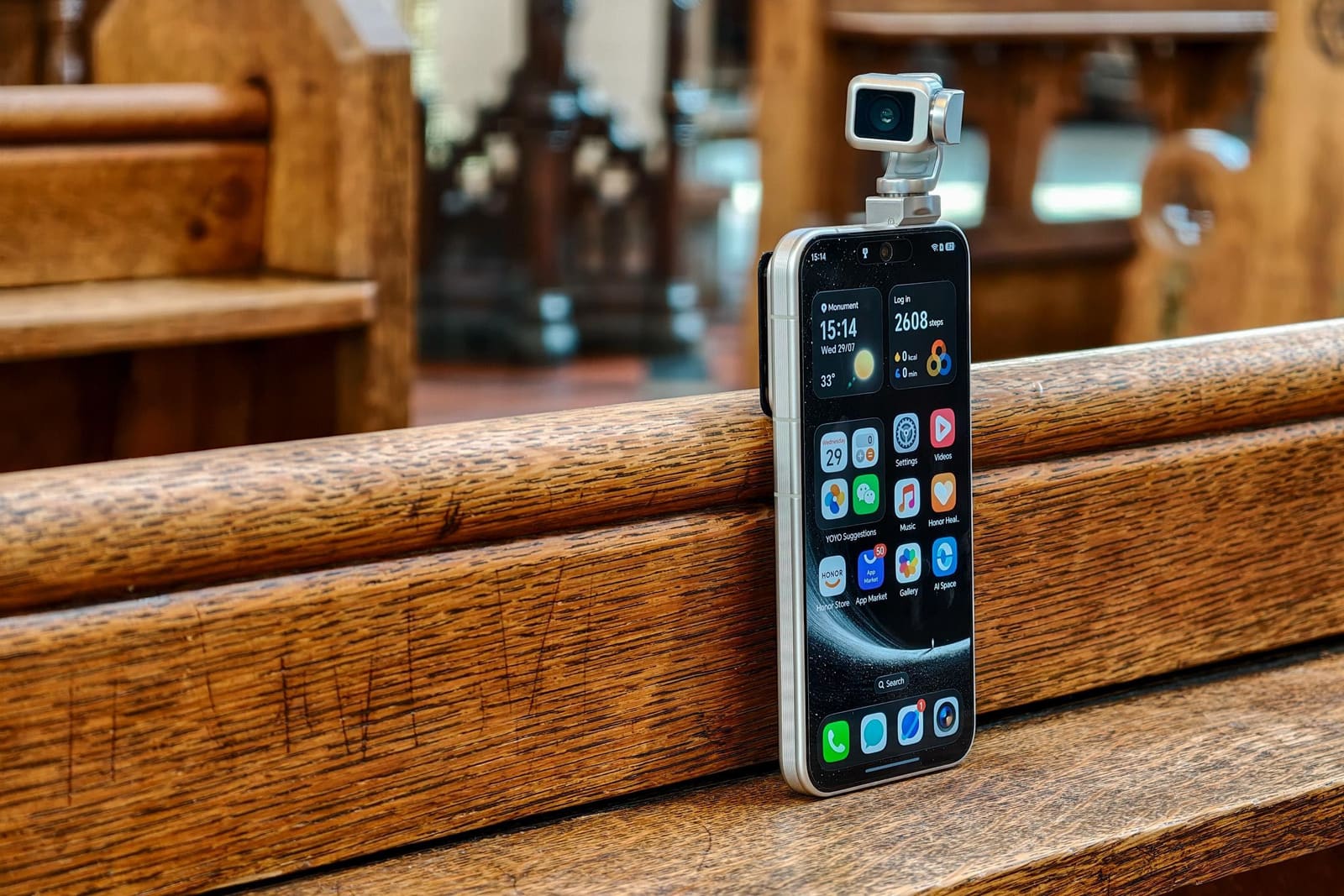
Honor introduced a smartphone with an integrated gimbal system this week, available initially in the Chinese market. The device houses a motorized stabilization arm that deploys from the phone's back panel, positioning the main camera sensor on a three-axis mount similar to what you'd find in standalone video equipment.
The engineering challenge is obvious: fitting precision motors, bearings, and a camera module into a chassis that already battles for every millimeter against battery cells, antennas, and thermal management. At DailyTechWire, we've watched smartphone makers chase differentiation through folding displays, pop-up selfie cameras, and modular accessories. This approach takes the pop-up concept further, trading pocket-friendliness for a specific video use case.
How Small Can a Gimbal Get?
According to Honor, the mechanism represents the most compact gimbal implementation in a consumer device. The claim is difficult to verify independently, but the physics are straightforward: smaller gimbals mean shorter lever arms, which reduces torque but also limits the mass they can stabilize. Honor is working within tight constraints, the camera sensor and lens assembly it can mount on this arm will be lighter and likely smaller than what the phone's primary camera might otherwise accommodate.
The trade-off matters because video quality depends on more than stabilization. Larger sensors gather more light, wider apertures improve low-light performance, and longer focal lengths require more internal space. A gimbal-mounted camera module is unlikely to match the optical performance of a fixed telephoto or the sensor size of a flagship's main shooter. Honor is betting that smooth motion outweighs raw image quality for a segment of users, particularly those shooting social video, vlogs, or action content where shake is the primary defect.
The Bulk Problem
The device is noticeably thicker than standard smartphones. This isn't surprising, the gimbal assembly, its motors, and the additional structural reinforcement needed to protect moving parts during drops all consume volume. Smartphone design has spent the past decade obsessing over thinness, and this reverses that trend in service of a feature that many buyers may never use.
There's a question of durability. Moving parts introduce failure modes that solid-state electronics avoid. Dust, moisture, and impact all threaten a mechanism that extends beyond the phone's protective frame. Honor will need robust sealing and strong materials, both of which add cost. We don't yet have data on how the gimbal performs after months of pocket carry, drops, or exposure to humidity.
Who This Is For
The target user is likely someone who currently carries both a phone and a separate gimbal or action camera. Content creators, travel videographers, and social media users who prioritize smooth footage might find value in consolidation. The question is whether that group is large enough to justify the compromises.
Most smartphone buyers optimize for photos, battery life, screen quality, and price. Video stabilization has improved dramatically through software, optical image stabilization, and sensor-shift mechanisms that don't require external moving parts. Apple, Samsung, and Google have all achieved impressive stabilization without gimbals, using computational photography and tight integration between the camera sensor and the phone's motion sensors.
Honor's approach makes sense if you assume software and OIS have hit a ceiling. That's debatable. Computational methods continue to improve, and they don't add weight, thickness, or mechanical risk. The gimbal phone is a bet that there's a gap between what software can do and what users want, and that gap is wide enough to tolerate a bulkier device.
The China Launch and What Comes Next
The device is launching in China first, a market where Honor competes directly with Xiaomi, Oppo, Vivo, and other brands that iterate rapidly on hardware features. Chinese consumers have historically been more receptive to experimental form factors, Honor is using this as a testing ground.
Whether the gimbal phone expands to other regions will depend on reception in China, regulatory hurdles, and whether Honor can reduce the size and cost of the mechanism in future iterations. The company hasn't disclosed pricing, but adding a gimbal will push the bill of materials higher than a standard phone with the same processor and display.
If the concept succeeds, expect competitors to explore similar designs or, more likely, to double down on software stabilization to prove that hardware isn't necessary. If it fails, this will join the long list of smartphone experiments that solved a problem too few people had, like modular phones, dual-screen devices, and phones with built-in projectors.
The Bigger Picture
Smartphone differentiation is increasingly difficult. Processors are fast enough, cameras are good enough, and batteries last long enough for most users. Brands are hunting for features that create separation, foldables, under-display cameras, ultra-fast charging, and now gimbals.
The gimbal phone is a reminder that hardware innovation hasn't stopped, it's just narrowed to niches. Honor is targeting a specific pain point for a specific user, and it's willing to accept trade-offs that would disqualify the device for mainstream buyers. That's a reasonable strategy in a saturated market, but it's also a risky one. Niche products require precise execution and marketing, and they rarely achieve the scale needed to drive down costs.
We'll be watching how this device performs in real-world use, how durable the gimbal proves to be, and whether buyers who care about video stabilization prefer this approach over software solutions or simply carrying a separate gimbal. The answer will tell us whether mechanical innovation still has a place in smartphones, or whether the future belongs entirely to silicon and algorithms.