Honda Deploys Competing AI Agents to Slash Vehicle Design Cycles by Two Years
The Japanese automaker is embedding adversarial AI systems into its engineering workflow, aiming to compress the traditional five-year development timeline to three.
Engineering Culture Meets Machine Debate
Honda's research teams in Tokyo have spent the past eighteen months solving a puzzle that most automakers haven't even articulated yet: how do you preserve the friction of good engineering debate when you automate part of the design process?
The answer, according to Honda Motor, involves setting AI systems against one another in structured disagreement. The company has begun deploying what it calls "adversarial agent workflows" in vehicle body design, a move intended to cut typical development timelines from five years down to three. The approach doesn't replace Honda's long-standing tradition of open, sometimes heated, brainstorming sessions among engineers. Instead, it attempts to encode that tradition into software.
At DailyTechWire, we've tracked dozens of AI deployment stories across automotive over the past two years. Most follow a predictable arc: train a model on legacy data, automate a narrow task, claim efficiency gains. Honda's experiment is more structurally interesting because it targets the messy, collaborative middle of the design process rather than the edges.
How the System Works
Honda's implementation pairs at least two AI agents during the early conceptual phase of body design. One agent generates proposals for structural elements like chassis geometry, material distribution, or crash-zone architecture. A second agent is tasked with critiquing those proposals, surfacing potential weaknesses in manufacturability, cost, aerodynamics, or safety performance.
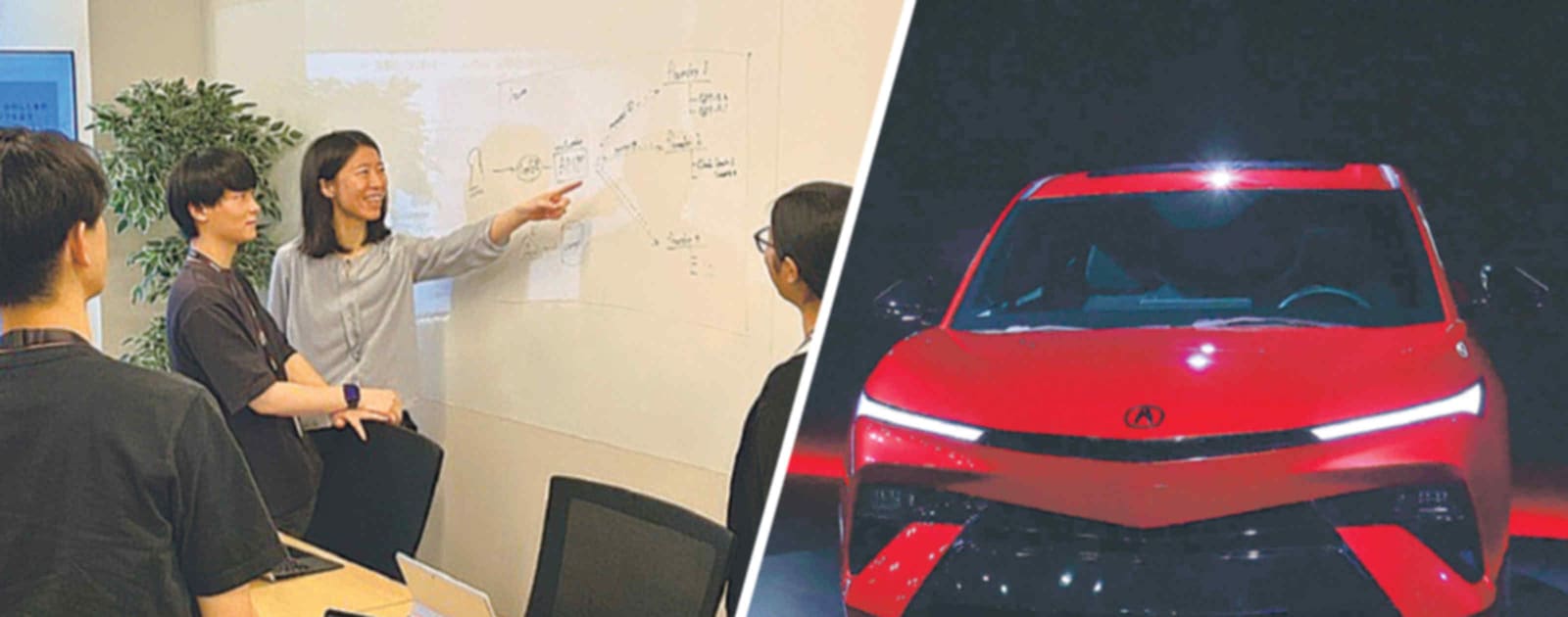
The adversarial setup mirrors the way Honda's engineering teams have historically operated. Senior engineers describe a decades-old internal norm: junior staff are expected to challenge assumptions, and cross-functional teams, spanning design, manufacturing, and supply chain, hold regular review sessions where ideas are stress-tested before they advance.
By embedding that cultural practice into the AI workflow, Honda hopes to avoid a common pitfall of generative AI in engineering: the production of technically valid but strategically shallow designs. A single-agent system might optimize for one variable, like weight reduction, while missing trade-offs that a human team would catch immediately.
The adversarial agents run iteratively. After the critique agent flags issues, the proposal agent refines its output, and the cycle repeats until convergence or until human engineers step in to adjudicate. Honda has not disclosed the underlying models or whether it built proprietary systems or fine-tuned commercial foundation models.
Speed Versus Depth
The three-year target represents a 40% reduction in development time. For context, Honda's current vehicle programs typically span five years from initial concept to production-ready design, a timeline that includes multiple physical prototyping rounds, regulatory testing, and supplier coordination.
Compressing that schedule has obvious competitive advantages. Shorter cycles mean faster response to market shifts, quicker integration of new battery or powertrain technologies, and reduced capital tied up in pre-production. But the risk is equally clear: speed can erode the exploratory, sometimes inefficient, conversations that yield breakthrough designs.
Honda's framing suggests the company is aware of this tension. By centering adversarial agents rather than a single generative model, the automaker is signaling that it values contestation as much as output. Whether that translates to better vehicles, or simply faster mediocre ones, will depend on how much decision-making authority the AI systems actually hold.
One question Honda has not answered publicly is how the agents handle uncertainty. Engineering debates often hinge on incomplete data, supplier constraints that shift mid-program, or regulatory changes that emerge during development. If the AI agents can't model those dynamic variables, their utility may be limited to early-stage concept work, leaving the hardest decisions to human teams anyway.
Regional Context and Competitive Pressure
Honda's move comes as Japanese automakers face mounting pressure from Chinese EV manufacturers, who have demonstrated the ability to bring new models to market in under two years. BYD, Nio, and Xpeng have all compressed development cycles by vertically integrating software, battery production, and final assembly, and by treating vehicle platforms as modular, software-defined systems rather than bespoke mechanical projects.
Honda, like Toyota and Nissan, has historically relied on longer development timelines to ensure quality and reliability. That approach has served the company well in internal combustion and hybrid markets, where mechanical complexity and long-term durability are key differentiators. But in the EV era, where software updates can add features post-launch and consumer expectations around styling shift faster, the five-year cycle feels increasingly like a liability.
AI-assisted design is one lever Honda can pull without abandoning its engineering culture or quality standards. If the adversarial agent system works as intended, it could allow Honda to maintain its deliberative approach while matching the speed of competitors who have less institutional inertia.
Other Japanese automakers are exploring similar territory. Nissan has partnered with autonomous driving startups to accelerate software integration, and Toyota has invested heavily in simulation and digital twin technologies. But Honda's emphasis on adversarial AI, rather than purely generative or predictive models, is a distinct strategic bet.
Open Questions on Implementation
Honda has not shared specifics on how the AI agents are trained, what datasets they draw from, or how they handle proprietary design constraints. Vehicle body design involves thousands of variables, many of them governed by trade secrets, supplier relationships, and regulatory requirements that vary by market.
If the agents are trained primarily on Honda's historical design data, they may struggle to propose genuinely novel approaches. If they draw on broader automotive datasets, the company risks leaking competitive intelligence or producing designs that feel generic.
There's also the question of human override. Honda describes the system as "AI-assisted," which implies that engineers retain final authority. But the practical dynamics of that relationship matter. If engineers consistently override the AI's recommendations, the system won't deliver the promised time savings. If they defer too often, the adversarial structure may be performative rather than functional.
What This Signals for the Industry
Honda's experiment is less about the specific technology and more about the cultural challenge every automaker faces as AI moves from back-office optimization into core creative and engineering work. The adversarial agent model is an attempt to preserve institutional knowledge and collaborative norms while automating parts of the workflow that have traditionally required weeks of human iteration.
Whether it works will depend on execution details that Honda has not disclosed. But the framing alone is worth attention. Most AI deployments in manufacturing are sold as cost-reduction or headcount-replacement plays. Honda is positioning this as a way to scale a cultural asset, turning the informal practice of engineering debate into a repeatable, machine-readable process.
If the three-year development target holds, and if the resulting vehicles meet Honda's quality benchmarks, other automakers will take note. If the system produces designs that feel derivative or miss the nuance that human teams catch, it will become a cautionary tale about automating too much, too fast.
For now, Honda is betting that adversarial AI can be more than a productivity tool. It's a test of whether machine learning can encode not just technical knowledge, but the messy, argumentative process that turns technical knowledge into good design.