Google Mandates Transparency Labels for AI-Generated Advertising
The search giant is introducing disclosure controls that reveal synthetic content in commercial messages, expanding beyond election-related material for the first time

A New Layer of Disclosure
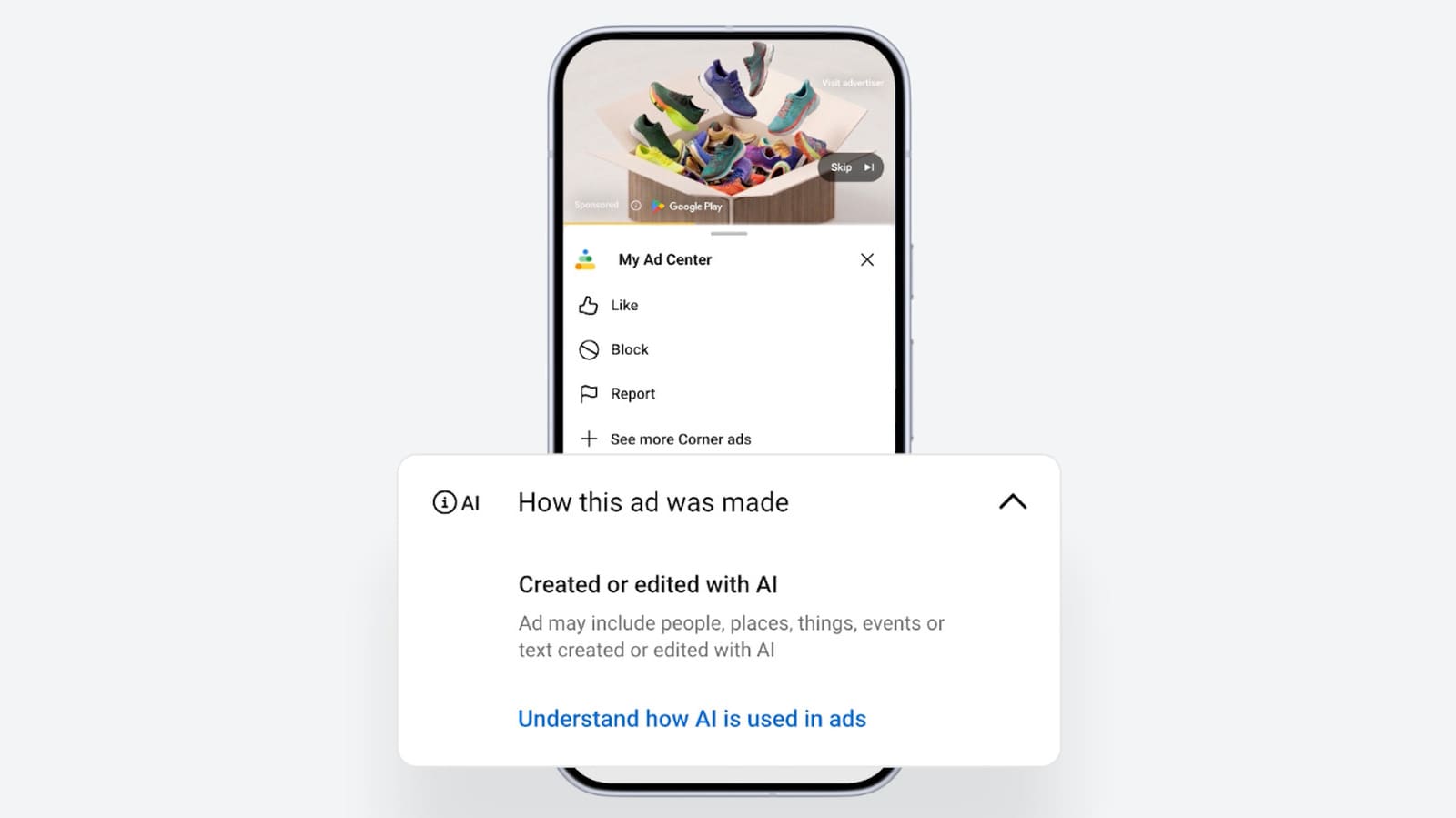
Starting this month, anyone clicking through the information panel on a Google advertisement can learn whether artificial intelligence played a role in crafting what they see. The feature arrives as generative tools reshape how brands produce commercial content, from product photography to video spots, often at a fraction of traditional production costs.
Google is embedding this transparency mechanism directly into My Ad Center, the control panel accessible through the three-dot menu or information icon that appears alongside ads on Search, YouTube, and Discover. Until now, the company reserved mandatory AI disclosure for political advertising during election cycles. Commercial campaigns operated under looser rules, even as machine-learning tools became standard in creative workflows.
The expansion reflects a broader tension in digital advertising: generative models accelerate campaign production and reduce costs, yet they also introduce questions about authenticity that neither regulators nor platforms have fully resolved. At DailyTechWire, we've tracked similar disclosure debates across Southeast Asia and East Asia, where e-commerce platforms face parallel pressure to distinguish between studio photography and algorithmically rendered product shots.
How the Mechanism Works
The disclosure appears under a new prompt labeled "How this ad was made." When users select it, they receive a plain-language explanation indicating whether AI tools were used to create or modify the advertisement. Google has built automatic triggers for campaigns produced through its own generative advertising suite, which includes tools that place products in virtual environments, generate background imagery, and rewrite copy across dozens of languages.
For creative work developed outside Google's ecosystem, the responsibility shifts to advertisers. A newly introduced control allows campaign managers to flag AI involvement manually. Google has made clear it will not audit these declarations or deploy its own detection systems to verify accuracy. The policy relies on advertiser compliance, a model that mirrors the company's existing framework for other content standards.
In markets where local regulation mandates labeling of synthetic media, the platform may apply additional markers automatically. The European Union's Digital Services Act and proposed AI Act both contemplate disclosure requirements for algorithmically generated content, though enforcement timelines remain uncertain. Singapore's Advertising Standards Authority has issued guidance on misleading imagery, and South Korea's Fair Trade Commission has signaled interest in synthetic-content rules for e-commerce. Google's global rollout positions the company ahead of some regulatory curves while leaving enforcement gaps in others.
The Economics Driving Adoption
Generative advertising tools have become central to Google's pitch to small and mid-sized businesses. A brand launching a new product line can now produce dozens of variations showing that product in different settings, lighting conditions, and seasonal contexts without scheduling a single photoshoot. Background generation, object insertion, and style transfer all happen in seconds, reducing time-to-market and lowering barriers for businesses without creative departments.
These efficiencies matter most in price-sensitive markets. Across India, Indonesia, and Vietnam, small merchants rely heavily on mobile-first advertising platforms where production budgets are minimal. Generative tools let a solo entrepreneur in Bengaluru compete visually with established brands, democratizing access to polished creative assets. Yet this same accessibility raises the stakes for disclosure: when a product image is entirely synthetic, consumers lose the ability to assess real-world appearance, texture, or scale.
The cost advantage is measurable. Traditional e-commerce photography can run from several hundred to several thousand dollars per product, factoring in studio rental, lighting, styling, and post-production. Generative workflows collapse that expense to near zero marginal cost once the model is trained. For platforms like Google that monetize through ad volume, lowering production friction directly expands the addressable market.
Trust, Deception, and the Gray Zone
Google's existing policy prohibits misleading and deceptive advertising outright. An ad cannot make false claims about a product's features, pricing, or availability. Yet synthetic imagery occupies a gray zone between outright deception and creative license. A digitally rendered handbag shown in a sunlit Parisian street is not a photograph, but it may accurately represent the product's design, color, and proportions. Conversely, an AI-generated image might exaggerate texture, distort scale, or depict features the physical item lacks.
Disclosure does not eliminate these risks; it simply transfers interpretive responsibility to the consumer. A shopper who knows an image is synthetic can adjust expectations accordingly, but the cognitive load increases. Behavioral research on disclosure effectiveness suggests that labels often go unnoticed or fail to change purchasing decisions, especially when the disclosure is buried behind a menu or rendered in passive language.
The policy also creates asymmetry. Advertisers using Google's proprietary tools receive automatic labeling, while those building campaigns elsewhere must self-report. This structure favors platform lock-in, a dynamic we've observed in other Google advertising initiatives. Brands that consolidate their workflow within Google's ecosystem gain operational simplicity; those maintaining independent creative pipelines face additional compliance overhead.
Regional Precedents and Divergence
Asia-Pacific markets have moved faster than North America on certain aspects of synthetic-content regulation. China's Cyberspace Administration requires watermarks on deepfakes and algorithmically generated media, though enforcement focuses primarily on video and audio rather than static advertising. Japan's Ministry of Economy, Trade and Industry has issued voluntary guidelines for e-commerce platforms, encouraging clear labeling of computer-generated product imagery.
Singapore's approach emphasizes consumer protection through existing false-advertising statutes rather than new AI-specific rules. The Advertising Standards Authority of Singapore has signaled that synthetic content falls under current prohibitions against misleading representations, placing the burden on advertisers to ensure that generated images do not materially misrepresent products. This framework aligns with Google's global policy but leaves room for interpretation around what constitutes material misrepresentation.
South Korea presents a more interventionist model. The Korea Fair Trade Commission has explored mandatory disclosure for virtual influencers and synthetic product endorsements, particularly in beauty and fashion categories where visual accuracy directly affects purchase decisions. If codified, these rules would require more prominent labeling than Google's current opt-in information panel, potentially forcing the platform to adjust its interface in that market.
What Disclosure Does Not Address
Transparency around AI involvement does not resolve deeper questions about training data provenance, copyright, or the environmental cost of large-scale inference. Generative advertising models are typically trained on vast image corpora scraped from the public web, raising unresolved legal questions about whether such use constitutes fair use or infringement. Several lawsuits in the United States and Europe are testing these boundaries, and outcomes could reshape the economics of generative advertising.
Energy consumption is another externality. Inference at the scale Google operates requires significant computational resources, particularly for high-resolution image generation and video synthesis. While the company has committed to carbon neutrality through offsets and renewable energy purchases, the absolute energy footprint of its advertising infrastructure continues to grow. Disclosure labels do not surface this information, leaving consumers unaware of the environmental trade-offs embedded in the ads they view.
The policy also does not address the labor displacement occurring within creative industries. Photographers, stylists, set designers, and retouchers face declining demand as generative tools automate tasks that once required specialized skills. This shift mirrors broader patterns we've documented in Asia's creative sectors, where freelance markets are contracting even as advertising volumes increase.
The Path Forward
Google's disclosure mechanism represents an incremental step toward transparency, not a comprehensive solution. Its effectiveness will depend on how prominently the disclosure is surfaced, whether consumers engage with it, and how aggressively regulators enforce accuracy. Early adoption will also test whether competitors follow suit. Meta, Amazon, and Alibaba all offer generative advertising tools, and their disclosure practices remain inconsistent.
For advertisers, the new control introduces a compliance checkpoint that may slow campaign launches but could also build consumer trust over time. Brands that proactively label AI-generated content may differentiate themselves in markets where authenticity concerns are rising. Conversely, those that skip disclosure risk reputational damage if synthetic content is later exposed.
The broader trajectory points toward a future where most commercial imagery carries some degree of algorithmic intervention, from minor color correction to full synthetic generation. In that environment, disclosure becomes table stakes rather than differentiation. The challenge for platforms and regulators alike is ensuring that transparency mechanisms keep pace with the tools they aim to describe, and that consumers retain the agency to make informed choices in an increasingly synthetic visual landscape.