Google Builds Study Tools Into Gemini as Academic Year Approaches
A new student hub integrates research notebooks, flashcards, and calendar syncing with syllabus deadlines, while Deep Research arrives in Gemini Live for voice-based investigation.
A Unified Academic Workspace
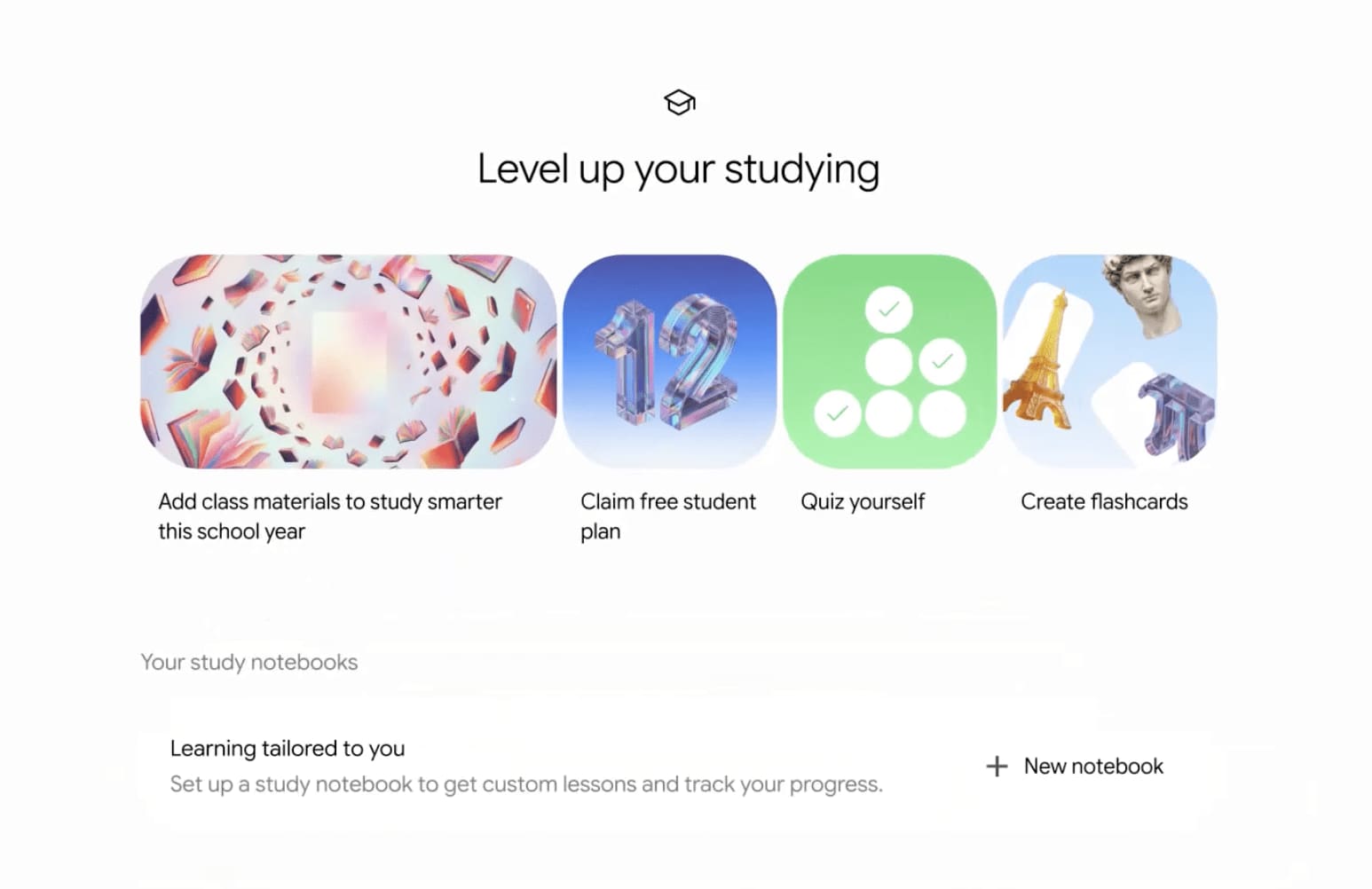
Google has launched a student-focused hub within Gemini, consolidating tools for managing coursework, organizing research, and preparing for exams. The hub functions as a centralized environment where students can maintain study notebooks, generate flashcards, and take practice quizzes without switching between multiple applications.
The timing aligns with the back-to-school period across much of Asia and North America, a window when education-technology providers typically unveil product updates aimed at capturing student adoption before semester routines solidify. At DailyTechWire, we've tracked how generative AI platforms compete for mindshare in education workflows, where habits formed early in an academic year tend to persist.
Enhanced Notebooks and Calendar Integration
Google has expanded the capabilities of its study notebooks to process graphs and images, allowing students to incorporate visual data from textbooks, lecture slides, or research papers directly into their notes. The system can parse syllabus documents and automatically populate Google Calendar with test dates and assignment deadlines, reducing manual entry and the risk of overlooked due dates.
This integration reflects a broader industry pattern: AI assistants moving from isolated query-response interactions toward persistent, context-aware environments that span multiple productivity surfaces. The calendar feature, in particular, addresses a friction point in student workflows where administrative overhead competes with study time.
Deep Research Comes to Voice
Gemini Live, the conversational interface for the platform, now supports Deep Research, a feature that generates multi-layered research reports on complex topics. Students can initiate a research request, discuss preliminary findings through voice interaction, then close the chat and lock their device while Gemini continues processing in the background. The system sends a notification when the report is ready.
The asynchronous model is significant. Most conversational AI tools require continuous engagement, which limits their utility for tasks that take minutes or hours to complete. By decoupling initiation from delivery, Google enables students to offload research tasks during commutes, between classes, or before sleep, then review synthesized results later. This design choice reflects an understanding that student schedules are fragmented and that AI tools must accommodate interruptions rather than demand sustained attention.
Competitive Context in Education AI
The student hub arrives as education becomes a contested vertical for generative AI providers. OpenAI has positioned ChatGPT as a tutoring aid, Anthropic's Claude is widely adopted for essay drafting and citation management, and Microsoft has embedded Copilot into its education-licensed Office suite. Google's advantage lies in its existing ecosystem: students already use Gmail, Drive, and Calendar, and Gemini's hooks into those services lower switching costs.
However, the education market imposes unique constraints. Institutions worry about academic integrity, data privacy, and whether AI-generated content undermines learning outcomes. Google has not yet detailed guardrails within the student hub to prevent plagiarism or ensure that flashcard generation reinforces understanding rather than rote memorization. These questions will shape adoption rates among universities that are still formulating AI policies.
Design Choices and Trade-Offs
The decision to bundle research, quizzing, and scheduling into a single hub suggests Google is betting on convenience over modularity. Students gain a streamlined interface, but they also inherit the platform's limitations. If Gemini misinterprets a syllabus date or generates inaccurate flashcards, the cost of error rises because multiple workflows depend on the same underlying model.
The visual processing upgrade for notebooks addresses a gap that has frustrated STEM students, who often work with charts, diagrams, and equations that text-only tools cannot parse. Yet the quality of that parsing will determine whether the feature becomes essential or ignored. Can Gemini reliably extract data from a poorly scanned graph or a hand-drawn diagram photographed in lecture? Early performance will dictate whether students trust the system with high-stakes material.
Implications for Study Habits
AI-assisted study tools introduce a tension: they can accelerate learning by surfacing connections and testing recall, but they can also create dependency if students outsource comprehension to the model. The practice quiz feature, for instance, is valuable if it identifies knowledge gaps, but less so if students treat passing an AI-generated quiz as equivalent to mastering the material.
Google's approach will likely influence how competitors design their own education features. If the student hub gains traction, we should expect parallel offerings from Anthropic, OpenAI, and regional players like Naver and Baidu, each adapted to local curricula and exam structures. The next six months will reveal whether students adopt Gemini as a primary study tool or treat it as a supplement to established methods.
What Remains Uncertain
Google has not disclosed whether the student hub will be available in all Gemini tiers or restricted to premium subscribers. Pricing could determine whether the features reach students in emerging markets, where cost sensitivity is high and Google faces competition from locally tuned models. The company also has not addressed how it will handle content moderation in study notebooks, which could contain sensitive or copyrighted material.
The Deep Research feature's accuracy and sourcing transparency are open questions. Students need to know whether synthesized reports cite primary sources, how the model handles conflicting information, and whether it flags uncertainty. Without those safeguards, the feature risks becoming a sophisticated but unreliable shortcut.
As the academic year begins, Google's student hub represents a clear bid to embed Gemini into daily learning routines. Whether it succeeds will depend not only on feature quality but on how well the platform navigates the ethical and pedagogical concerns that accompany AI in education.