Claude Voice Can Now Tap Sonnet and Opus Models
Anthropic lifted the Haiku-only ceiling on its voice interface, letting users route spoken queries through more capable models and connected services.
The Constraint That Defined Early Voice
Since its 2025 debut, Claude's voice interface carried a deliberate limitation: every spoken query ran exclusively through Haiku, the company's fastest but least capable model. Anthropic made that trade to keep latency low, reasoning that conversational responsiveness mattered more than raw reasoning depth. For users who wanted to dictate simple tasks or quick lookups, the compromise held. But anyone hoping to explore complex multi-step problems through speech hit a ceiling almost immediately.
That calculus shifted in July 2026. Anthropic opened voice mode to Sonnet and Opus, the two tiers above Haiku in the company's model hierarchy. At the same time, the interface gained the ability to pull context from connected apps including Gmail, Google Calendar, and Slack. The changes turn voice from a convenience layer into a genuine alternative input method for work that demands deeper reasoning or external data.
How the Interface Works Now
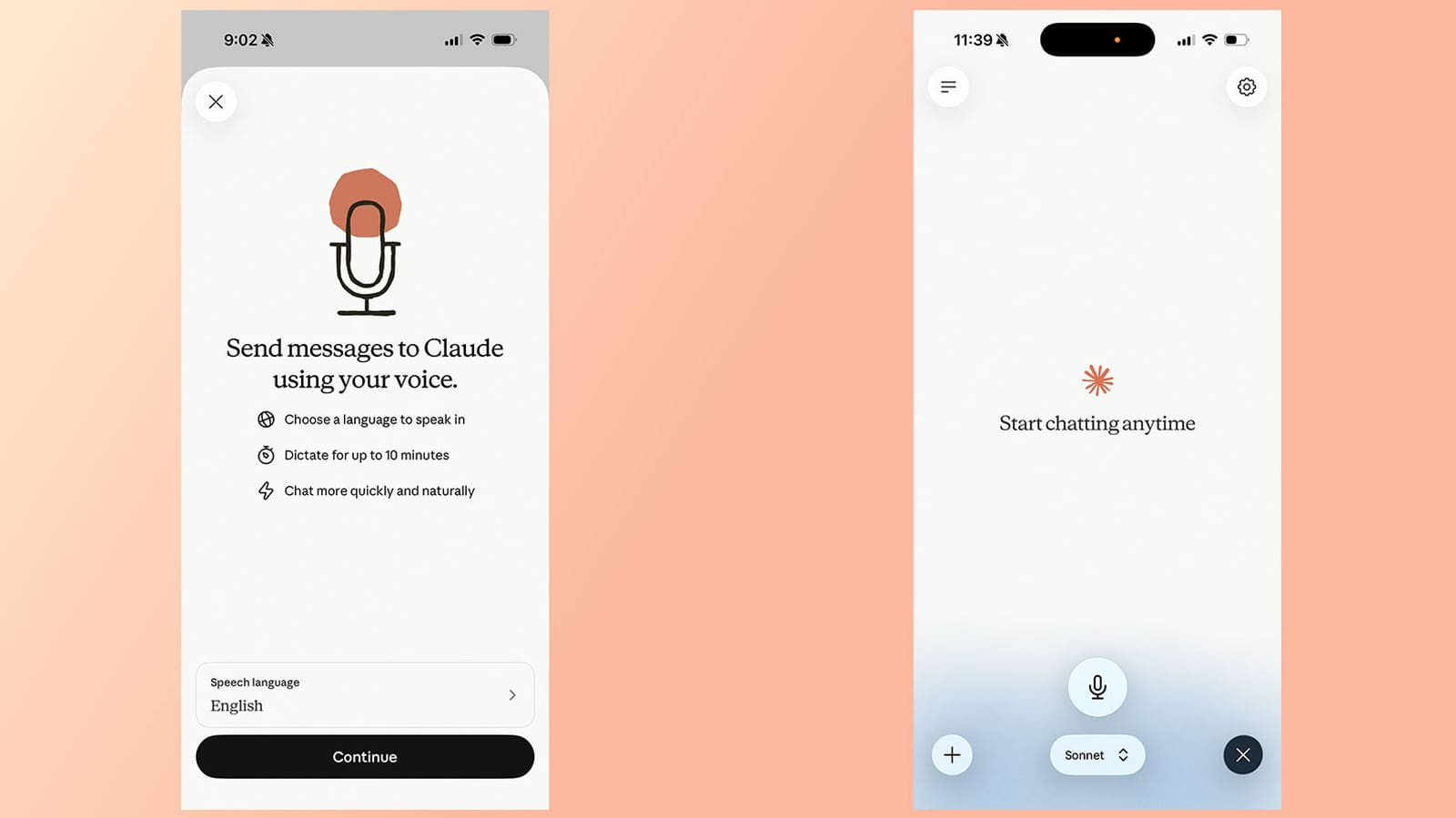
Voice mode lives inside the Claude mobile apps on Android and iOS, the desktop client, and the web interface. Anthropic recommends the phone experience for the best results. To activate it, users tap the black waveform icon in the lower right corner, not the adjacent microphone symbol, which triggers text transcription instead. The app requests microphone permission on first use, then listens for a complete prompt before generating a response.
The architecture remains turn-based. Claude waits for silence before processing speech, a design that differs from the duplex system OpenAI deployed in ChatGPT's GPT-Live models. That duplex approach lets the model listen and generate output simultaneously, reducing the chance it misreads a pause as the end of a sentence. Claude's turn-based flow occasionally interprets brief hesitations as full stops, so Anthropic suggests breaking multi-part questions into separate prompts rather than stringing them together in one breath.
Model Picker and Access Tiers
A dropdown at the bottom of the interface lets users choose which model handles their spoken query. Haiku remains the fastest option, suited for quick answers that don't require extended reasoning. Sonnet sits in the middle, balancing speed and capability for everyday tasks. Opus, reserved for paid Pro and Max subscribers, tackles the most complex prompts.
Free accounts can route voice queries through Haiku and Sonnet without restriction, though usage counts against the standard monthly limit. Opus access requires a subscription. For most spoken tasks, Sonnet delivers enough intelligence to handle summarization, drafting, and multi-step planning without the latency penalty that Haiku's earlier monopoly imposed.
Connected Apps and Context Pulling
The July update also wired voice mode into the same app integrations that text chat has used for months. Users can ask Claude to summarize recent emails, check calendar availability, or scan Slack threads by naming the service in their prompt. The first time Claude accesses a third-party app, it requests permission through the standard OAuth flow.
This capability matters more in voice than in text. Dictating "summarize my Gmail from the last two days" while walking between meetings or commuting removes the friction of opening an app, copying thread snippets, and pasting them into a chat window. The model pulls the relevant messages, processes them, and returns a spoken summary without requiring the user to touch the screen.
Voice, Language, and Cadence Options
As of mid-2026, Claude's voice interface supports 14 languages, with several available in regional dialects. English offers five voice options: Buttery, Airy, Mellow, Glassy, and Rounded. Japanese users choose from two. The language setting determines which voices appear in the picker.
Users preview each voice by swiping through a carousel in the settings menu, located under the Voice section below the App heading. The same menu offers three cadence speeds: Slow, Normal, and Fast. Two recording modes round out the configuration panel. Hands-free mode listens continuously until the user taps Stop, a design Anthropic recommends for quiet environments. Push-to-talk requires holding a button, useful in noisier settings where background sound might trigger false starts.
One limitation stands out: Claude cannot detect mid-sentence language switches. If a user plans to shift from English to Spanish within a single prompt, they need to state that intent aloud or manually change the language setting beforehand. The model processes each turn in the language selected at the start of the interaction.
Where Voice Fits in the Workflow
At DailyTechWire, we've tracked how voice interfaces evolve from novelty features into tools that reshape daily interaction patterns. The shift from Haiku-only to multi-model support moves Claude's voice mode out of the "quick lookup" category and into territory where users might genuinely prefer speaking over typing for substantive tasks.
The turn-based architecture still imposes a rhythm that feels slower than duplex systems, especially for users accustomed to ChatGPT's real-time interruption handling. But the trade-off buys stability: Claude rarely cuts off a prompt mid-sentence or generates a response before the user finishes speaking. For workflows that prioritize accuracy over speed, particularly those involving connected app data, that predictability may outweigh the latency cost.
The broader question is whether voice becomes a primary interface or remains a secondary input method for moments when hands and eyes are occupied. Anthropic's decision to extend voice beyond Haiku suggests the company sees demand for the former. The usage limits that apply to free accounts and the Opus paywall indicate the company also expects voice to drive meaningful compute costs, not just serve as a lightweight feature to boost engagement metrics.
Voice interfaces in AI products still occupy an uncertain space between convenience and necessity. Claude's latest iteration makes a case that spoken interaction can carry the same reasoning weight as text, provided the underlying model has enough capacity and the user adapts to the system's rhythm. Whether that case persuades users to shift their default input method will depend on how often the friction of typing outweighs the precision it affords.