Central Eurasia's Startup Pipeline Doubles Down on Global Access
A regional pitch program that once drew 485 applicants now pulls 726, with three winners headed to San Francisco and a collective $100,000 on the line
A Second Year, a Bigger Tent
Last year's pilot run of the Silkroad Innovation Hub pitch program brought in 485 applications from 27 countries. This year, that figure climbed to 726 submissions spanning 39 markets, a near-50% increase that positions the initiative as one of the larger structured paths out of Central Eurasia for early-stage teams. At DailyTechWire, we've tracked similar platform plays across Southeast Asia and the Gulf, but few have matched the geographic spread or the sheer velocity of growth seen here.
The program operates as a feeder mechanism: national rounds winnow the pool to 22 regional finalists, who then compete in a live event. Three winners earn seats at TechCrunch Startup Battlefield 200 in San Francisco this October, alongside flights, accommodation, and a combined $100,000 in prize capital split $50,000, $30,000, and $20,000 across first, second, and third place. Astana Hub Ventures, IT Park Ventures, and Silkroad Innovation Hub are jointly funding that pool.
Asset Abdualiyev, founder of Silkroad Innovation Hub, framed the effort in practical terms: "There's a lot of talent here the world hasn't found yet, and that's exactly who we're looking for." The program's first cohort sent Polygraf AI (Azerbaijan/U.S.), Surfaice (Kazakhstan/U.S.), and Investbanq (Singapore/U.S.) to the global stage. Whether those ventures secured follow-on capital or meaningful traction remains a question the organizers have not publicly detailed, but the symbolic value of representation at a major U.S. event is clear.
Who Made the Cut
The 22 regional finalists include MoliyAI, Sino AI, Deepen, Fermopolis, Oqim App, and Cerberus from Uzbekistan; Soup, CortexAI, Scano, 4sell.ai, WeGlobal AI, and ZhanCare.AI from Kazakhstan; Kaptın Kaptın and Pocket eSIM from Türkiye; SeaDar from Azerbaijan; Telagri from Georgia; Admyra from the U.S.; Soulward from Kyrgyzstan; Suriy from Mongolia; MVSxAI from Qatar; Looq from Japan; and Defensive Pedal from Romania.
Kazakhstan and Uzbekistan each placed six companies in the final round, a distribution that mirrors the two countries' infrastructure investments over the past half-decade. Astana Hub, which launched in 2018 as a special economic zone with tax holidays and simplified visa rules for tech workers, has become a anchor institution for the Kazakh ecosystem. IT Park Uzbekistan, established in 2019, offers similar incentives and has attracted more than 1,700 resident companies, according to government figures.
Magzhan Madiyev, CEO of Astana Hub, noted the concentration of AI products among applicants. "We're seeing steady growth in AI products, especially from Kazakhstan and Central Eurasia," he said. The data supports that observation: 609 of the 726 applicants, or roughly 84%, are building AI-focused solutions. That ratio is higher than comparable figures from Southeast Asian accelerator cohorts we've reviewed, where AI typically accounts for 60 to 70% of new ventures.
Age, Stage, and the AI Default
Eighty-nine applicants are under 18, with the youngest founder at 14. Seven of those teenage applicants hail from Uzbekistan and Kazakhstan. The majority of the pool sits at the MVP or pre-seed stage: 41.6% reported having a minimum viable product, 38.6% are at pre-seed, 14.7% at seed, and 4.7% remain at the idea stage.
The dominance of AI reflects both global trends and regional policy. Uzbekistan's government launched an AI strategy in 2023 that includes curriculum changes in technical universities and a state-backed AI lab. Kazakhstan's Digital Kazakhstan program, now in its second iteration, allocates funding for machine learning research and has established partnerships with institutions including MIT and the University of California, Berkeley.
Azamat Karamatov, CEO of IT Park Uzbekistan, emphasized the international orientation of applicants. "For founders from Uzbekistan and across Central Eurasia, entering international markets is becoming part of their strategy from the very beginning," he said. That shift is partly structural: domestic markets in the region are small, and venture capital remains scarce. Uzbekistan's total VC investment in 2025 was approximately $42 million, according to data from the Central Asia Venture Forum, while Kazakhstan recorded roughly $68 million.
The Partner Network and Prize Structure
The program draws on a network of more than 30 regional partners, including Accelerate Prosperity, Activat VC, Ardventure, Bilkent Cyberpark, Bilişim Vadisi, Caucasus Ventures, CEVF, Doha Business Consulting, Future Laboratory, Future Unicorns, Global Tech Weekend Tbilisi, Hello Tomorrow Türkiye, IT Park Dushanbe, IT Park Mongolia, Khan Tengri Innovation Hub, MOST, Nazarbayev University, SABAH Angels, SABAH Fund, Silkroad Angels, Sofia Tech Park, Startup Moldova, Stanbase, StartupCentrum, and Terricon Valley. TheTech provides regional media coverage.
In addition to the cash prizes, the top three finalists will receive up to $100,000 in OpenAI API credits, split in the same proportion as the cash. The remaining 19 finalists each receive $10,000 in API credits. Those credits are intended to subsidize compute costs during the prototyping phase, though their practical utility depends heavily on the specific use case and the venture's burn rate.
Marlen Sikhayev, adviser to the president of Freedom Holding Corp., which co-sponsors the program, highlighted the regional dimension. "What stands out most is how much of it is being driven by AI, solutions built right here in Kazakhstan and across our region that are no longer staying local," he said.
What Comes After the Stage
The value proposition for winners extends beyond the trip to San Francisco. Battlefield 200 offers exposure to a network of roughly 1,000 founders from 39 countries, alongside direct access to investors and corporate development teams that attend Disrupt. Whether that exposure translates into term sheets or partnerships is a different question. Historically, Battlefield alumni have raised follow-on capital at rates that vary widely by year and geography, and Central Eurasian ventures face additional friction in the form of time zones, regulatory unfamiliarity among U.S. investors, and the absence of established relationships with anchor limited partners.
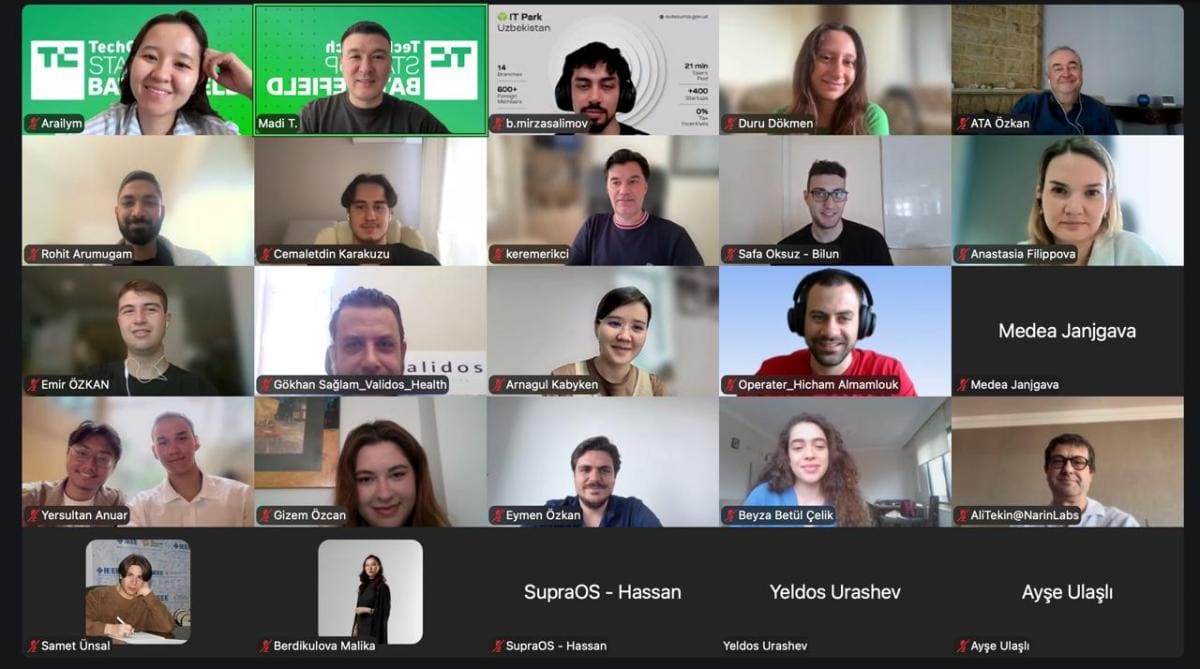
The program's second year suggests that demand for structured access to Silicon Valley remains high, even as the venture environment globally has tightened. The 50% jump in applications year-over-year indicates either a broadening awareness of the program or a growing population of fundable startups in the region, or both. The national rounds, which ran online from July 6 to 20, drew 47 judges from eight countries, including venture capitalists, hub executives, and founders, alongside an AI judge named AI-Dana.
The regional final is scheduled for August 12, after which the three winning teams will have two months to prepare for the October event in San Francisco. For the 19 teams that do not advance, the program offers a form of validation and a modest compute subsidy, but no guaranteed follow-on support. Whether the program evolves to include post-event acceleration, investor introductions, or other forms of structured follow-up will be a key indicator of its long-term impact.
For now, the trajectory is clear: Central Eurasia's startup infrastructure is maturing, and initiatives like this one are among the few mechanisms that connect early-stage teams in Almaty, Tashkent, and Baku to the capital and networks concentrated in San Francisco, Singapore, and London. The question is not whether the region can produce talent, it demonstrably can, but whether that talent can access the resources and relationships required to scale beyond their home markets.